BC resource
Stress leave in BC: how to get it, whether it is paid, and your rights at work
To get stress leave in BC, see a physician or nurse practitioner, who certifies that you are unable to work and until when; give that note to your employer; then claim income the same week. It is partly paid: five paid and three unpaid sick days a year under the Employment Standards Act once you have 90 days of service, then an employer short-term disability plan or EI sickness benefits (55% of insurable earnings, to $729 a week in 2026, for up to 26 weeks). It lasts as long as the certificate says, reviewed in blocks. A counsellor cannot sign it, and your employer is entitled to your limitations, not your diagnosis.
Stress leave is not a separate law in BC. It is a medical leave for a mental-health reason: certified by a doctor or nurse practitioner, paid from sick days, EI or an employer plan, and protected by employment standards and human rights law.
10 min read · Updated
How to get stress leave in BC, in five steps
There is no government form and no approval step beyond a medical certificate. What catches people is the order, so this is the order.
1. Use the sick days you already have. Under the BC Employment Standards Act, an employee who has worked for the employer for 90 days gets five paid and three unpaid days of illness or injury leave each calendar year, and mental health counts. For a bad week that may be the whole answer; sick days and mental-health days in BC covers how to use them.
2. See a physician or nurse practitioner. For anything longer, someone medically qualified certifies that you are unable to work and sets a review date. A walk-in clinic, an urgent and primary care centre or a virtual visit can do it if you have no family doctor. What to say to get the doctor’s note covers the appointment.
3. Tell your employer in writing. That you are on a medical leave, from when, and when it will be reviewed, with the certificate attached or to follow. Not why. A copyable request email says exactly that much.
4. Start the income claim the same week. If your employer has a short-term disability plan, its forms and deadlines come first. If not, apply for EI sickness benefits online as soon as you stop working: Service Canada says applying more than four weeks after your last day of work can cost you benefits. The EI guide works through what it pays.
5. Diarise the review date and plan the return. Certificates run in blocks and are extended at review. A graduated return is usually an accommodation your employer has to consider, and returning to work after a mental-health leave covers it.
The longer walk-through, with what to say at work and why the order matters, is going on stress leave in BC, step by step.
Is stress leave paid in BC? Paid and unpaid, source by source
Partly, and from different places in turn. Your employer pays the first five sick days of the calendar year; after that nobody pays automatically, and income comes from an employer disability plan or EI. A WorkSafeBC claim pays only when work caused the injury. Which row applies to you depends on your job and your plan, not on your diagnosis, so work it out before the leave starts rather than three weeks in. A collective agreement can only add to these floors, often with a sick-leave bank. To see it as your own weeks, the stress leave pay calculator for BC turns your weekly pay into the paid sick days, the EI weeks and an estimated dollar figure for each.
| Source | Paid? | How much, how long | Who it covers, what it needs |
|---|---|---|---|
| BC sick days (Employment Standards Act) | 5 days paid, then 3 unpaid | Each calendar year, job-protected | Employees with 90 days of service; the employer may ask for reasonably sufficient proof |
| EI sickness benefits (federal) | Paid, taxable | 55% of insurable earnings, to $729 a week in 2026, for up to 26 weeks | 600 insured hours in the last 52 weeks, earnings down more than 40%, a medical certificate; apply within 4 weeks of your last day |
| Short-term disability (employer plan) | Paid, if your employer has a plan | Set by the policy, commonly 15 to 26 weeks | Plan members; the insurer’s own forms, deadlines and definition of disability |
| Long-term disability (employer plan) | Paid, if your employer has a plan | Starts when short-term disability ends | Plan members still unable to work; the definition often tightens at two years |
| WorkSafeBC | Paid, if the claim is accepted | Wage-loss benefits and treatment | A diagnosed condition caused by a significant work-related stressor or a traumatic event at work; not employer decisions such as workload, discipline or reorganisation |
| Federally regulated job (Canada Labour Code) | 10 days paid, then unpaid | Up to 10 paid medical leave days a year, plus up to 27 weeks of unpaid, job-protected medical leave | Banks, airlines, telecoms, interprovincial transport and other federal employers |
| Serious personal illness or injury leave (Employment Standards Act) | Unpaid, job-protected | Up to 27 weeks in any 52-week period, taken in whole weeks | BC-regulated employees regardless of length of service; a certificate from a doctor, nurse practitioner or other designated health professional. Income comes from the EI or disability rows above |
How long can you be on stress leave in BC?
As long as a physician or nurse practitioner certifies that you are unable to work, reviewed in blocks: a first certificate commonly runs two to six weeks and is extended at review. The money sets the practical limits. EI sickness benefits run for up to 26 weeks, and a short-term disability plan sets its own length before long-term disability is assessed.
In a BC-regulated job, the Employment Standards Act gives up to 27 weeks of unpaid, job-protected serious personal illness or injury leave in any 52-week period, regardless of how long you have worked there, with a certificate from a doctor, nurse practitioner or other designated health professional. Federally regulated employees have their own 27 weeks of unpaid medical leave under the Canada Labour Code. Beyond either leave, the duty to accommodate a disability to the point of undue hardship still applies, and a mental-health condition supported by medical documentation is a disability for that purpose.
Who can put you on stress leave: a doctor or nurse practitioner, not a counsellor
A physician or nurse practitioner certifies a medical leave in BC. For EI sickness benefits Service Canada also accepts a psychologist, among the practitioners it lists. A Registered Clinical Counsellor or any other therapist cannot certify that you are unable to work, for an employer, an insurer or EI.
What a counsellor can do is tell you, and your doctor if you ask, that time off looks warranted, write a letter confirming you are in treatment where an insurer asks for one, and work on what the leave is for. The certificate itself is the doctor’s.
Three systems that get confused
- Accommodation (human rights law), A mental-health condition can be a disability under the BC Human Rights Code, and employers have a duty to accommodate to the point of undue hardship. Accommodation is about changing how you work: hours, workload, deadlines, a graduated return, a change of duties, not about time away.
- Disability benefits (an insurance contract), Short-term and long-term disability are insurance products bought by your employer, governed by a policy rather than by legislation. The insurer decides eligibility using its own definitions, and mental-health claims frequently require more documentation than physical ones. Short and long-term disability for mental health sets out how a claim runs.
- WorkSafeBC (a claim against work causation), A separate system for injuries caused by work. Mental-health claims are accepted in defined circumstances, most clearly for a traumatic event experienced at work, and in some cases for cumulative work-related stressors. It requires demonstrating that work caused the condition, which is a higher bar than having it. WCB psychological injury claims covers the test and the exclusion.
What your employer is entitled to know
This is the question that causes the most anxiety and has the clearest answer. Your employer is generally entitled to know your functional limitations: what you can and cannot currently do, what accommodations would help, and expected timelines. They are not entitled to your diagnosis, your treatment, your medication or your appointment content.
A well-written medical note therefore describes capacity rather than condition: "unable to work for four weeks, to be reviewed then" or "able to return to modified duties, no client-facing work, maximum six hours daily for four weeks". It should not name a condition, and a physician will usually write it that way if asked.
An insurer, by contrast, will require considerably more detail, because it is assessing a claim rather than arranging accommodation. That information goes to the insurer, not to your employer, and the distinction matters, insurers are typically permitted to share only what is necessary for administering the claim.
Note also that a Registered Clinical Counsellor does not diagnose, which means counselling notes generally cannot serve as the medical documentation these processes require. That usually needs a physician, nurse practitioner or psychologist. It is worth knowing before a deadline, not after.
Accommodations that are commonly workable
- Adjusted hours or a later start, Frequently the single most effective accommodation where sleep is disrupted or medication causes morning sedation.
- A graduated return to work, Returning at reduced hours and building up over weeks. Better evidenced than a hard return, and reduces the chance of a second absence.
- Workload or deadline adjustment, Temporarily reducing concurrent projects, or extending deadlines, where concentration is affected.
- A change in duties, Moving temporarily away from the specific trigger, the client-facing part, the on-call rotation, the particular site.
- Remote or hybrid work, Genuinely helpful for some presentations and unhelpful for others, since isolation makes low mood worse. Worth thinking about rather than assuming.
- Time for appointments, Protected time for regular counselling or medical appointments, which is a small accommodation with a large effect on whether treatment is sustained.
If a disability claim is denied
Denials on mental-health claims are common and they are not the end of the process. Every policy has an internal appeal route with a deadline, and missing the deadline is the most avoidable reason claims fail permanently.
Ask the insurer in writing for the specific reason for denial and the evidence they relied on. Denials frequently rest on insufficient documentation rather than on a judgement that you are well, which is a fixable problem, usually by obtaining more detailed medical evidence addressing the policy's specific definition of disability.
Keep records throughout: dates, names, what was said, copies of everything submitted. If you are in a union, involve them early rather than after a denial. Legal advice is available through Access Pro Bono in BC for people who cannot afford a lawyer, and the BC Human Rights Clinic assists with human rights complaints including failures to accommodate.
If you are offered a stay-at-work plan
Most people first meet a stay-at-work plan as a letter from an insurer or HR: instead of a full leave, you keep working with adjustments, such as reduced hours for a period, changed duties, a modified schedule, or treatment arranged alongside work. Who runs these in BC (WorkSafeBC on an accepted claim, a group insurer, an occupational-health provider, sometimes the EFAP) is set out on the stay-at-work services page for BC employers.
Whether one is offered depends on the employer and the plan, not on the diagnosis, and it is worth being clear about what it is and is not. It is a workplace arrangement. It is not care. A plan that changes the hours and leaves the cause untouched tends to become a leave a few months later, which is why counselling commonly runs beside a stay-at-work plan rather than instead of it, and why a good plan names who is providing the treatment.
If you have been offered one, the questions worth asking are who designed it, what it commits the employer to, when it is reviewed, and what happens if it does not work. The WorkSafeBC route is different again: that is a claim, with its own assessment and its own timelines, and the two are regularly confused.
Where counselling fits
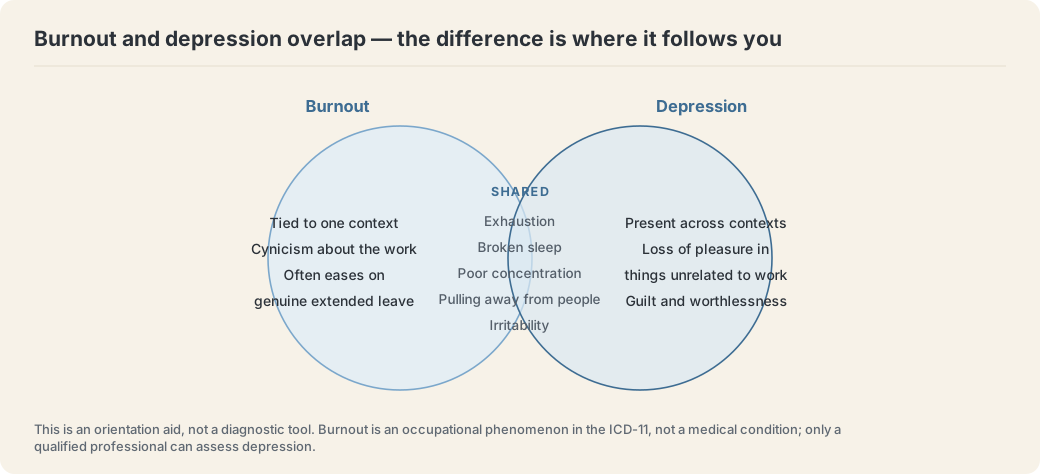
Counselling does not produce the documentation these systems require, and it is important to be straightforward about that. What it does is work on what is actually happening, the burnout, the anxiety or panic attacks at work, the aftermath of an incident at work, the decision about whether to stay.
It is also useful for the process itself, which is its own stressor. Preparing for a difficult conversation with a manager, deciding what to disclose and to whom, and managing the strain of an appeal are all legitimate session material.
If you are not sure whether this is burnout or something that travels with you, the burnout or depression check takes three minutes and stores nothing, and what you can access, and how soon sorts the routes open to you, including the free ones most people never use. Burnout compared with depression and counselling for healthcare and shift workers cover the ground in more depth.
If you want to talk to someone, the order that usually works. First, an employee and family assistance programme if your employer has one: it costs you nothing at the point of use, and EFAP compared with private counselling sets out what it covers and where it stops.
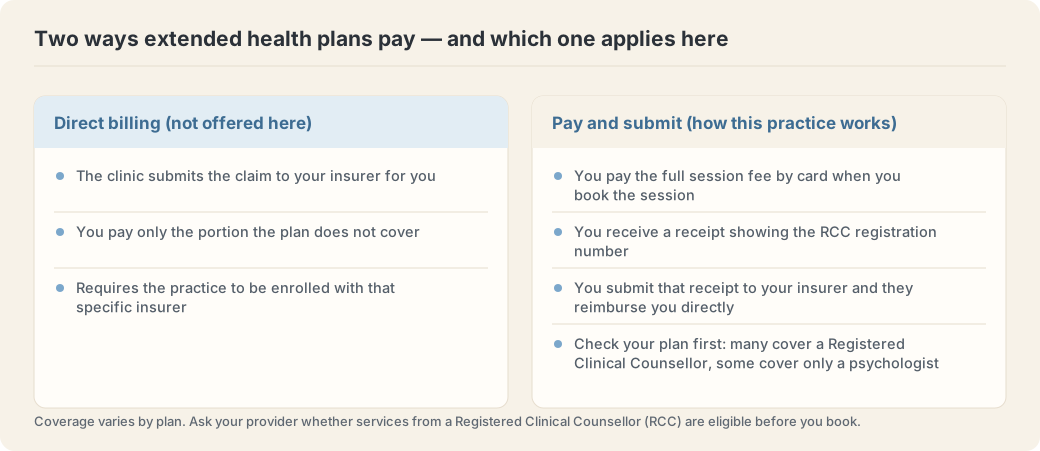
Then, privately. Online counselling in BC: a Registered Clinical Counsellor by video from anywhere in the province, $140 for a 50-minute individual session, paid at booking with a receipt for your extended health plan. Whether the plan reimburses it depends on the plan, and on a calendar-year plan using counselling benefits before the end of the year shows which year’s maximum a session counts against.
Reading this as the manager or HR? Counselling support for employers and HR is this page from your side of the desk.
Preparing for the conversation with your manager
This conversation goes considerably better with preparation, and the preparation is mostly about deciding in advance what you are asking for.
Separate disclosure from request. You can ask for an accommodation without naming a condition. "I am dealing with a health issue and my doctor has recommended some adjustments" is sufficient for most purposes, and it keeps a diagnosis out of a conversation where it is not required.
Arrive with a specific proposal. "I would like to start at ten for the next six weeks and drop the on-call rotation" is actionable. "I am struggling and need some flexibility" transfers the problem back to a manager who does not know what would help. Specificity dramatically increases the chance of a yes.
Put it in writing afterwards. A short email summarising what was agreed protects everyone, and it is the record that matters if the arrangement is later disputed or if your manager changes.
Know your route if it goes badly. Employment standards, human rights, a union if you have one. Knowing the route in advance changes how the conversation feels even if you never use it.
And decide what you will do if the answer is no. Sometimes the honest conclusion is that the job is the thing making you unwell and no accommodation fixes that. That is a decision worth making deliberately rather than by attrition, and it is legitimate session material.
Returning to work after leave
The return is where a good deal of leave is undone, and it is the phase with the least support attached to it.
Graduated returns are better evidenced than hard returns, and they are frequently available even where nobody offers them. Two or three days a week building over four to six weeks gives a nervous system a chance to recalibrate, and it substantially reduces the chance of a second absence.
Agree the plan in writing before the first day back, including what happens if it is not working. A return with no review point is a return with no exit except another collapse.
Decide what colleagues will be told, and by whom. Walking into a room where nobody knows what to say is hard, and a single agreed sentence from a manager removes most of it.
Expect the first two weeks to be disproportionately tiring. Capacity returns more slowly than motivation, and people routinely interpret ordinary readjustment fatigue as evidence that the leave failed.
And address what caused it. A return to precisely the conditions that produced the absence has a predictable outcome. Where the workload, the role or the relationship was the driver, the return plan has to include a change to it, otherwise the leave functioned as a pause rather than a treatment.
Common questions
How do I get stress leave in BC?
See a physician or nurse practitioner and describe what is happening to your ability to work. If they agree, they give you a certificate saying you are unable to work and when that will be reviewed. Give it to your employer, then start the income claim the same week: your employer’s short-term disability plan if there is one, otherwise EI sickness benefits online. Your first five sick days of the year are paid by your employer once you have 90 days of service.
Is mental health leave paid in BC?
Partly, and it is the same leave as stress leave: a medical leave for a mental-health reason, paid from different places in turn. The first five sick days in a calendar year are paid by your employer under the Employment Standards Act once you have 90 days of service, and three more are unpaid. After that there is no automatic pay: income comes from an employer short-term disability plan if one exists, or from EI sickness benefits at 55% of insurable earnings, to $729 a week in 2026, for up to 26 weeks, and the usual one-week unpaid waiting period is waived for new claims that start by 9 October 2027. The serious personal illness or injury leave of up to 27 weeks protects the job but is unpaid. WorkSafeBC pays only on an accepted claim for an injury caused by work. BC Public Service employees have their own plan, STIIP, and many collective agreements carry a sick-leave plan of their own; sick days and mental-health days in BC sets both out.
How long can I take off work for mental health in BC?
A day or a few days on your Employment Standards Act sick days, with no note needed unless your employer asks for reasonably sufficient proof. For longer, as long as a physician or nurse practitioner certifies that you cannot work, usually in blocks of two to six weeks with a review before each extension. EI sickness benefits pay for up to 26 weeks; an employer disability plan sets its own length.
Can a therapist put you on stress leave?
No. In BC a physician or nurse practitioner certifies a medical leave, and for EI Service Canada also accepts a psychologist. A counsellor or therapist cannot sign a stress leave for an employer, an insurer or EI. A therapist can recommend time off, tell your doctor so if you ask, and write a letter confirming you are in treatment, which insurers sometimes want alongside the medical note.
Can an employer deny a mental health leave?
Not a certified one, in the ordinary case. The Employment Standards Act sick days and its serious personal illness or injury leave of up to 27 weeks are job-protected, the employer may ask only for reasonably sufficient proof, and the Human Rights Code requires an employer to accommodate a mental-health disability to the point of undue hardship. An employer can ask for functional information, such as when you expect to return, but not your diagnosis. If a leave is refused, or you are penalised or dismissed for taking one, the Employment Standards Branch and the BC Human Rights Tribunal are the routes, and an employment lawyer is worth calling early.
Is there a 27-week stress leave in BC?
Yes. The Employment Standards Act gives up to 27 weeks of unpaid, job-protected serious personal illness or injury leave in any 52-week period, regardless of how long you have worked there, with a certificate from a doctor, nurse practitioner or other designated health professional. It is separate from the five paid and three unpaid sick days a year. Federally regulated employees, such as those at banks, airlines and telecoms, have a 27-week medical leave under the Canada Labour Code instead. Neither leave pays: EI sickness benefits, up to 26 weeks, or a disability plan provide the income.
Does WorkSafeBC pay for stress leave?
Only when work caused the injury. WorkSafeBC accepts a mental-health claim where a diagnosed condition results from a significant work-related stressor or a traumatic event at work, and it excludes conditions caused by an employer’s decisions about employment, such as workload, discipline or reorganisation. An accepted claim pays wage-loss benefits and treatment. Ordinary overload goes down the medical-leave route instead; WorkSafeBC psychological injury claims sets out the test.
Can I see my own counsellor while on a stay-at-work plan?
Yes. A stay-at-work plan is a workplace arrangement, and it does not choose your treatment for you. You can see a counsellor privately alongside it, booked and paid by you and claimed on your own extended health plan where it covers counselling, and the practice does not report to your employer. A good plan names who is providing the treatment, so it is worth saying who that is when the plan is written.
Is burnout covered by disability insurance?
Burnout is classified as an occupational phenomenon rather than a medical condition, so claims usually turn on an accompanying diagnosable condition. This is exactly why the wording of medical documentation matters.
Using this page
- Free to link to, from any website, intranet, handout or resource list. No need to ask.
- May be reproduced, in print or online, with attribution to Westpeak Wellness and a link to this page.
- Last updated October 13, 2026.
- Spotted something out of date? Email info@westpeakwellness.com.
Suggested citation
Sources
- Province of BC, paid sick leave (read 13 Oct 2026)
- BC Employment Standards, leaves and job protection
- Government of Canada, EI sickness benefits: do you qualify (read 13 Oct 2026)
- Government of Canada, EI sickness benefits: apply (read 13 Oct 2026)
- Government of Canada, medical leave with pay (federally regulated employers, IPG-118)
- Province of BC, leaves of absence: serious personal illness or injury leave (read 15 Oct 2026)
- Canada Labour Code, s. 239, medical leave of up to 27 weeks
- BC Human Rights Tribunal
- WorkSafeBC, mental health claims (read 13 Oct 2026)
General information, not clinical, financial, or legal advice. Coverage and service details change, verify anything decision-critical directly with the provider or insurer. If you are in crisis, call or text 9-8-8 (Canada, 24/7) or 310-6789 for BC Mental Health Support.