Passing it on
If someone you know is looking.
The practice has openings. If you know someone trying to find a counsellor in BC, here is what is useful to send them, and what you will never be asked for.
What you will never be asked for
A review, a testimonial, or a rating. Not now and not later, and not if you stop being a client. The BC Association of Clinical Counsellors prohibits it, and the reason is a good one: somebody in a counselling relationship is not in a position to freely say no to their counsellor asking for a favour, so consent to be used as marketing cannot really be given. That is why there are no reviews anywhere on this site and why there never will be.
Passing a name to a friend is a completely different thing. Nothing is published, nothing is used as advertising, and the practice does not find out who told whom.
There is no reward, deliberately
No discount, no free session, no credit. If a recommendation came with something in it for the person making it, the person receiving it would have no way of knowing that, and for a health service that is a conflict of interest rather than a growth tactic. A recommendation is worth something precisely because there is nothing behind it.
What is actually useful to send
Most people looking for a counsellor stall on the same three questions. These are the pages that answer them, and any one of them is a better thing to send than a home page:
- “What does it cost, and will my benefits cover it?” Fees and coverage, with the questions to ask an insurer before booking anything.
- “What actually happens?” What to expect in a first session, for someone who has never done this before.
- “Is it even worth booking?” The free 15-minute consultation. No card, no intake form, and deciding not to continue is a normal outcome.
- Someone who would rather work in Punjabi, ਪੰਜਾਬੀ ਵਿੱਚ, or the English page on Punjabi-speaking counselling.
- Someone who would rather work in Tagalog, the page on Tagalog-speaking counselling, and finding a counsellor in Punjabi or Tagalog in BC for the wider picture.
If it turns out not to be a fit
That is a perfectly good outcome and worth saying to whoever you pass this to. This practice is virtual only and works with adults, couples, families, and young people who can consent to their own care. It does not do assessments, diagnoses, court-related work or crisis response. The full list is on standards and scope. Where it is not the right place, saying so and pointing somewhere better is the normal result of a consultation, not a failure of one.
If cost is the barrier for them, free and low-cost counselling in BC is a real list rather than a gesture, and worth sending on its own.
If the person wants their doctor in the loop
No referral is needed to see a counsellor in BC, a point worth making early, because plenty of people wait months for a permission nobody was ever going to be asked for. Where somebody does want their GP involved, about medication, a leave or an assessment, the one-page summary to take to a doctor is written to be printed and handed over: designation, scope limits, fees, and how information sharing works.
For clinics, employers, and counsellors who are full
A clinic, campus or agency front desk can print a sheet of four cut-out cards with the booking address and the crisis lines on each. A counsellor whose own caseload is full can see who is accepting here, and in which languages, and pass a client on with no fee and nothing reciprocal. An HR or benefits lead who wants something to attach to a benefits pack has the one-page summary for HR: fees, what a receipt carries, and the plan wording to look for.
Free to link, print or embed
For a clinic, campus, library, union, HR team or settlement agency putting together a resource list. Every page below is free to link to, with no need to ask, and may be reproduced in print or online with attribution to Westpeak Wellness and a link to the page. Each carries a citation line to copy. To report something out of date, email info@westpeakwellness.com.
- BC crisis and mental health support directory. Every crisis and support line covering BC, with who each one is for and when to call it.
Westpeak Wellness, “BC crisis and mental health support directory”, updated September 2, 2026. https://www.westpeakwellness.com/resources/bc-crisis-and-support-directory
- Finding a counsellor in Punjabi or Tagalog in BC: a guide for the person helping. For the settlement worker, employer or relative helping someone find a counsellor in their own language.
Westpeak Wellness, “Finding a counsellor in Punjabi or Tagalog in BC: a guide for the person helping”, updated October 1, 2026. https://www.westpeakwellness.com/resources/finding-a-counsellor-in-punjabi-or-tagalog-in-bc
- Mental-health leave templates for BC: the request, the note, and the HR checklist. The leave request email, the doctor’s-note checklist and the HR checklist, ready to copy.
Westpeak Wellness, “Mental-health leave templates for BC: the request, the note, and the HR checklist”, updated October 1, 2026. https://www.westpeakwellness.com/resources/mental-health-leave-templates-bc
- Free and low-cost counselling in BC. Free and reduced-cost counselling across BC, and who qualifies for each.
Westpeak Wellness, “Free and low-cost counselling in BC”, updated August 23, 2026. https://www.westpeakwellness.com/resources/low-cost-counselling-bc
- Registered Clinical Counsellor (RCC): what it means, and how to check one. What RCC means, and how to check a counsellor on the free BCACC register.
Westpeak Wellness, “Registered Clinical Counsellor (RCC): what it means, and how to check one”, updated October 13, 2026. https://www.westpeakwellness.com/resources/verify-a-counsellor-in-bc
- Stress leave in BC: how to get it, whether it is paid, and your rights at work. Stress leave in BC: who signs it, what is paid, and what an employer may ask.
Westpeak Wellness, “Stress leave in BC: how to get it, whether it is paid, and your rights at work”, updated October 13, 2026. https://www.westpeakwellness.com/resources/workplace-mental-health-bc
- What counselling means in Punjabi, word by word. The Punjabi words for counselling and therapy, in one table, for families and front desks. The one-page printable sheet (PDF) may be printed and posted on a notice board or front desk on the same terms.
Westpeak Wellness, “What counselling means in Punjabi, word by word”, updated October 13, 2026. https://www.westpeakwellness.com/resources/counselling-in-punjabi-what-the-words-mean
- Does my student health plan cover counselling? BC student supports. What each BC student-society plan pays for counselling, and the free campus routes.
Westpeak Wellness, “Does my student health plan cover counselling? BC student supports”, updated October 1, 2026. https://www.westpeakwellness.com/resources/student-mental-health-supports-bc
- The stress leave pay calculator for BC. What a leave pays week by week, on a person’s own wage. Its figures table may be quoted with attribution, and comes as a CSV file; the calculator itself can be embedded on your own site by pasting a short snippet.
Westpeak Wellness, “Stress leave pay calculator for BC”, updated October 15, 2026. https://www.westpeakwellness.com/tools/stress-leave-pay-calculator#figures
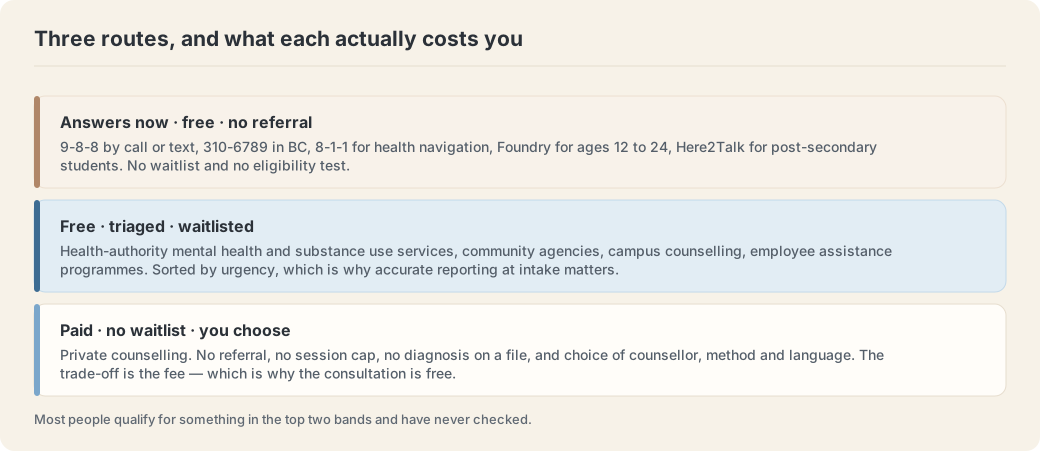
- Routes to mental health support in British Columbia. A one-picture summary of the three ways in: services that answer now, publicly funded services, and private counselling. Shown on psychiatrist or counsellor in BC; the diagram may be reproduced on the same terms as the pages above.
Routes where somebody else pays
Cost is the most common reason a recommendation goes nowhere, and a surprising amount of counselling in British Columbia is funded by somebody other than the person attending. Most people do not know these exist, which makes them worth mentioning when you pass something on.
- After a motor vehicle crash, ICBC. Anyone injured in a crash in BC is pre-approved for twelve counselling sessions with a Registered Clinical Counsellor in the first twelve weeks, and no doctor’s note is required to start. This is the single most underused entitlement in the province. It does not need a lawyer, and using it does not commit anybody to a claim decision. This practice is not currently registered with ICBC and does not direct-bill; the entitlement can be used with a registered vendor.
- Through an employer, EAP. Most mid-size and large Canadian employers carry an employee assistance programme covering a set number of sessions at no cost to the employee, usually without the employer being told who used it. Worth checking before assuming there is no coverage.
- Extended health. Many BC plans reimburse a Registered Clinical Counsellor specifically, depending on the plan. Pacific Blue Cross accepts direct claims from RCCs, but this practice is pay-and-submit: the session is paid at booking and the receipt carries the counsellor’s registration number, which is what an insurer needs to reimburse it. what BC extended health plans actually cover sets out how to check a plan in about five minutes, and the cost estimator does the arithmetic once the numbers are known.
- After a crime, the Crime Victim Assistance Program. CVAP funds counselling for victims of violent crime, and for immediate family members in some circumstances. It funds a course of treatment rather than a handful of sessions.
- First Nations and Inuit clients. The First Nations Health Authority and the federal Non-Insured Health Benefits programme both cover mental-health counselling and both maintain approved-provider lists.
Not every route above is one this practice is currently on a panel for, and it is worth asking rather than assuming in either direction. But the point of listing them is broader than this practice: if the person you are thinking of is not going to see anybody at all because of what it costs, one of these five is usually the reason that assumption is wrong.
If you are in crisis right now
This is not the page for that, and nor is this practice, sessions are scheduled and there is no on-call line. If you are in immediate danger call 9-1-1. For urgent mental-health support in BC at any hour, call or text 9-8-8, or call 310-6789, no area code needed.
Therapy starts with one conversation.
Book a free 15-minute consultation over secure video. No pressure, just a chance to see if we’re a good fit.
Book Free ConsultationNot ready to book? Send a line about what is going on. A reply comes within one business day, or read the guides first and come back when you want to.
Looking on behalf of someone else? What to send them, and what not to, including the funded routes most people do not know they qualify for.