EMDR Therapy
Online Trauma Therapy and EMDR in BC: Process painful memories so they stop running the show.
Online trauma therapy at Westpeak Wellness is paced, trauma-informed counselling by secure video anywhere in British Columbia with a Registered Clinical Counsellor, and EMDR (Eye Movement Desensitization and Reprocessing) is one route through it: a structured eight-phase therapy for distressing memories, with a strong evidence base for post-traumatic stress. Most of the protocol is preparation rather than eye movements: reprocessing does not begin until the regulation skills to come back down are reliably in place.
- 50 minutes per session
- Secure video sessions
- Free 15-min consult
- $140 / 50 min weekly · $190 / 90 min intensive
- Registered Clinical Counsellor · BCACC registered
EMDR (Eye Movement Desensitization and Reprocessing) is an evidence-supported therapy that helps the brain reprocess distressing memories so they lose their grip. You don't have to relive everything in detail or explain it perfectly: EMDR works with how memory is stored, not just how it's told. Available online across BC, including a 90-minute intensive format.
Updated
Online trauma therapy in BC, with and without EMDR
Trauma therapy is available online anywhere in British Columbia, by secure video with a Registered Clinical Counsellor, and EMDR is one route through it rather than the only one. Where a specific memory keeps intruding, EMDR is often the centre of the work; where the difficulty is more about regulation, safety and getting through the present, trauma-informed counselling without reprocessing can be the better start, and most people need some stabilisation before either. Which of those fits is what the free 15-minute consultation is for. Trauma-informed counselling here is with Camille Granda, RCC, CCC and Savneet Singh, RCC; EMDR is with Camille Granda, RCC, CCC. If you are not sure whether what you carry counts as trauma at all, what trauma actually means starts there.
Trauma therapy over secure video is an established practice, not a pandemic improvisation. The structured trauma protocols: EMDR with on-screen or self-administered bilateral stimulation, cognitive processing work, stabilisation and resourcing, all adapt to video, and the research on video-delivered therapy includes trauma-focused work specifically.
Two things matter more online than in a room, and both are manageable. The first is your space: trauma work needs privacy and a plan for the hour after the session, not a car in a work parking lot before a shift. The second is pacing, which is a clinical skill rather than a format property: a trauma therapist who rushes is a problem in any medium, and one who paces well loses nothing over video. For some people the screen genuinely helps: being in your own home, with your own exits, changes what feels sayable.
And where the work keeps being cut short by the standard hour. A target memory that takes twenty minutes just to access. The 90-minute EMDR intensive exists for exactly that arithmetic, once stability is in place.
How do we approach it?
Your counsellor is EMDR-trained and works in a paced, trauma-informed way, we build safety and stability first, and never move faster than you're ready for. EMDR translates well to virtual sessions, and many people find the comfort of their own space helps the work.
Why EMDR works differently from talking it through
Ordinary memories fade and integrate. You remember that something happened without your body returning to the state it was in at the time. Some memories do not file themselves that way. They stay stored with the images, sounds, body sensations and beliefs from the moment intact, so recalling them is closer to re-experiencing them.
That is why "I know intellectually it wasn't my fault" so often changes nothing about how it feels. The understanding is in one system; the memory is stored in another.
EMDR works on that storage problem rather than on the narrative. You hold the memory in mind while your attention is partly occupied by bilateral stimulation: eye movements, alternating taps, or alternating tones, and the memory typically becomes less vivid and less charged. You do not have to describe it in detail for this to work, which is why EMDR is often the route in for people who have avoided therapy precisely because they cannot face retelling it. There is a phase-by-phase walkthrough in the guide on what EMDR is.
Who you would see for EMDR therapy
Taking new clients and seeing people across BC by secure video. Each is a Registered Clinical Counsellor; the registration is on the profile and can be checked on the BCACC register.

Camille Granda, RCC, CCC
English and Tagalog · EMDR, Trauma, Anxiety and chronic stress
In her words: “I want sitting with me to feel like the biggest belly breath you have ever taken.”
Might be a fit if
What people tend to arrive with
A memory that still intrudes
Arriving uninvited, in full colour, sometimes triggered by something small and unrelated.
You understand it but still feel it
The gap between what you know and what your body does, the clearest indication for EMDR over purely talk-based work.
You cannot face describing it
Avoidance of therapy specifically because of the retelling. EMDR requires far less of that.
Your reactions do not match the present
Startle, panic, shutdown, or rage at a scale that belongs to something older than what is in front of you.
A single identifiable event
An accident, an assault, a medical event, a death. Single-incident trauma is where EMDR tends to move fastest.
Grief that has not moved
A loss that stayed frozen rather than settling over time.
Recognise several of these? A free 15-minute consultation is the least committal way to find out whether this is the right approach, including if the answer turns out to be something else.
How EMDR runs here
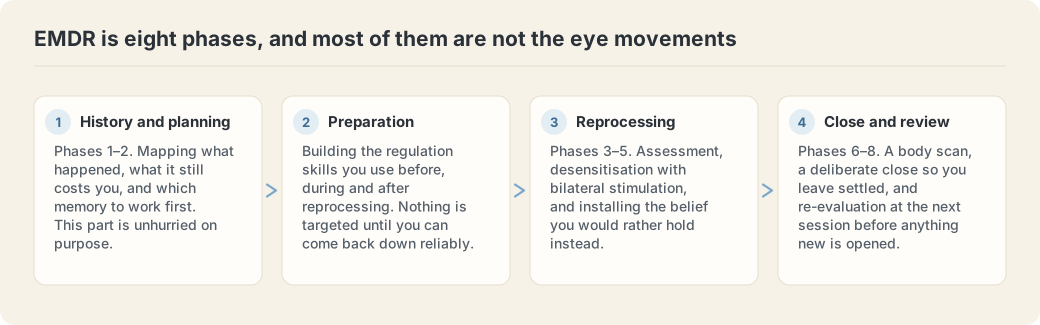
EMDR is an eight-phase protocol, not an improvised technique. The first two phases are history-taking and preparation: building grounding skills, a settling place, and an agreed signal to stop. This is the part that gets rushed by inexperienced practitioners and should not be. Nothing gets processed before there is enough stability to tolerate it.
Processing sessions run 50 minutes, with a 90-minute intensive format available where longer uninterrupted time suits the work better. Sessions always close before you leave. You are never sent off mid-processing.
Online, bilateral stimulation uses a moving marker on screen, alternating tones through headphones, or self-administered tapping, the butterfly hug, arms crossed, alternating taps on each shoulder. Many people prefer the self-administered version because it puts the pace directly in their control.
When it is not the right first move: if you are in an actively unsafe situation, in early substance-use recovery, or currently without much ground underneath you, the honest answer is often "not yet": stabilisation first. A practitioner proposing processing in a first session, without knowing your history, is moving too fast.
Questions
More on how this work runs
Who EMDR is not the first choice for
EMDR has strong evidence for post-traumatic stress and it is not a general-purpose therapy, so being clear about the edges matters more than listing what it treats.
It is generally not the first move where stabilisation has not happened. Someone in an ongoing dangerous situation, in active crisis, or without reliable ways to regulate themselves is not well served by opening a memory. The preparation phase exists precisely for this, and where it needs to take two months, it takes two months.
It is not usually the right tool for a difficulty with no traumatic memory attached to it. A decision you are stuck on, a communication problem, a career question. Those are ordinary therapy, and using a trauma protocol on them is a category error.
It requires caution with dissociation. Significant dissociative presentations need assessment and a modified approach rather than a standard protocol, and a counsellor who does not screen for this before starting is not being careful.
It also sits alongside rather than instead of medical care. Where substance use is active, where a medication is being adjusted, or where an unassessed physical condition may be contributing, sequencing matters, and a counsellor should say so rather than proceed.
Finally, it is not the only effective trauma treatment, and anyone presenting it as uniquely powerful is overselling. Trauma-focused cognitive approaches have comparable evidence, and the better question is which suits you, see CBT vs EMDR for trauma.
How much does EMDR therapy cost in BC?
EMDR here is $140 for a weekly 50-minute session and $190 for the 90-minute intensive, and the first 15-minute consultation is free. There is no GST on counselling by a Registered Clinical Counsellor in BC.
MSP does not pay for private EMDR. It is claimed on extended health exactly like any other session with a Registered Clinical Counsellor, so whether your plan reimburses it, and how much of the annual maximum each session uses, is plan-dependent. An intensive uses more of a yearly maximum per session than a weekly appointment, which is worth checking before choosing that format.
How many sessions EMDR takes varies too widely for an honest average: preparation alone can be two sessions or two months, and a single recent event is different work from something that began in childhood. Progress should be reviewed with you openly rather than sold as a package. Intensive or weekly EMDR compares the two formats, and the free consultation is the place to ask about yours.
Phase one, which is most of the work
Trauma therapy is usually described in three phases: stabilisation, processing, integration, and the widespread assumption is that phase two is where the treatment happens. In practice phase one is where most of the time goes, and skipping it is the single most common way this work goes wrong.
Stabilisation is not preamble. It is the deliberate construction of capacity: reliable ways to come back from high arousal, ways to come back from numbness, an ability to notice which state you are in before it is total, and enough external stability that a hard session does not have nowhere to land.
What that looks like in sessions is often unglamorous: practising orientation to the room, tracking body signals, building a repertoire of things that reliably shift your state, and identifying what to do in the forty-eight hours after difficult material. It can feel like nothing is happening. It is the part that makes the rest survivable.
The signal that phase one has done its job is specific: you can bring a difficult subject partway up, notice it happening, and come back down within the session, without either flooding or shutting down. That is the threshold for opening anything.
People frequently want to skip ahead, particularly if they have waited a long time to start. A counsellor who agrees to that is not being responsive; they are increasing the chance you leave a session worse than you arrived and learn that the subject is dangerous. Pacing here is a clinical decision made with you, and it is negotiable in its details but not in its existence.
Signs the pacing is wrong
- You leave sessions unable to function, Feeling stirred for a few hours is expected. Losing the rest of the day, repeatedly, means too much is being opened relative to current capacity.
- You dread sessions rather than find them hard, A meaningful distinction. Difficult is normal; dread that builds through the week suggests the container is not holding.
- Sessions end abruptly at the hard part, A well-run trauma session reserves the last ten to fifteen minutes for closing down. Finishing mid-material and sending you out is a structural problem, not a scheduling accident.
- Symptoms are worsening over weeks, not days, A temporary increase after opening something is expected. A sustained escalation across a month is a signal to slow down and rebuild stabilisation.
- You are dissociating in sessions, Going blank, losing time, watching from outside. It means the work has moved outside the window of tolerance and should be paused and reoriented rather than pushed through.
- You have started using something to get through, An increase in drinking or anything else timed around sessions is the clearest signal that the pace is exceeding capacity. Say it. It changes the plan rather than ending it.
What "trained" actually means, and what to ask
EMDR training is tiered, and the word on a website covers a wide range. Asking about it is a normal question that a properly trained clinician answers without defensiveness.
Standard training runs in parts, with supervised practice and consultation between them, and completing the full sequence is the baseline for practising it. Beyond that, some clinicians pursue certification, which requires additional consultation hours and demonstrated competence, and some go further into consultant-level training. None of that guarantees a good fit; it establishes a floor.
The questions worth asking are specific. Have you completed the full training, or part of it? Do you receive ongoing consultation on EMDR cases? How do you handle it if reprocessing destabilises someone? The third is the most revealing, because it separates clinicians who understand the protocol as a safety structure from those who have learned a technique.
It is also worth asking how they screen for dissociation before starting. A standard protocol applied to a significant dissociative presentation without assessment is the clearest way this work goes wrong, and a careful clinician will have a clear answer.
Finally, ask what they would do if EMDR is not the right fit for you. Anyone whose answer is that it always is has told you something useful, see CBT vs EMDR for trauma.
EMDR in a first language, and why it is not a preference
On most of this site the argument for working in Punjabi is about comfort and precision, not having to translate a family argument, or explain what log kya kahenge means before describing how it felt. Real, but a matter of degree.
In EMDR it is structural. The protocol is built around a negative cognition: a short sentence in the first person that the memory still seems to prove: "I am not safe", "it was my fault", "I am not enough". You rate how true it feels, hold it alongside the memory during bilateral stimulation, and work toward a positive cognition that begins to feel true instead. That sentence is the instrument.
A memory laid down in Punjabi carries its cognition in Punjabi. Translated into English on the way into the session, it becomes a near-equivalent, usually flatter, sometimes carrying a slightly different accusation, occasionally missing the register entirely. English has no single word doing the work of sharam, and "shame" and "disgrace" each capture part of it and imply different things about who else is affected. Processing the translation is processing something adjacent to what happened.
The rating scales have the same problem. Asking how disturbing something feels from nought to ten, in a language the event did not occur in, invites a considered answer rather than an immediate one, and the immediate one is what the protocol needs.
What this looks like in practice is unremarkable: the cognition stays in whichever language it arrived in, the instructions and the scales are usually in English because those are administrative, and nobody stops to tidy up the switching. Sessions frequently run bilingually within a single sentence, which is how a lot of people think anyway.
None of this makes EMDR in English wrong for a Punjabi speaker. Plenty of people process in their second language perfectly well, particularly for events that happened in it. It matters most where the memory is old, from childhood, from before migration, or from inside a family, which is a large share of what people bring.
The edges set out above apply unchanged: stabilisation first, caution with dissociation, and it is not the right tool for a difficulty with no traumatic memory attached. Working in Punjabi does not shorten the preparation phase, and a counsellor offering to skip it is not being accommodating.
EMDR online: how the therapy works over video
EMDR online replaces the therapist’s moving hand with an on-screen target, alternating audio tones, or self-administered tapping, adaptations with years of clinical use behind them, not workarounds. Everything else about the method is unchanged: the same eight phases, the same preparation before processing, the same closing discipline at the end of every session.
Practically, online EMDR asks for a private room, headphones, and a stable connection, and it removes the commute that would otherwise bracket an emotionally heavy hour on both sides. For the longer 90-minute intensive format, that absence of a commute turns out to matter more, not less: the session can end with proper closing and then simply… end, in your own space.
Before you book
Do I have to tell you what happened?
Not in detail. Your counsellor needs enough to identify the target. An image, the belief attached to it, where it sits in your body, but the processing itself does not require narration. Many people say little during a set.
Does EMDR work over video?
It can, with adaptation. On-screen movement, alternating audio, or self-administered tapping replace the hand movements of an office session, and the preparation phase matters more online, not less. The research on video-delivered EMDR is still small: a 2021 study of 102 sessions run by 23 therapists (Mischler et al., Frontiers in Psychology) found distress ratings fell within sessions by an amount similar to in-person EMDR studies, while noting its therapists were a self-selected group. In BC, check that the person is registered (an RCC, for example) and ask what EMDR training they have completed.
How many sessions?
Single-incident trauma in someone otherwise stable can resolve in a handful of processing sessions. Complex or intergenerational trauma is a longer piece of work, and most of the early time goes to stabilisation.
Can EMDR make things worse?
Trauma work paced badly can destabilise anyone, which is what phases 2 and 7 exist to prevent. Distress during a session is normal and temporary; deterioration lasting days is a signal to slow down, and worth saying out loud.
How much does EMDR therapy cost in BC?
A weekly 50-minute EMDR session is $140, and the 90-minute intensive is $190. The first 15-minute consultation is free. MSP does not pay for private EMDR; it is claimed on extended health like any session with a Registered Clinical Counsellor, so whether and how much your plan reimburses is plan-dependent. How many sessions it takes varies too widely for an honest average.
More in the full FAQ, or see fees and extended health coverage.
Explore more
Other ways we can work together
Individual Therapy
1:1 for anxiety, depression, life transitions, identity, family dynamics.
Individual Therapy in BCFamily Counselling
For the pattern between you, not the person you think is the problem.
Family Counselling in BCEMDR Therapy by area
Trauma Therapy and Counselling by area
Keep going
Other counselling services
EMDR Therapy, starting with a conversation.
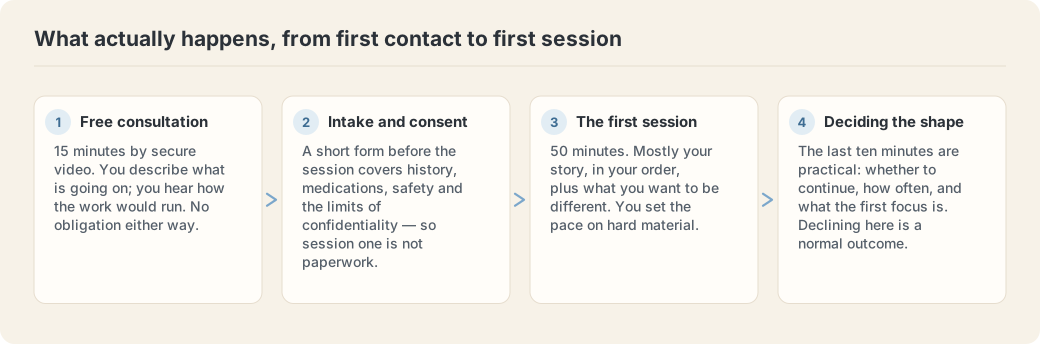
Book a free 15-minute consultation over secure video. No pressure, just a chance to see if we’re a good fit.
Book Free ConsultationNot ready to book? Send a line about what is going on. A reply comes within one business day, or read the guides first and come back when you want to.
Looking on behalf of someone else? What to send them, and what not to, including the funded routes most people do not know they qualify for.