BC resource
Registered Clinical Counsellor (RCC): what it means, and how to check one
A Registered Clinical Counsellor (RCC) in BC is a counsellor with a master’s degree in counselling, supervised clinical hours, a code of ethics and a complaints process through the BC Association of Clinical Counsellors (BCACC), the professional body that grants the RCC and keeps a register you can check yourself. It is a professional registration, not a government licence; psychotherapy becomes regulated in BC on 29 November 2027. You can check any RCC free on the BCACC register. To check anyone, ask which designation the person holds and which body holds it, then search that body’s public register yourself: BCACC for a Registered Clinical Counsellor, the College of Health and Care Professionals of BC for a psychologist, the BC College of Social Workers for a social worker. If they hold no designation with any body, there is no complaints process and no minimum standard behind the title. Search the BCACC register, or find one in BCACC’s Find a Counsellor directory.
RCC is the set of letters most BC counsellors put after their name. Here is what it certifies, what it does not, and the four-minute check that confirms it.
8 min read · Updated
Looking for an RCC rather than checking one?
The counsellors taking new clients at this practice are RCCs. Camille Granda works in English and Tagalog, by video anywhere in BC, and offers individual counselling, couples counselling, EMDR and family counselling. Savneet Singh works in English and Punjabi, by video anywhere in BC, and offers individual counselling.
An individual session is $140 for 50 minutes, and every fee is on the fees page. Check them on the register first, then talk to one of them.
What is a Registered Clinical Counsellor (RCC)?
RCC is a designation granted and policed by the BC Association of Clinical Counsellors (BCACC), a professional association founded in 1988. Holding it means the counsellor has cleared a specific bar: a master’s degree in counselling psychology or an equivalent discipline, a period of supervised clinical practice, current professional liability insurance, continuing education that does not stop at registration, and a code of ethics with teeth. There is a formal complaints process, and registrants can be, and are, removed. The same bar, read from the applicant’s side, is how to become a Registered Clinical Counsellor in BC.
Each RCC carries a registration number, and the RCC Register is public and free to search. That combination, a number plus a register anyone can check in two minutes, is the practical meaning of the designation. A claim you can verify is categorically different from a claim you have to take on trust, and the walkthrough below shows exactly where to look.
What the designation is not: a government licence. That distinction is not a technicality in British Columbia, and it has its own section below, because it is the thing most pages on this subject skate past.
It is also the designation you are most likely to meet. In August 2026 BCACC reported 10,000 Registered Clinical Counsellors, about 90% of the clinical counsellors and psychotherapists in BC.
| Registered Clinical Counsellor (RCC) | In BC |
|---|---|
| Granted by | The BC Association of Clinical Counsellors (BCACC), since 1988 |
| Minimum training | A master’s degree in counselling or a closely related field, plus supervised clinical hours |
| Kept up by | Liability insurance, continuing education, and the BCACC code of ethics and complaints process |
| A government licence? | No. A professional registration; psychotherapy becomes a regulated profession in BC on 29 November 2027 |
| Can diagnose or prescribe? | No. Counselling and psychotherapy; diagnosis and medication sit with physicians, psychologists and some clinical social workers |
| Covered by MSP? | No. Many extended health plans reimburse an RCC, depending on the plan |
| How many in BC | 10,000, about 90% of BC’s clinical counsellors and psychotherapists (BCACC, August 2026) |
| How to check one | The RCC Register on bcacc.ca, free, by name or registration number |
Registered counsellor, clinical counsellor, licensed counsellor: what each title means in BC
"Registered counsellor" almost always means an RCC. When a website or an insurer in BC says "registered counsellor" or "clinical counsellor", it nearly always means a Registered Clinical Counsellor on the BCACC register. The precise question is which register the person is on, since "registered" on its own could refer to any association, including ones with no clinical requirements.
BC has no "licensed counsellor". The phrase is American; there is no BC licence corresponding to it. Somebody advertising as a licensed counsellor in BC may be perfectly qualified, but the word "licensed" is not carrying the meaning it appears to carry. What exists in BC is registration: RCC through BCACC, CCC through the Canadian association, R.Psych and RSW through their colleges.
The alphabet is genuinely confusing, so: RCC (BC association, master’s-level, therapy), CCC (Canadian Certified Counsellor, the national association’s equivalent, also master’s-level), RSW/RCSW (social workers, statutory college, clinical registration can include diagnosis), R.Psych (doctoral, statutory college, diagnosis and formal assessment). All four are real, checkable designations held by real therapists; the practical differences are scope, cost and what your insurance lists.
If you are choosing between them for your own care, that decision has its own page, RCC vs psychologist vs social worker, with fees, scope and coverage side by side. This page’s job is smaller: when you see "RCC" after a name, you now know precisely what it certifies and how to confirm it.
The uncomfortable context: counselling is not yet regulated in BC
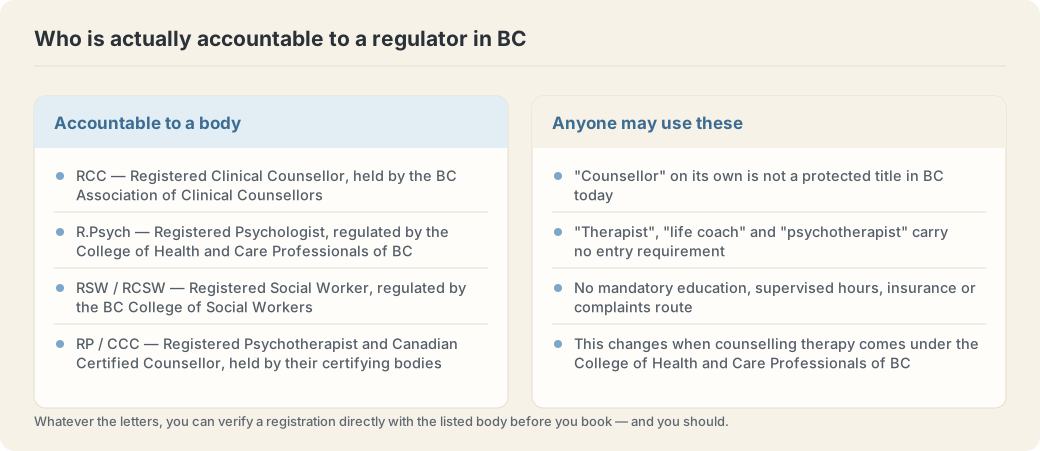
In British Columbia today, "counsellor", "therapist", "psychotherapist" and "life coach" are not protected titles. Anyone may use them, with no required training, no supervised practice, no insurance and no complaints route. "Psychologist" and "social worker" are protected by statutory colleges; the words most people actually search for are not. This is the current state of the law, and it is why the letters after a practitioner’s name carry the weight they do here.
What carries meaning is the designation: RCC, R.Psych, RSW, RCSW, CCC. Each is held by a body with entry requirements and a process for investigating complaints. The designation is what gives you somewhere to go if something goes wrong.
This changes in 2027. Under the Health Professions and Occupations Act, psychotherapy is being brought under the College of Health and Care Professionals of BC, with regulation of the profession beginning 29 November 2027. Until then, the register is your protection, and a practitioner who displays a checkable registration number is telling you they want to be checked.
The four-minute check
- 1. Get the exact designation and full name, From the website or by asking directly. "I am a counsellor" is not a designation. RCC, R.Psych, RSW, RCSW and CCC are.
- 2. Find the right body, RCC is held by the BC Association of Clinical Counsellors. Registered Psychologist is regulated by the College of Health and Care Professionals of BC. Registered Social Worker is regulated by the BC College of Social Workers. Canadian Certified Counsellor is held by the Canadian Counselling and Psychotherapy Association.
- 3. Search that body's public register, Each keeps a searchable register. For an RCC it is BCACC’s RCC Register, searchable by name or registration number, not its Find a Counsellor directory, which lists only counsellors who choose to be listed. Go to the body’s own website rather than following a link from the practitioner’s site.
- 4. Check status, not just presence, A register entry shows current standing. Look for whether the registration is active, and whether the body publishes any disciplinary history.
- 5. If they are not listed, ask why, There are innocent explanations, a recent name change, registration under a different legal name, membership of a body you have not checked. There are also non-innocent ones. A registered professional will answer this question without offence.
RCC vs CCC vs psychologist vs social worker: who grants each, and where to check
These are the four sets of letters a BC reader is most likely to meet on a therapist’s website, and each is held by a body with a public register. Some BC counsellors hold both the RCC and the CCC. In BC the RCC is the designation a plan booklet names and BCACC’s register confirms; the CCC matters most in provinces with no counselling register of their own, Alberta among them: how to check a counsellor in Alberta. A psychiatrist is a medical doctor, which is a different road again: psychologist vs psychiatrist in BC.
Choosing between them for your own care is a different question, with fees and scope side by side: RCC vs psychologist vs social worker.
| Designation | Granted or regulated by | Minimum training | Can diagnose? | Where to check |
|---|---|---|---|---|
| Registered Clinical Counsellor (RCC) | BC Association of Clinical Counsellors, a professional association | Master’s in counselling or a closely related field, plus supervised clinical hours | No | BCACC’s RCC Register, by name or registration number |
| Canadian Certified Counsellor (CCC) | Canadian Counselling and Psychotherapy Association, a national certification since 1986 | A graduate degree in counselling or a related field, including a supervised practicum | No | CCPA’s Find a CCC search |
| Registered Psychologist (R.Psych) | College of Health and Care Professionals of BC, a statutory regulator; “psychologist” is a protected title | Usually a doctorate, plus supervised practice | Yes, and formal psychological assessment | The college’s public registry |
| Registered Social Worker (RSW, RCSW) | BC College of Social Workers, a statutory regulator | A social work degree; RCSW is the clinical registration | With clinical registration (RCSW) | The college’s public registry |
Beyond the register: other things worth checking
- Training in a specific method, "EMDR-trained" covers a wide range. Asking what level of training someone completed, and with which training body, is a normal question a properly trained clinician will answer directly.
- Liability insurance, Required for RCC registration. Fair to ask about for anyone whose designation does not require it.
- Whether they will state their scope, A practitioner who names what they do not work with is showing you good judgement. Anyone claiming to treat everything is telling you something else.
- How fees and cancellations work, in writing, Ambiguity here rarely resolves in your favour.
If something has gone wrong
If the practitioner is registered, complain to the body that holds the designation. BCACC administers a complaints process for RCCs that is independent of any individual counsellor, and you do not need that counsellor's knowledge or agreement to use it. The College of Health and Care Professionals of BC and the BC College of Social Workers have statutory processes for their registrants.
If the concern is specifically about privacy: how your information was collected, used, stored or disclosed, the Office of the Information and Privacy Commissioner for BC oversees private organisations under the Personal Information Protection Act.
If the practitioner holds no designation at all, there is no professional body to complain to. Depending on what happened, the remaining routes are Consumer Protection BC, small claims, or the police. That asymmetry is the entire practical argument for checking first.
What an RCC can and cannot do
- Provide psychotherapy, the core of the work, Individual, couples and family counselling for anxiety, depression, trauma, relationships and the rest of the territory, using recognised modalities. This is what the training is for.
- Cannot formally diagnose, Diagnosis in BC sits with physicians, psychiatrists, psychologists and clinical social workers with the relevant registration. An RCC works with what you are experiencing; the label on a file, where one is needed, comes from elsewhere. The three-way comparison covers when that matters.
- Cannot prescribe, Medication is physician work, always. An RCC coordinates with your doctor, with your written consent, rather than replacing them.
- Issues receipts for extended-health claims, Many BC extended-health plans reimburse RCC counselling, depending on the plan. Plans list professions, not services, so the wording check in the coverage guide comes before the first session, not after.
- Answers to a code of ethics, Including BCACC’s advertising standards, with a complaints process that sits outside any one practice. What those standards mean for a practice’s own website is in the section on verifying a practice as well as a person.
What to do if the register says something unexpected
- The designation is not the one advertised, Worth clarifying. Some practitioners hold several, and some describe themselves loosely. The question is whether the specific designation you were told about is current.
- The registration is listed as inactive or lapsed, This matters. An inactive registration generally means the person is not currently entitled to practise under that designation, and it may also mean no insurance and no complaints route.
- There is a published disciplinary history, Read it rather than reacting to its existence. Bodies publish outcomes, and the substance ranges from administrative matters to serious findings. What it is matters more than that it is there.
- You cannot find the register, Go to the body's own website directly rather than following a link from the practitioner's site, and use their search rather than a general search engine.
Verifying a practice as well as a person
- Is the fee published?, A practice that will not state its rate without a call is optimising for a sales conversation. Fees, session length and cancellation terms should be findable. This practice’s are on one page, with no call needed.
- Does it publish testimonials?, Client testimonials are prohibited under BCACC advertising standards. A practice displaying them is either not bound by those standards or not following them, and both are worth knowing.
- Does it make outcome claims?, Guarantees, success rates, "proven results" and before-and-after framing are all outside what a registered counsellor may advertise.
- Does it say what it does not do?, A practice that states its scope limits is showing you the judgement you want. A list of twenty specialisms with no boundaries is showing you positioning.
- Is there a privacy statement that says anything specific?, "We value your privacy" is not information. What is collected, where it is stored, how long it is kept, and what the limits of confidentiality are. Those are.
- Who wrote the content?, Health content written by an agency and published without clinical review is common. Whether a site says who is accountable for what it publishes is a reasonable thing to weigh.
Common questions
Where is the BCACC registry, and how do I look up an RCC?
BCACC calls its registry the RCC Register, at bcacc.ca/search-our-member-register. It is free and public: search by name or registration number, and it shows whether the registration is active. BCACC’s Find a Counsellor directory is a different tool, opt-in and for finding someone, so a counsellor missing from it tells you nothing; the register is the check.
How do I use the BCACC Find a Counsellor tool?
BCACC has two tools, and they answer different questions. Find a Counsellor, at bc-counsellors.org, is for finding someone: filter by city, concern, language and whether they offer online sessions. Every listing in it is an RCC, which makes it a directory of BCACC’s own registrants, so it cannot list someone who is not registered, but it lists only RCCs who choose to be listed, so a counsellor missing from it tells you nothing. To check a particular counsellor, use the RCC Register instead (bcacc.ca/search-our-member-register): search by name or registration number, and it shows whether the registration is active and any notes. The register covers RCCs only; psychologists and social workers are on their own colleges’ registers.
How do I find a Registered Clinical Counsellor in BC?
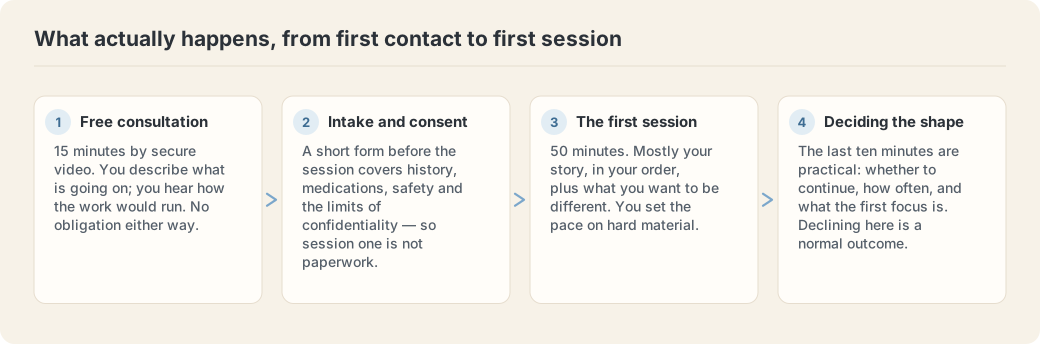
Two places. BCACC’s Find a Counsellor directory, at bc-counsellors.org, lists the RCCs who choose to be listed and filters by city, concern, language and online sessions. A practice’s own website should name each counsellor’s designation and registration number, which you can then confirm on the RCC Register. Many RCCs work by secure video anywhere in BC, so where you live limits the choice less than it once did, and many offer a free first conversation to check fit before any paid session.
What is BCACC?
The BC Association of Clinical Counsellors, founded in 1988: the professional association that grants the RCC designation, keeps the public RCC Register and runs a complaints process for its registrants. It is the largest association for clinical counsellors and psychotherapists in BC. It is not a government regulator; psychotherapy comes under the College of Health and Care Professionals of BC on 29 November 2027.
How many Registered Clinical Counsellors are there in BC?
BCACC reported 10,000 Registered Clinical Counsellors in August 2026, about 90% of the clinical counsellors and psychotherapists in the province.
What does RCC stand for?
Registered Clinical Counsellor: the designation granted by the BC Association of Clinical Counsellors (BCACC) to counsellors who meet its education, supervision, insurance and ethics requirements. It is a BC designation; the national equivalent from the Canadian Counselling and Psychotherapy Association is CCC, Canadian Certified Counsellor.
What is the difference between an RCC and a CCC?
Who grants it and where it carries weight. The RCC is granted by the BC Association of Clinical Counsellors and checked on BCACC’s RCC Register; the CCC is a national certification from the Canadian Counselling and Psychotherapy Association, which has granted it since 1986. Both are master’s-level and neither allows diagnosis. In BC the RCC is the designation to look for in a plan booklet; in a province with no counselling register, such as Alberta, the CCC is the one to ask about. Some counsellors hold both.
What is an RCC number?
The registration number BCACC gives each Registered Clinical Counsellor. It belongs on the counsellor’s receipts, because an insurer asks for it, and you can type it into the RCC Register to confirm the registration is active. At this practice each counsellor’s number is on her profile.
What is the difference between an RCC and a psychologist?
Training level and scope. A registered psychologist in BC holds a doctorate, is regulated under the College of Health and Care Professionals of BC, and can formally diagnose and conduct psychological assessments. An RCC holds a master's degree, is registered with a professional association rather than a regulatory college until 2027, and provides counselling and psychotherapy but does not diagnose. For talk therapy the two overlap heavily; for a diagnosis or an assessment you need the psychologist. Fees differ accordingly.
Is an RCC a real therapist?
Yes: master’s-level training, supervised hours, insurance, continuing education and a code of ethics with a complaints process. The designation exists precisely to separate trained, accountable practitioners from the anyone-at-all who may legally use the word "counsellor" in BC today.
Is RCC the same as a licensed counsellor?
There is no such thing as a "licensed counsellor" in BC. The phrase is American. RCC is a professional registration, which is the closest thing BC currently has, and it becomes a regulated-profession framework when psychotherapy comes under the College of Health and Care Professionals of BC in late 2027.
Does insurance cover an RCC?
Many extended health plans reimburse an RCC, depending on the plan; some list only psychologists and social workers. The plan wording, not the plan brand, decides, and the coverage guide lists the exact questions to ask.
What does it take to become an RCC?
A master’s degree in counselling psychology or a closely related field, supervised clinical practice, professional liability insurance, continuing education, and agreement to the BCACC code of ethics and complaints process. Current requirements live on the BCACC site, since they do change.
What happens to RCCs when regulation arrives in 2027?
Psychotherapy becomes a regulated profession under the College of Health and Care Professionals of BC on 29 November 2027, on a protected-title model. The practical effect for clients: the accountability that is currently voluntary through BCACC becomes statutory. Existing qualified practitioners transition into the new framework.
What is a registered counsellor in BC, and is it the same as an RCC?
In practice, the same thing: when a website or an insurer in BC says "registered counsellor" it almost always means a Registered Clinical Counsellor (RCC), a member of the BC Association of Clinical Counsellors who holds a master’s degree, has completed supervised clinical hours, carries liability insurance and is bound by a code of ethics and a complaints process. The precise question to ask is which register the person is on, since "registered" on its own could refer to any association, including ones with no clinical requirements. Registration is voluntary until psychotherapy is regulated in 2027, which is exactly why checking the register matters: the title "counsellor" alone certifies nothing.
How do I check if a counsellor is registered in BC?
Ask which designation they hold, then search that body's own public register: BCACC’s RCC Register for an RCC, the College of Health and Care Professionals of BC for a psychologist, the BC College of Social Workers for a social worker. Search by surname. A registered person appears with their status; a name that returns nothing is a question to put to them, as step 5 of the check above says, since a registration can sit under a different legal name.
Is it rude to check?
No, and a registered professional will not be offended. Public registers exist precisely so that anyone can search them without asking permission.
What if someone is registered but has no complaints history shown?
That is the normal case. Most practitioners have no disciplinary history, and its absence is not evidence of anything either way.
Does a counsellor have to be registered in BC to see me?
No BC law requires a counsellor to be registered until psychotherapy is regulated on 29 November 2027. Registration is still the thing to check: this practice’s counsellors are RCCs whose registration and insurance cover clients located in BC, and other provinces set their own rules, so you need to be in BC for each session. That is why you are asked where in BC you are, and why it matters if you travel.
Are there good counsellors without a designation?
Possibly. The point is not that everyone unregistered is unskilled. It is that you have no way to tell, and no recourse if it goes wrong.
Using this page
- Free to link to, from any website, intranet, handout or resource list. No need to ask.
- May be reproduced, in print or online, with attribution to Westpeak Wellness and a link to this page.
- Last updated October 13, 2026.
- Spotted something out of date? Email info@westpeakwellness.com.
Suggested citation
Sources
- BC Association of Clinical Counsellors
- BCACC, RCC Register (to verify a counsellor)
- College of Health and Care Professionals of BC, regulating psychotherapists (read 16 Oct 2026)
- BCACC, Find a Counsellor (an opt-in directory, to find one)
- BCACC, complaints and investigations
- BCACC, who we are (founded 1988; read 3 Oct 2026)
- BCACC news release, RCCs surpass the 10,000 mark, 12 Aug 2026 (read 3 Oct 2026)
- Canadian Counselling and Psychotherapy Association, Canadian Certified Counsellor certification (since 1986; read 13 Oct 2026)
- Canadian Counselling and Psychotherapy Association, certification FAQ: graduate degree and supervised practicum (read 13 Oct 2026)
- College of Health and Care Professionals of BC
- BC College of Social Workers
General information, not clinical, financial, or legal advice. Coverage and service details change, verify anything decision-critical directly with the provider or insurer. If you are in crisis, call or text 9-8-8 (Canada, 24/7) or 310-6789 for BC Mental Health Support.