Couples Therapy
Online Couples and Marriage Counselling in BC: Strengthen communication, deepen connection, repair what's frayed.
Couples therapy at Westpeak Wellness is Gottman Method-informed relationship counselling delivered by secure video across British Columbia, provided by a Registered Clinical Counsellor. The work begins with a structured assessment, a joint session, an individual session with each partner, then an agreed treatment plan, rather than with advice. It addresses recurring conflict, drifting apart, rebuilding after a breach of trust, and deciding whether to continue. Separating well is treated as a legitimate outcome rather than a failure.
- 50 minutes per session
- Secure video sessions
- Free 15-min consult
- $175 / 50 min · $340 / 110 min
- Registered Clinical Counsellor · BCACC registered
Every couple hits friction. Couples therapy is a structured, research-based space to understand the patterns underneath the arguments, and to build the skills to move through conflict without losing each other. Sessions are 50 minutes (or a 110-minute extended option), online across BC.
Updated
Gottman-informed couples counselling in BC
Plainly, what this is: couples counselling that uses the structure and the tools of the Gottman Method, delivered by secure video to couples anywhere in British Columbia by a Registered Clinical Counsellor registered with the BC Association of Clinical Counsellors. "Gottman-informed" is the accurate phrase. The method is a body of training rather than a licence, and the regulated credential underneath it is the RCC designation, which is what you are entitled to check.
Marriage counselling and couples counselling are the same work here, at the same fee: nothing about the sessions depends on whether you are married. Online means anywhere in the province, from Victoria to Fort St. John, and the two of you can join from one screen or from two places. Couples sessions are with Camille Granda, RCC, CCC, in English or Tagalog.
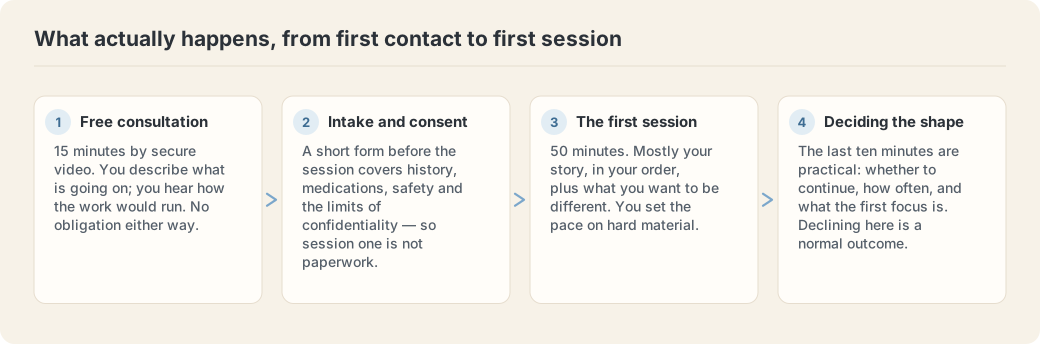
What that looks like in practice is the assessment-first structure described below: a joint session, an individual session with each partner, the questionnaires, and then a treatment plan agreed with both of you. Sessions are 50 minutes, with a longer extended option, at a time the two of you can actually both make, from one couch or from two cities. Both partners are welcome on the free 15-minute consultation, and that call is the right place to ask how the counsellor was trained and how much of their work is with couples.
If it is specifically Emotionally Focused Therapy you are after, this is not the practice for it, and the Gottman vs EFT comparison says so rather than pretending otherwise. For the method itself, the research behind it and what the Four Horsemen are, the guide to how the Gottman Method works is the longer read.
How do we approach it?
Couples work here is Gottman-informed, drawing on one of the most researched approaches to couples therapy. It's practical and skills-based: you'll leave sessions with tools, not just insight, and a clearer map of how the two of you connect and repair.
What makes the Gottman Method different
Most couples therapy grew out of clinical theory. The Gottman Method grew out of observation, decades of research watching couples interact under controlled conditions and following them for years to see which relationships lasted.
The practical result is specificity. Instead of "work on your communication", the model names particular behaviours strongly associated with breakdown: criticism, contempt, defensiveness, and stonewalling, and teaches particular replacements for each. Couples generally leave with something to do, not only something to understand.
A second finding worth knowing early: research suggests a large share of conflict in long-term relationships is perpetual rather than solvable, rooted in enduring differences in personality or values. The goal for those is not resolution but a way of having the disagreement that does not damage anything. Recognising which of your arguments are which is often the first relief. There is a fuller explanation in the guide to how the Gottman Method works.
Who you would see for couples therapy
Taking new clients and seeing people across BC by secure video. Each is a Registered Clinical Counsellor; the registration is on the profile and can be checked on the BCACC register.

Camille Granda, RCC, CCC
English and Tagalog · Couples counselling, Trauma, Anxiety and chronic stress
In her words: “I want sitting with me to feel like the biggest belly breath you have ever taken.”
Might be a fit if
What people tend to arrive with
The same argument on a loop
Predictable moves on both sides, a predictable ending, and no memory of what it was originally about.
You have become logistics
Two competent people running a household efficiently, with the friendship quietly gone.
One of you shuts down
Withdrawal read as indifference, which is usually flooding, overwhelmed and offline rather than uncaring.
Trust has been broken
An affair, a financial betrayal, a serious breach, and both of you want to try to repair it.
A decision you cannot discuss
Children, moving, money, family obligation. Every attempt ends the same way.
You need to know whether to stay
A legitimate goal. Couples therapy is not obliged to produce a reconciliation.
Recognise several of these? A free 15-minute consultation is the least committal way to find out whether this is the right approach, including if the answer turns out to be something else.
How the work is structured
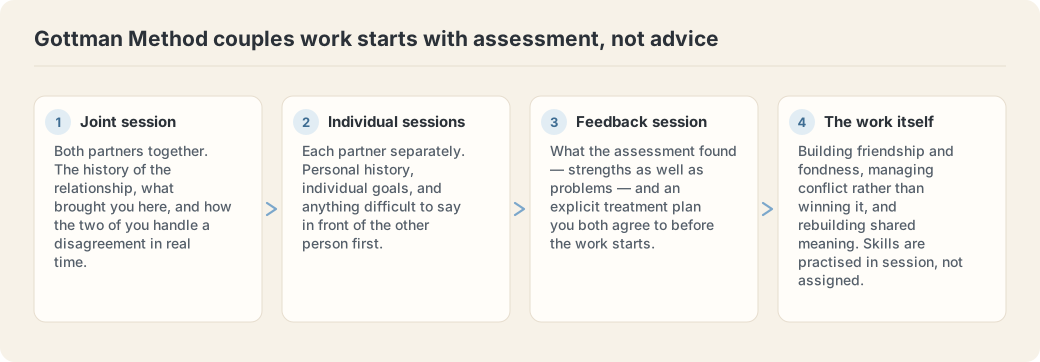
Gottman work starts with a structured assessment rather than diving in: a joint session, an individual session with each partner, and questionnaires covering friendship, conflict, and shared meaning. You then get a shared picture of where the relationship is strong and where it is stuck, often the first time both people have looked at the same map.
Sessions are 50 minutes, with a 110-minute extended option for work that keeps getting cut off at the fifty-minute mark. Every session is by secure video, together on one screen or from two places. Much of the work happens during the session itself: structured conversations with the counsellor interrupting patterns in real time, rather than reporting on the week afterwards.
On safety: the individual sessions are partly a screen. Where there is ongoing violence or coercive control, couples therapy is not the safe starting point and can increase risk. A responsible practitioner will say so and redirect. VictimLinkBC is available 24/7 at 1-800-563-0808.
On sequencing: if one partner is carrying untreated trauma, depression, or an addiction, individual work alongside or before couples sessions is often the more effective order. The comparison of individual and couples therapy covers how to decide.
Questions
More on how this work runs
The rules that make the room usable
Couples work only functions if the session is safer than the kitchen argument, and that safety comes from structure rather than goodwill. A few working agreements do most of the load.
No adjudication. The counsellor will not decide who is right, and asking is understandable and unproductive. The target is the pattern between you, which neither of you controls alone and both of you maintain.
Speak for yourself. "I felt dismissed" is workable. "You always dismiss me" invites a defence and the next twenty minutes disappear into whether "always" is accurate. This is a skill, it feels artificial for about three sessions, and then it stops feeling artificial.
Nothing said in an individual session gets carried into the joint room without agreement. That is what makes the individual sessions honest, and it occasionally means a counsellor holds something they cannot use yet.
Either partner can call a break. Physiological flooding is real and measurable, and nothing therapeutic happens above a certain level of arousal. A twenty-minute break announced in advance is a clinical intervention, not an avoidance of one.
No litigating between sessions. The single most common way couples work stalls is the fight on the drive home, where whatever was said in session gets used as ammunition. Agreeing not to do that is worth more than any technique.
None of this requires either of you to be calm, agreeable or fair-minded on arrival. It requires both of you to be willing to work inside a structure, which is a much lower bar and a much more realistic one.
How much does couples counselling cost in BC?
The BC Association of Clinical Counsellors’ 2026 fee guide recommends $155 to $205 per 50 minutes for couples and family counselling with a Registered Clinical Counsellor; that is the association’s recommendation, read 1 October 2026, and practitioners set their own fees.
Couples counselling here is $175 for a 50-minute session, or $340 for the 110-minute extended format, after a free 15-minute consultation that both partners can join. There is no GST on counselling by a Registered Clinical Counsellor in BC.
MSP does not cover private couples counselling. Whether an extended health plan reimburses couples sessions depends on the plan: some that list Registered Clinical Counsellors include them, and some exclude relationship counselling or limit it, so read the wording before the first paid session. Each session produces one receipt, in the name of the partner who claims it.
If cost rules private sessions out, community agencies offer sliding-scale and sometimes free couples counselling, and low-cost counselling in BC lists where to look. If it does not, book the free consultation with the counsellor who takes couples work, and ask about the extended format there.
What happens if you decide to separate
Some couples work concludes that the relationship is ending, and treating that as the failure case is both inaccurate and unhelpful. Separation conducted well is a legitimate outcome, and the work changes shape rather than stopping.
What it becomes is practical and specific. Agreeing how the decision is communicated, particularly where children are involved, and doing it once, together, rather than in fragments over weeks. Separating the logistics from the grievances, so that decisions about money and time are not being made as a continuation of the argument. And establishing what the relationship becomes, since two people with children remain in relationship indefinitely. The question is only what kind.
The evidence on children is fairly consistent and worth knowing: what predicts poor outcomes is not separation itself but sustained conflict between parents. A well-managed separation is generally better for a child than a household running on contempt. That finding tends to relieve a considerable amount of guilt, and it also raises the stakes on doing the separation carefully.
It is also common for one partner to reach this conclusion before the other, and for the sessions to be doing two different jobs at once, grieving for one person, deciding for the other. Naming that openly is uncomfortable and considerably better than six more weeks of ambiguity.
Online couples counselling in BC: how two people share one session
The phrase people search is "online couples counselling bc", and the practical question inside it is simple: does couples work survive the screen? The structured approaches used here translate directly: assessment questionnaires, guided conversations, between-session practice, and the format solves the scheduling problem that sinks more couples therapy than any clinical issue does: two working adults, one appointment, and no commute for either of them.
The setup that works: both partners on one couch and one camera where possible. The therapist reads the space between you, and sharing a frame keeps that visible. Where life requires it (a rotation, a work trip, a separation-in-progress), three-way video from two locations is workable and sometimes clinically useful. The one non-negotiable is the same as in-person: a private hour, phones down, door shut.
Before you book
Does my partner have to be willing?
For couples work, yes. It does not function with one participant. But individual therapy about a relationship is useful in its own right, and changing your side of a pattern sometimes shifts things enough that the other person reconsiders.
Will the counsellor take sides?
No, and the method is explicitly structured to prevent it. If you consistently feel ganged up on, name it. That is a problem with the work rather than a normal feature of it.
Can we attend from different locations?
Yes. Because sessions are virtual, partners can join from separate places when work or travel requires it, which removes one of the most common scheduling obstacles for couples.
Does online couples counselling work as well as in person?
The evidence is encouraging and still small. A 2022 randomised trial of 30 couples (Kysely et al., Frontiers in Psychology) delivered the same six-session couples programme by video or face to face, and found relationship satisfaction, stress and the working relationship with the therapist improved about equally in both groups, with the gains in satisfaction still there three months later. It was one therapist running a structured relationship-education programme, and too small to rule out smaller differences, so it is a pointer rather than proof. The safety screen described above matters as much by video as in a room. Is online therapy as effective as in person? covers the wider research.
How long does couples therapy take?
Assessment alone is typically two to four sessions. Beyond that it depends on what you are working on; a specific stuck pattern usually moves faster than repair after a significant breach.
Is this Gottman Method couples therapy?
It is Gottman Method-informed. The structured assessment, the work on criticism, contempt, defensiveness and stonewalling, and the repair conversations described on this page come from the Gottman Institute’s model. The Institute trains clinicians in three levels, and Certified Gottman Therapist is a separate, longer designation; neither replaces the Registered Clinical Counsellor registration that is the regulated credential in BC. Asking which level a counsellor has completed is a reasonable question for the free consultation, here or anywhere else. How the Gottman Method works explains the model itself.
How much does couples counselling cost, and will insurance cover it?
$175 for a 50-minute session, or $340 for the 110-minute extended session, after a free 15-minute consultation. MSP does not cover private counselling. Many extended health plans reimburse a Registered Clinical Counsellor, depending on the plan, and some that do exclude or limit couples sessions, so check your plan's wording first. Each session has one receipt, in the name of the partner who claims it.
More in the full FAQ, or see fees and extended health coverage.
Explore more
Other ways we can work together
Individual Therapy
1:1 for anxiety, depression, life transitions, identity, family dynamics.
Individual Therapy in BCFamily Counselling
For the pattern between you, not the person you think is the problem.
Family Counselling in BCCouples and Marriage Counselling by area
Keep going
Other counselling services
Couples Therapy, starting with a conversation.
Book a free 15-minute consultation over secure video. No pressure, just a chance to see if we’re a good fit.
Book Free ConsultationNot ready to book? Send a line about what is going on. A reply comes within one business day, or read the guides first and come back when you want to.
Looking on behalf of someone else? What to send them, and what not to, including the funded routes most people do not know they qualify for.