Our services
Counselling matched to what you need.
Individual, couples, EMDR and family counselling by video anywhere in BC, with Camille Granda or Savneet Singh. Sessions are $140 for 50 minutes ($175 for a couple) after a free 15-minute call.
Westpeak Wellness offers six counselling services online across British Columbia: individual therapy (for anxiety, depression, trauma and life transitions), Gottman-informed couples therapy, EMDR therapy, family counselling, Punjabi-speaking counselling and Tagalog-speaking counselling. All are delivered by Registered Clinical Counsellors over secure video, are reimbursable through many extended health plans, depending on the plan, and begin with a free 15-minute consultation.
Updated

Individual Therapy
1:1 for anxiety, depression, life transitions, identity, family dynamics.
With Camille or Savneet
Individual Therapy in BC
Couples Therapy
Gottman-informed: communication, conflict, connection, repair.
With Camille
Couples Therapy in BC

Family Counselling
For the pattern between you, not the person you think is the problem.
With Camille
Family Counselling in BC
Punjabi-Speaking Counselling
Therapy in Punjabi, English, or both, culturally fluent.
With Savneet
Punjabi-Speaking Counselling in BCTagalog-Speaking Counselling
Therapy in Tagalog, English, or both, with Filipino family context understood.
With Camille
Tagalog-Speaking Counselling in BC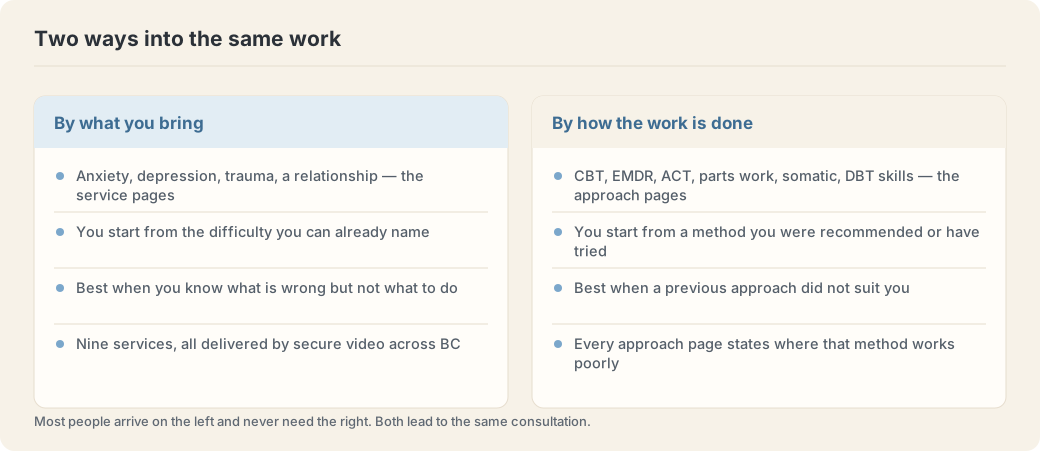

Who we see
Adults, young adults and teens, across British Columbia and, with Camille, anywhere in Canada. For a teen, a parent is usually part of the first conversation and the teen decides how much of the work is theirs alone; in BC a young person who understands the care can consent to it themselves under the Infants Act, and that is respected here. Several pages are written for a particular situation rather than a diagnosis: teens and young adults, university students, international students, new parents, healthcare and shift workers, truck drivers, first- and second-generation South Asian adults and the rest of the situations we write for. For anything else, the instant answers page holds every question the site answers.
How to tell which one you need
You do not have to arrive knowing. Most people do not, and working it out is a reasonable use of the first conversation rather than something to settle beforehand. That said, a few rough distinctions help.
Start with the problem, not the modality. Anxiety counselling and depression counselling are named for what you are experiencing. EMDR and the Gottman Method are named for how the work is done. They are approaches used within the others rather than separate destinations. If you know the difficulty but not the method, that is the right way round.
Individual or couples is usually the first real fork, and it is not always obvious, the comparison of the two sets out when each makes more sense, including when relationship difficulty is better addressed on your own.
Language and cultural context are not an add-on. Sessions in Punjabi and South Asian mental health work exist because for many people the alternative is spending a session translating rather than working. Not sure which of these fits? Five questions will suggest a starting point.
And if you are still deciding whether to do this at all, the counselling guides cover what therapy involves, and how to find a therapist in BC includes the free options worth trying first.
Practical detail
What every service has in common
Fully virtual, BC-wide
Secure video from anywhere in the province, see the areas served across BC.
English, Punjabi or Tagalog
Individual counselling in English, Punjabi or Tagalog; couples and EMDR therapy in English or Tagalog.
Free 15-minute start
Every service begins with a no-cost consultation, with no obligation afterward.
All sessions are provided by a Registered Clinical Counsellor, background and training here.
Choosing between them
Not sure which one you need?
Six service pages can imply six different things being sold, which is not how the work actually runs. Most of these overlap heavily, and a fair number of people end up doing two of them at once. The distinctions that genuinely matter are only three.
Who is in the room. Individual therapy and couples therapy are structurally different pieces of work with different assessments, not the same conversation with an extra chair. If you are not sure which your situation calls for, individual vs couples therapy walks through it, including the common case where only one of you wants to go.
What is being worked on. Anxiety, depression and trauma are three genuinely different jobs. Anxiety work is largely about interrupting avoidance; depression work often has to move from the outside in, because waiting for motivation is the trap; trauma work is sequenced, building capacity before anything is opened. That sequencing is not a preference, and what trauma actually means explains why rushing it is the most common way trauma therapy goes wrong.
Which method. EMDR is a specific eight-phase protocol rather than a general orientation, and it is the more direct route when a memory keeps firing in the present regardless of what you understand intellectually. CBT vs EMDR for trauma is the comparison most people arrive wanting.
Counselling in Punjabi and South Asian mental health are not a separate category of therapy. They are the same methods without the translation overhead, and without having to establish the family context from scratch. Online counselling is the delivery format every one of these uses.
If you are still not sure
Working out which service fits is genuinely part of the consultation rather than a prerequisite for it. Arriving and saying “I do not know which of these I need” is an entirely ordinary opening, and it is a faster route to an answer than another hour of reading. If you would rather read first, what happens in a first session and questions worth asking a therapist cover the ground properly, and the pages written for particular situations may be a better starting point than the service list. The FAQ covers cost, coverage and what a first session involves without reading a full page, and the approach pages are the place to start if what you want to understand is the method rather than the problem.
Every service on this page, anywhere in BC
None of the services above is limited by where you live. The practice is virtual and registered across British Columbia, so a session from Prince George is the same session as one from Surrey. What does change by location is what is available to you locally, and a few places have their own page because that gap changes what there is to say.
What is available locally in Punjabi is a separate question with a very different answer in most of the province. Those regions have their own pages, and the full provincial picture is on areas served.
Not sure where to start?
Book a free 15-minute consultation. We’ll figure it out together.
Book Free ConsultationNot ready to book? Send a line about what is going on. A reply comes within one business day, or read the guides first and come back when you want to.
Looking on behalf of someone else? What to send them, and what not to, including the funded routes most people do not know they qualify for.