Trust and transparency
How these pages are written and reviewed
This site publishes guides about mental health, which means it can do harm if it is careless. Here is the standard it holds itself to, so you can judge whether it meets it.
Last reviewed
Who writes and reviews this content
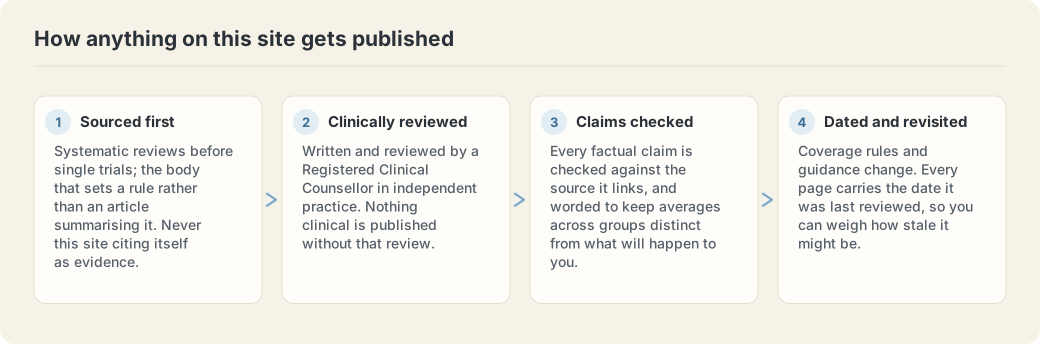
Every clinical page on this site. The services, the guides, the comparisons, the resource pages, is written and reviewed by a Registered Clinical Counsellor in independent practice in British Columbia. It is not outsourced to a content agency, and it is not published without clinical review.
One exception, stated rather than hidden: twenty-five pages written in Tagalog are live and have not yet been read by a Tagalog speaker. They were published on the practice’s decision, and until that review happens they should be read alongside the English pages they correspond to.
That is a statement about accountability, not authority. A counsellor writing about anxiety is not thereby correct about anxiety. The reason every substantive claim on this site carries a link to its source is so that the source, not the author, carries the weight.
What counts as a source here
Sources are ranked, and the ranking is applied consistently:
- Systematic reviews and meta-analyses first, Where a body of research exists, this site cites the synthesis rather than the single trial that agrees with it. A pooled result across many studies is a far better guide than one striking finding.
- Primary sources for facts about systems, Anything about coverage, regulation, wait times or eligibility links to the body that actually sets it. A health authority, a regulator, a government page, not to another article summarising it.
- No citing ourselves as evidence, Internal links point to other pages for context, never as the support for a factual claim.
- Nothing behind an unmarked paywall, Where a cited paper is not freely readable, the page says so or links an open version, so a reader can actually check the claim.
- Dates on everything, Coverage rules, wait times and regulation change. Every page carries the date it was last changed, and a clinical-review date as well where one exists, so you can weigh how stale it might be. The two are different claims and are not merged.
How claims are worded
Mental-health writing fails most often in its verbs. "Therapy cures anxiety" and "therapy has been found to reduce anxiety symptoms in controlled trials" are different claims, and only one is defensible.
This site tries to keep three distinctions visible: the difference between what research shows on average across groups and what will happen to you; the difference between an approach with strong evidence for one problem and an approach that is good for everything; and the difference between describing a pattern and diagnosing a person. Where the honest answer is "the evidence is mixed" or "nobody knows yet", the page says that instead of picking a side.
Guides also state their trade-offs. A page about online therapy that lists only advantages is an advertisement wearing a guide's clothing.
What this site will not publish
- Client testimonials or reviews, Prohibited under BCACC advertising standards, and for good reason, consent given inside a therapeutic relationship is not freely given. See standards and accountability.
- Fabricated case studies, No invented clients, no composite characters presented as real people, no "one client I worked with" stories.
- Self-diagnosis quizzes, A ten-question widget cannot assess anyone, and dressing one up as a screening tool implies a precision that does not exist.
- AI-generated clinical content published unreviewed, Drafting tools may assist with structure or editing. No clinical claim reaches this site without being checked against its source by a person who is accountable for it.
- Comparisons naming other practices, Pages here compare approaches, designations and delivery formats. They do not name competing clinics or counsellors, because a marketing page is not a fair forum for that.
- Keyword pages with nothing in them, This site does not publish a page per city or per keyword because the phrase gets searched. The rule for a location page is that it must say something specific to that place, its routes to care, its distances, the questions people there actually ask, rather than a city name swapped into a template. When a page has nothing specific to say, it is folded into one that does.
Corrections
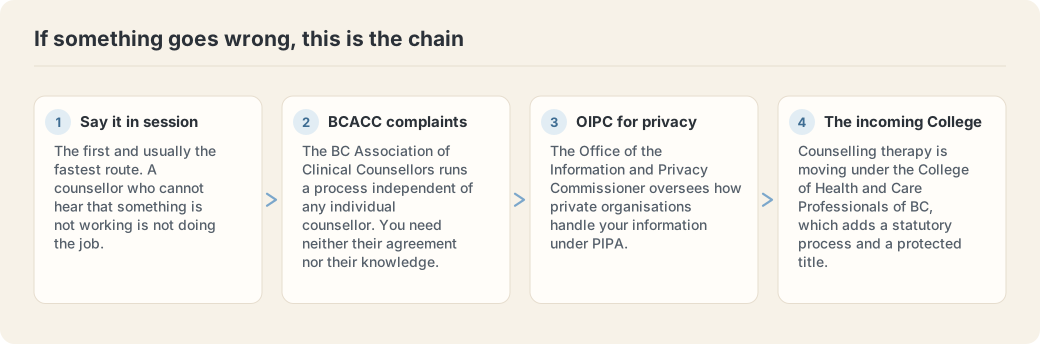
If something on this site is wrong. A broken fact, an out-of-date rule, a link that no longer supports the claim attached to it. The correct response is to fix it, and the practice would rather hear about it than not. Write to the address on the contact page.
Substantive corrections change the reviewed date on the page. Fixing a typo does not, because pretending a typo fix is a clinical review would make the dates meaningless.
Questions about any of this are fair game before you commit to anything, ask them in a free 15-minute consultation.
What this content is not
Nothing on this site is clinical advice, an assessment, or a diagnosis, and reading it does not create a counselling relationship. Guides are written to help you ask better questions and arrive at a first session better oriented, not to substitute for one.
If you are in crisis, no page is the right resource. Call or text 9-8-8 anywhere in Canada, twenty-four hours a day, or reach 310-6789 for BC Mental Health Support without an area code. In immediate danger, call 9-1-1.
How to read any health website critically
This applies to this site as much as to anywhere else, and it is worth having a checklist that does not depend on trusting the author.
Is there a date? Coverage rules, wait times, regulation and clinical guidance all change. A page with no date is asking you to assume it is current.
Are the claims sourced, and does the source say what the page says it says? Following one or two links is the fastest way to test a site's reliability. Pages that cite a study which does not support the claim attached to it are more common than people expect.
Does it distinguish averages from individuals? "Research finds X on average across studies" and "X will happen to you" are different claims, and blurring them is the most common failure in health writing.
Does it state any trade-offs? A page describing a treatment with no downsides, no limits and no situations where it is unsuitable is advertising.
Does it say what it does not know? Honest health content contains sentences like "the mechanism is not settled" and "the evidence is mixed", because that is the actual state of a great deal of the field.
Who benefits from you believing it? Not disqualifying. This site is written by a practice that would like you to book, but it is a reason to weight the sourced claims more heavily than the framing.
Applying that list to this site is encouraged rather than resented. Content that cannot survive being checked should not be relied on.
This page is general information about how the practice operates, not clinical or legal advice. If you are in crisis, call or text 9-8-8 (Canada, 24/7) or BC Mental Health Support at 310-6789.
Still deciding?
A free 15-minute consultation costs nothing and commits you to nothing. It is the fastest way to find out whether this is the right fit.
Book Free ConsultationNot ready to book? Send a line about what is going on. A reply comes within one business day, or read the guides first and come back when you want to.
Looking on behalf of someone else? What to send them, and what not to, including the funded routes most people do not know they qualify for.