Punjabi-Speaking Counselling
Punjabi-Speaking Counselling: You don't have to translate yourself.
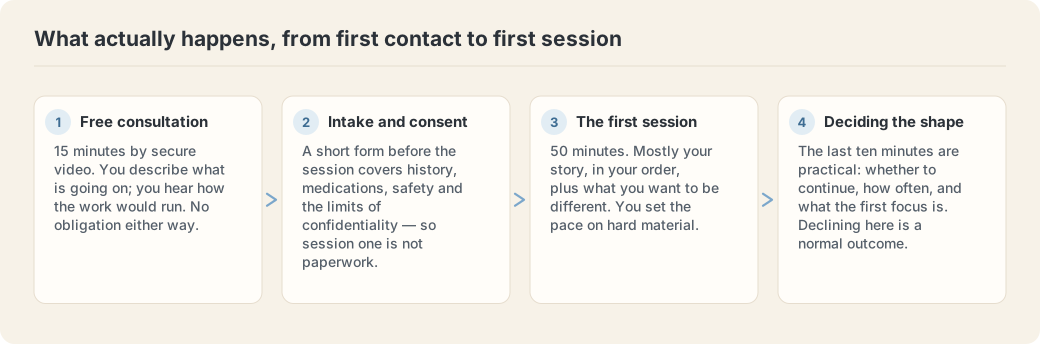
Counselling in Punjabi (ਪੰਜਾਬੀ) at Westpeak Wellness is with Savneet Singh, RCC, who works in English and Punjabi by secure video anywhere in British Columbia. Working in the language you think in removes the translation overhead from material that is difficult to say once, and means family context does not have to be explained from scratch. Individual sessions are available in Punjabi, and you can move between Punjabi and English within a session; couples counselling and EMDR currently run in English or Tagalog.
- 50 minutes per session
- Secure video sessions
- Free 15-min consult
- $140 per session
- Registered Clinical Counsellor · BCACC registered
Some things only land in your first language. Sessions are available in Punjabi, English, or a mix of both: with the cultural fluency to understand family expectations, generational silence, and "log kya kahenge" without needing it explained. Online across BC. There is also a full page in Punjabi (ਪੰਜਾਬੀ) covering services, fees and what a first session involves.
Updated
How do we approach it?
Sessions in Punjabi are with Savneet Singh, a Registered Clinical Counsellor who works in Punjabi and English. In her words, what family expects, what respect looks like and what silence means are not things you need to translate for her first; they are where the work starts. You won't have to justify your context to be understood.
Why first language matters even when your English is fluent
People who work, study and socialise in English often assume Punjabi-language therapy is not meant for them. In practice, the language you are fluent in and the language your feelings live in are frequently not the same one.
You can be entirely comfortable presenting in a boardroom and still find that the words for grief, shame, obligation, or the exact texture of a family argument only exist properly in Punjabi. Some things flatten in translation, starting with the word for counselling itself, which what counselling means in Punjabi unpacks. And if you spend a session translating, you spend it one step removed from what you actually feel, describing the emotion rather than being in it.
There is also the effort you never have to spend. Explaining what log kya kahenge means, why moving out is not simple, why a parent's disappointment carries the weight it does. That is twenty minutes of every session recovered, and more importantly it removes the low-level work of translating yourself to be understood.
Who you would see for Punjabi-speaking counselling
Taking new clients and seeing people across BC by secure video. Each is a Registered Clinical Counsellor; the registration is on the profile and can be checked on the BCACC register.

Savneet Singh, RCC
English and Punjabi · Anxiety, Depression, Trauma and attachment
In her words: “Comforting, safe and supportive, is what I aim for.”
Might be a fit if
What people tend to arrive with
You switch languages when it gets real
English for the account of what happened, Punjabi for what it did to you. Sessions here can move between them mid-sentence.
You are the first in your family to do this
No template, nobody to ask, and often not telling anyone you are going.
Family expectation is the actual subject
Career, marriage, money, obligation, and the guilt attached to choosing for yourself.
Previous therapy missed the point
Advice to set boundaries or move out that made sense in the abstract and none at all in your family.
Silence around mental health at home
A household where distress was met with practicality, prayer, or nothing, usually not cruelty, but a generation with no language for it.
Privacy is the barrier, not stigma
The concern is who might see you at a local clinic. Virtual sessions remove the question entirely.
Recognise several of these? A free 15-minute consultation is the least committal way to find out whether this is the right approach, including if the answer turns out to be something else.
How sessions work
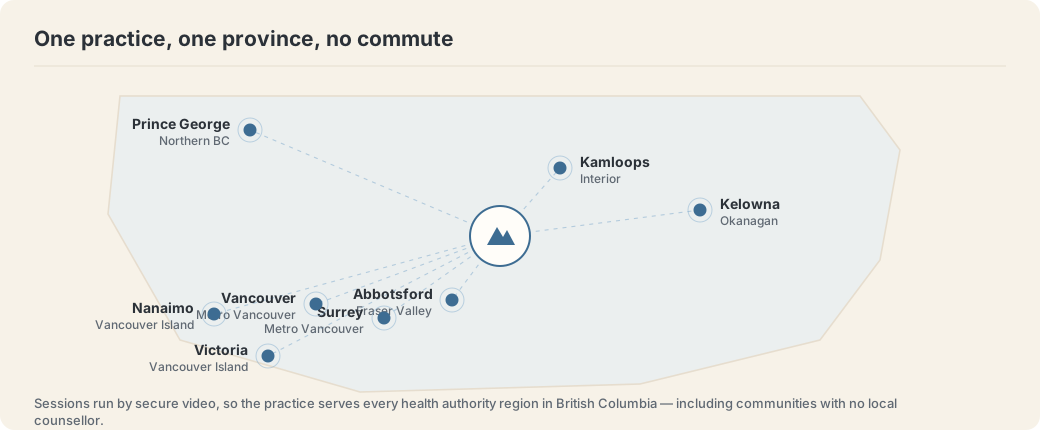
Sessions run in Punjabi, in English, or moving between them. You do not have to decide in advance, and most people end up doing both without planning it. Sessions are 50 minutes, fully virtual, anywhere in British Columbia.
That province-wide reach matters here. Availability of Punjabi-speaking counsellors, and their openings, varies from place to place, and BCACC’s Find a Counsellor directory filters by language if you would like to see who is listed near you. By video, the session works the same in the Interior, the North or on the Island as in Surrey. Punjabi counselling in Kelowna and Punjabi counselling in Prince George set out the local picture, census figures included.
On what the work is not: it is not therapy that treats your family as the diagnosis and distance as the cure. Most people arriving here want something harder, to stay in relationship with their family and stop carrying the parts that are not theirs. That is a legitimate goal and it is workable, and any decision about distance stays yours.
On confidentiality: nothing is shared with your family without your consent, and because sessions are virtual there is no clinic to be seen entering. The only limits are risk of serious harm to you or someone else, a child or vulnerable adult at risk of abuse or neglect, or a court order.
Questions
More on how this work runs
What changes when the session runs in Punjabi
The practical difference is larger than "convenience", and it shows up in three specific places.
Emotional vocabulary does not translate cleanly. A great deal of what people bring to counselling was originally encoded in a particular language. The exact phrasing a parent used, the specific weight of an obligation, the joke that was not a joke. Rendering that into English while simultaneously feeling it is genuinely demanding cognitive work, and it flattens the material. People frequently notice they are describing an event rather than being in it.
Context does not have to be built from scratch. Explaining why a decision that looks straightforward from outside is not straightforward inside a family can take two or three sessions with a counsellor who does not share that context. Those are sessions you have paid for and spent on background rather than on the difficulty itself.
Code-switching is itself information. Bilingual clients often move between languages at particular moments: English for the analytical account, Punjabi for the parts with more feeling attached, or the reverse. Where that happens is clinically useful, and it requires a counsellor who can follow both.
A necessary caveat: shared language is not the same as shared experience, and shared background is not the same as knowing your family. Assumptions about what a particular arrangement means, or what a family expects, get checked out loud rather than acted on. The advantage is that the checking starts from a much closer position.
Sessions run in whichever language suits, including moving between them within a session. Couples work currently runs in English or Tagalog, so sessions for the two of you together are in one of those; either partner can still have individual sessions in Punjabi alongside them.
The specific binds that come up most
- Obligation that is genuinely reciprocal, Much popular advice treats family obligation as a boundary problem to be dismantled. In families where care ran in both directions, and where parents made real sacrifices, that framing is both inaccurate and insulting. The workable question is which obligations you endorse and what they cost, not how to have fewer.
- Being the outcome of a migration, Carrying a family's hopes is not a metaphor when a specific set of people gave up a specific life so that you would have this one. It produces achievement, and it produces a version of failure that feels like a debt unpaid.
- Reputation as a shared asset, Where a family's standing is genuinely collective, a personal decision is not a personal decision. That is a real constraint rather than a distortion, and it is not solved by being told to stop caring what people think.
- Mental health as a family exposure, The reluctance is frequently not about stigma in the abstract but about a concrete concern: what it would mean for a sibling's prospects, or for how the family is regarded. Naming that specifically makes it discussable.
- Two sets of expectations at once, Meeting a Canadian workplace's expectations about assertiveness and a family's expectations about deference, daily, without either being wrong. That is exhausting in a way neither context recognises.
- Grief across distance, Losing someone in another country, unable to be present, and arriving late to a mourning that has already happened without you.
What cultural competence should and should not mean
The phrase gets used loosely enough to be worth defining, because the version that helps and the version that irritates look similar from outside.
What it should mean is that the context does not have to be explained from scratch. That you do not spend twenty minutes establishing why a decision that looks straightforward is not. That references land. That a counsellor understands obligation as something other than dysfunction, and does not treat a family structure as a problem to be dismantled.
What it should not mean is a counsellor who believes they already know your family. Communities are not uniform, and assumptions about religion, region, migration history, class or generation are frequently wrong in ways that are difficult to correct once stated with confidence.
The working version is closer to cultural humility than cultural expertise: a starting position considerably closer to yours, combined with a habit of checking rather than assuming. In practice that sounds like "in some families that would mean X, is that how it works in yours?" rather than a confident account of your situation.
It also means being able to hold two things at once: that a cultural expectation can be genuinely valuable to you and genuinely costly, without a counsellor pushing you toward either abandoning it or accepting it. That is the specific thing people most often report not getting elsewhere.
Bringing family into it, or not
A question that comes up often: should a parent, spouse or sibling be part of this? There is no default answer, and the considerations are worth setting out.
Reasons it can help. Where the difficulty is genuinely relational and both people are willing, a session together can move something that months of individual work cannot. Where an older family member holds crucial history, their account can be genuinely clarifying. And in families where the individual seeking help is assumed to be the problem, a joint session sometimes redistributes that framing usefully.
Reasons to be cautious. Once a family member is in the room, what you can say changes, and it does not always change back. Where there is a significant power imbalance, a joint session can reproduce it rather than address it. And where the difficulty is partly about the freedom to have your own view, importing the audience defeats the purpose.
The practical position taken here is that individual work is the default, joint sessions are possible and are planned deliberately rather than arranged casually, and nothing about your individual sessions is disclosed in a joint one without your agreement.
It is also worth saying that supporting a family member without them attending is legitimate work in itself, see how to support someone who is struggling.
Before you book
What is counselling called in Punjabi?
Most often it is simply written ਕਾਊਂਸਲਿੰਗ, the English word in Gurmukhi, and that is the word this site's Punjabi pages use. The older word ਸਲਾਹ means advice, which is close but not the same thing: counselling is not somebody telling you what to do. Sessions here can be entirely in Punjabi, entirely in English, or the mix most families actually speak.
What does burnout mean in Punjabi?
There is no single Punjabi word for it. The Punjabi guides on this site describe it as a ਥਕਾਵਟ, an exhaustion, that rest does not fix, usually from work or from caring for others, and that is the honest definition in any language. If that describes you, the burnout-or-depression check on this site takes two minutes and is written in plain English.
How do I find a Punjabi-speaking counsellor in BC?
Filter BCACC’s Find a Counsellor directory by language, then check the name on the RCC Register before the first session. The free Punjabi-speaking options, each with the date it was checked, and the steps in order are on our guide to finding a Punjabi- or Tagalog-speaking counsellor in BC. At this practice, Savneet Singh works in Punjabi and English by video.
Is there a Punjabi-speaking therapist near me?
Sessions here are by secure video, so they work from any private room in British Columbia, with Savneet Singh, RCC, who works in English and Punjabi. The first 15-minute consultation is free. If you would rather see someone in person, BCACC’s Find a Counsellor directory filters by language and city; availability and openings vary.
Do you offer counselling in Hindi or Urdu?
Not at present. Sessions here are in English, Tagalog or Punjabi. BCACC’s Find a Counsellor directory filters by language, so it is the place to look for a counsellor who works in Hindi or Urdu; availability and openings vary.
What does counselling in Punjabi cost, and is it covered?
An individual session in Punjabi is $140 for 50 minutes, the same fee as in English, after a free 15-minute consultation. MSP does not cover private counselling. Many extended health plans reimburse a Registered Clinical Counsellor, depending on the plan, so check yours. This practice is pay-and-submit: you pay at booking and submit the receipt, which carries the counsellor’s registration number, to your plan. Does my plan cover counselling? gives the one question to ask your insurer.
Do sessions have to be entirely in Punjabi?
No. Most people move between Punjabi and English within a single session, which is how a lot of people actually think. You do not have to choose a language in advance or stick to it.
Will my family find out?
Not without your written consent. Counselling is confidential and whether you tell anyone is your decision; the only exceptions are the legal ones: risk of serious harm to you or someone else, a child or vulnerable adult at risk of abuse or neglect, or a court order. Virtual sessions mean there is no waiting room and no building, which for many people here is the deciding factor.
Will I be told to cut off my family?
No. That framing misreads the situation for most people. The work is usually about staying connected while stopping carrying what is not yours.
My parents think therapy is for serious problems. Are they wrong?
They are describing a generation's understanding of it, formed when the only visible mental-health care was for crisis. Most therapy is ordinary people working on ordinary difficulty before it becomes serious.
More in the full FAQ, or see fees and extended health coverage.
Explore more
Other ways we can work together
Individual Therapy
1:1 for anxiety, depression, life transitions, identity, family dynamics.
Individual Therapy in BCKeep going
Other counselling services
ਮੁਫ਼ਤ ਸਲਾਹ-ਮਸ਼ਵਰਾ ਬੁੱਕ ਕਰੋ
Book a free 15-minute consultation: in Punjabi, English, or both. No pressure, and no obligation afterward.
Book Free ConsultationNot ready to book? Send a line about what is going on. A reply comes within one business day, or read the guides first and come back when you want to.
Looking on behalf of someone else? What to send them, and what not to, including the funded routes most people do not know they qualify for.