Compare · Paying for it
Your EAP (or EFAP) vs a private counsellor
An employee and family assistance programme gives you a small number of free sessions, usually starting within days, from a counsellor assigned out of a contracted network. Private counselling costs money and gives you choice of counsellor, no session cap, and continuity. For a bounded difficulty, an EFAP is often enough; for anything long-standing, the cap tends to arrive at the point where the work is getting somewhere.
A free, fast option and a paid, open-ended one. Most people should probably use both, and in a particular order.
7 min read · Updated
| EFAP | Private counselling | |
|---|---|---|
| Cost to you | Free, employer funded | Session fee, often partly reimbursed by extended health |
| Wait to first session | Usually days | Usually days to a couple of weeks |
| Number of sessions | Capped, commonly a handful per issue per year | No cap |
| Choice of counsellor | Usually assigned from a network | You choose, and can change |
| Continuity after the cap | Ends, or transfers elsewhere | Continuous |
| Specialisation | Whoever the network has available | You can select for method or population |
| Employer visibility | Aggregate usage data only; not your content | None at all |
| Best suited to | A defined, recent, bounded difficulty | Long-standing patterns, trauma, couples work |
What is an EFAP, actually?
An employee and family assistance programme is a service your employer buys from a third-party provider. It typically covers short-term counselling for employees and often for household family members, along with things like legal information, financial advice and referral services. It is paid for by the employer and free at the point of use.
The counselling component is deliberately short-term. The specific number varies by contract, commonly somewhere in the range of a few sessions per issue per year, and it is worth phoning to establish your exact entitlement rather than relying on what a colleague told you.
The confidentiality question is the one people worry about most. Providers report aggregate usage to the employer, how many people used the service, not who used it or what was discussed. Clinical confidentiality applies as it does anywhere, with the same legal exceptions. It is a fair thing to ask the provider to confirm directly when you call.
Where the cap bites
Short-term counselling is useful for a specific, recent, bounded problem: a difficult decision, a workplace conflict, an acute period of stress, an early grief. Six sessions can resolve a great deal when the target is clear.
The difficulty arrives when the presenting problem turns out to be the visible part of something older. A pattern that formed in childhood, complex trauma, a relationship in genuine trouble. These do not conclude in six sessions, and the cap frequently arrives at exactly the point where trust has been established and the real work is starting.
That is not a criticism of the model, which was never designed for long-term work. It is a reason to know the cap at the start rather than discovering it at session five, and to plan for what happens afterwards.
The order that usually works best
- Start with the EFAP if you have one, It is free and it is fast. If the problem is bounded, you may need nothing else, and you will have lost nothing by finding out.
- Ask about the cap in the first call, How many sessions, per issue or per year, and what happens at the end. Knowing shapes how the time is used.
- Say what you want in session one, Short-term work rewards a clear target. Spending two of six sessions establishing what you are working on is expensive.
- Ask for a transfer summary at the end, If you continue elsewhere, a summary means you are not starting over. You are entitled to ask.
- Move to private for anything long-term, Trauma work, couples work and long-standing patterns need continuity with one counsellor. Starting that inside a capped programme means changing counsellor mid-course, which is the worst of both.
Where private counselling earns its cost
- You choose the counsellor, Method, population, language. Being able to select for a specific approach or for sessions in Punjabi is not available in most assigned-network models.
- No cap, no cliff edge, The work ends when it is finished rather than when the contract runs out.
- Continuity with one person, For trauma work in particular, changing counsellor partway is costly. One relationship across the whole course of work matters more here than almost anywhere else.
- No employer involvement of any kind, Not even aggregate. For people who are uneasy about using a benefit their employer purchased, that is a real consideration.
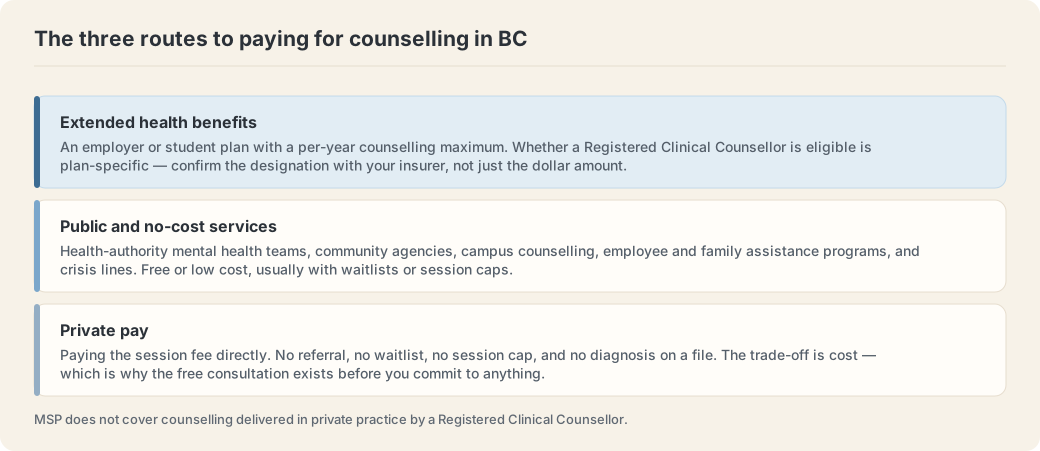
- Often partly covered anyway, Many extended health plans reimburse counselling separately from the EFAP, which means you may effectively have two pools. See extended health coverage in BC.
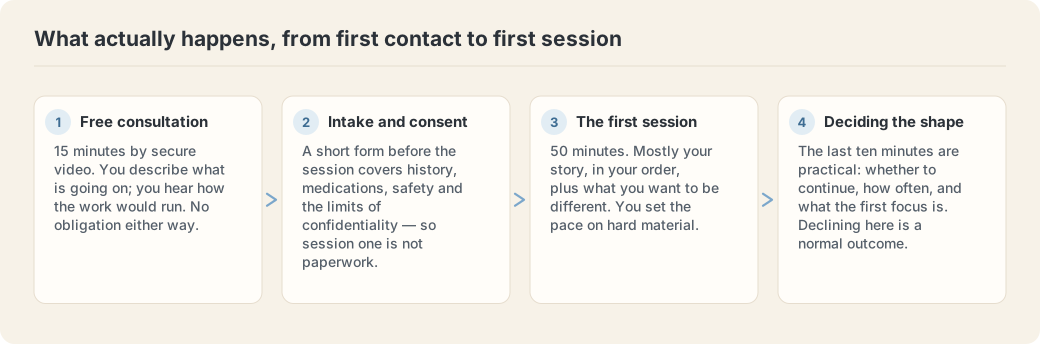
If your EFAP sessions have run out and the work was not finished, a free 15-minute consultation is a straightforward next step.
If you have neither
Not everyone has an EFAP or extended health, and private fees are a real barrier rather than a rhetorical one. There is more available than most people are told: health-authority mental-health services, community agencies, campus counselling for students, and free structured programmes for low mood and anxiety.
Low-cost counselling in BC sets out the routes, and what to do while you wait covers the interval, which is often the harder part.
And regardless of coverage, the crisis services are free and immediate: 9-8-8 by call or text anywhere in Canada, or 310-6789 for BC Mental Health Support.
Getting the most out of a capped programme
If you have six sessions, the difference between using them well and using them badly is substantial, and most of it is decided in the first appointment.
Name the target in session one. Short-term work rewards a specific goal. Spending two of six sessions establishing what you are working on is a quarter of the entitlement gone. Arriving with "I want to be able to do X" is worth a great deal.
Ask about the cap immediately. Exactly how many sessions, per issue or per year, and what happens at the end. Providers will tell you; people rarely ask, and then discover the boundary at session five.
Say plainly that the time is limited. A counsellor who knows they have six sessions works differently from one who assumes an open horizon: more structured, more focused, more likely to give you something to continue with.
Ask for a written summary at the end. What was worked on, what helped, what remains. It costs the counsellor ten minutes and it is what turns a handover into a continuation rather than a restart.
Do not start deep trauma work inside the cap. It is the one thing genuinely ill-suited to a short-term programme, because the stabilisation phase alone can consume the whole entitlement and stopping midway is worse than not starting. Use the sessions for stabilisation and planning, and do the processing somewhere with continuity.
What to do when the sessions run out mid-work
The most predictable failure point in a capped programme is reaching session six with the work half done. There are better and worse ways to handle it, and the difference is largely about acting before you get there.
Raise it at session three, not session six. A counsellor who knows the cap is approaching can shift toward consolidation, making sure you leave with something usable rather than mid-excavation. Left to the last session, that is not possible.
Ask what happens at the end. Some programmes allow an extension for a new issue, some allow a fresh allocation in a new benefit year, and some can refer you into a longer-term service. Providers do not always volunteer this.
Get a written summary. What was worked on, what helped, what remains, and what the counsellor would recommend next. It is the difference between resuming and restarting, and it can save several sessions of history-taking wherever you go next.
Check whether your extended health is a separate pool. Many people have both an EFAP and a counselling benefit under their health plan, and treating them as one entitlement leaves money unused, see extended health coverage in BC.
And do not restart from zero. Bring the summary, say what was covered and where it stopped. A new counsellor with that information moves considerably faster than one starting cold.
Where Westpeak Wellness fits
This practice is private and is not part of any EFAP network. If you have an EFAP and your difficulty is bounded, using it first is genuinely the sensible move and a consultation here will say so.
Where an EFAP has run out partway through something that needs longer, continuing privately is common. Ask your EFAP counsellor for a transfer summary so the work resumes rather than restarts.
Sessions are paid by card when you book, with a receipt showing the RCC registration number for your insurer. Whether your plan reimburses a Registered Clinical Counsellor is worth confirming before you book, see the fees page.
Common questions
Will my employer know I used the EFAP?
Providers report aggregate usage numbers, not identities or content. Clinical confidentiality applies with the same legal exceptions as anywhere. Ask the provider to confirm their specific policy when you call.
Can I use my EFAP and extended health benefits both?
Usually yes. They are typically separate entitlements. Check your benefits booklet or ask your plan administrator.
Can I choose my EFAP counsellor?
Sometimes, within the contracted network. It is worth asking, particularly if you need a specific language or approach.
Does using an EFAP affect my employment record?
No. It is a benefit, not a disclosure, and your employer does not receive information about individual use.
How many sessions does an EAP usually cover, and what happens when they run out?
It varies by contract, commonly a few sessions per issue per year, so phone the provider and ask for your exact entitlement before the first session. When they run out, ask your EAP counsellor for a transfer summary so the work resumes rather than restarts, then continue privately or through an extended health plan, if yours reimburses a Registered Clinical Counsellor; many do, depending on the plan. Sessions here are paid by card when you book, with a receipt showing the RCC registration number for your insurer.
Is an EAP the same as therapy?
Not quite. An EAP gives you short-term counselling from a counsellor assigned out of a contracted network, aimed at a defined, recent difficulty. Therapy with a private counsellor is open-ended, with a counsellor you choose and can stay with for the whole course of the work. Which fits depends on whether the difficulty is bounded, and the two can be used in that order: the EAP first, then privately if the work needs longer.
Sources
- Canadian Mental Health Association, BC Division
- BC government, mental health and substance use support
- BC Association of Clinical Counsellors
General information, not clinical or legal advice. Fee ranges are typical BC private-practice ranges and vary by practitioner. Confirm any practitioner’s registration directly with the relevant college or association.
Individual sessions are $140 for 50 minutes, after a free 15-minute consultation; card at booking.
Many extended health plans reimburse a Registered Clinical Counsellor, depending on the plan, so check yours; MSP does not cover private counselling. All fees.
Talk it through before you commit.
A free 15-minute consultation, including an honest answer if what you need is someone other than an RCC.
Book Free ConsultationNot ready to book? Send a line about what is going on. A reply comes within one business day.
Or a smaller step: What counselling costs in BC · What sessions cost · What the free 15 minutes is like
Looking on behalf of someone else? What to send them, and what not to, including the funded routes most people do not know they qualify for.
Where you are
Online counselling across British Columbia
Every session is by secure video, so the counsellor you see does not depend on where you live. Each city page covers coverage, local public services and who is taking new clients there.