Trust and transparency
Standards, ethics and accountability
Anyone in British Columbia can call themselves a counsellor. This page sets out what this practice is actually accountable to, and how you can check it without taking anyone at their word.
Last reviewed
The registration behind the practice
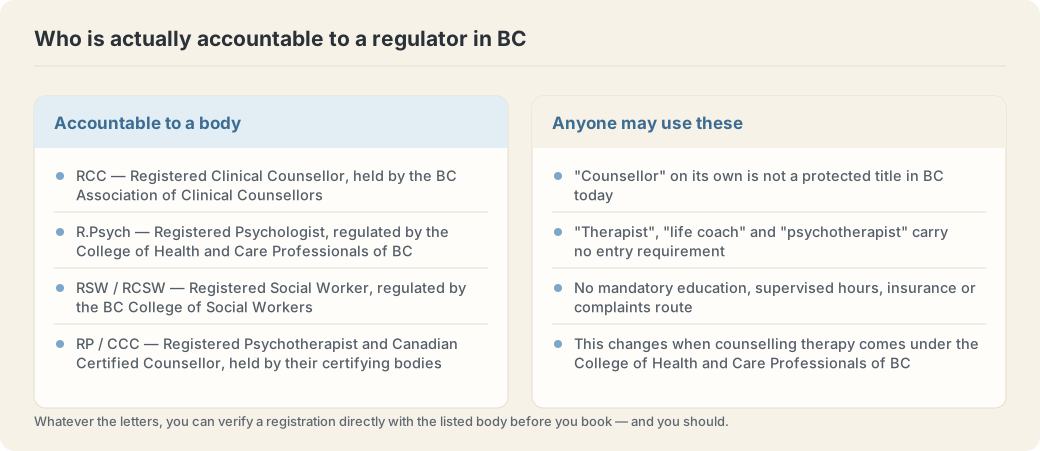
Sessions at Westpeak Wellness are provided by a Registered Clinical Counsellor (RCC), a designation held through the BC Association of Clinical Counsellors, which requires a master's degree in counselling or a closely related field, supervised clinical hours, continuing education, professional liability insurance, and adherence to a published code of ethics.
The important part is not the letters. It is that the letters come with somewhere to complain. An RCC who behaves unethically can be investigated and can lose the designation. Someone using the unprotected word "counsellor" cannot lose anything, because there is nothing to lose.
You can verify any RCC's standing directly through the BCACC register. You do not need permission to do that, and you should do it before booking with anybody, here or anywhere else.
What is changing in BC regulation
The Health Professions and Occupations Act has been in force in British Columbia since 1 April 2026. Under it, psychotherapy becomes a regulated profession on 29 November 2027, licensed by the College of Health and Care Professionals of BC, the same regulator that already oversees psychologists and several other professions. From that date there is a statutory complaints process, and "psychotherapist" is the protected title: only someone licensed by the College may use it.
"Counsellor" stays unprotected, before and after that date, as does "counselling therapist". Anyone may still call themselves a counsellor, which is why the question to ask is not what someone is called but who they answer to.
Until 29 November 2027, the association route, the RCC designation and the BCACC code of ethics, is the accountability structure that actually exists. This practice intends to seek licensure with the College when it opens, and this page will be updated when that happens rather than quietly changed.
If you want the fuller picture of what the different designations mean in practice, the comparison of RCC, psychologist and social worker sets them side by side.
Scope of practice, what this practice does not do
A page that only lists what a practice offers is only half the information. These are the deliberate limits:
- No diagnosis, A Registered Clinical Counsellor does not diagnose mental disorders. If you need a formal diagnosis, for a disability claim, an accommodation, a medication decision. That requires a physician, psychiatrist or registered psychologist.
- No prescribing, Counsellors do not prescribe or adjust medication. Where medication is part of the picture, the work runs alongside your prescriber rather than instead of them.
- No formal psychological assessment, Psychoeducational assessments, ADHD or autism assessments, and cognitive testing all require a registered psychologist. This practice can point you toward the right assessor.
- No court-ordered or forensic work, This practice does not conduct custody evaluations, parenting assessments, or any assessment intended for use as evidence. Mixing a therapeutic relationship with an evaluative one damages both.
- Not a crisis service, Sessions are scheduled. There is no 24-hour on-call line. If you are in immediate danger, call 9-1-1; for urgent mental-health support call or text 9-8-8, or reach BC Mental Health Support at 310-6789, any hour, no area code needed.
- Not a fit for every presentation, Active psychosis, an eating disorder needing medical monitoring, or a substance dependence needing withdrawal management are better served by a specialised team. Saying so during the free consultation is a normal outcome, not a rejection.
The ethical commitments that shape sessions
- Informed consent is ongoing, You are told what an approach involves and what it may stir up before it starts, and you can decline or stop any intervention at any point without having to justify it.
- Confidentiality, and its real limits, What you say stays in the room, with the legally required exceptions: risk of serious harm to yourself or an identifiable other, suspected abuse or neglect of a child or vulnerable adult, and a court order. These are named in writing before the first session, not discovered later.
- No dual relationships, Counsellors do not take on clients they have another significant relationship with: social, business, or otherwise, because the second relationship compromises the first.
- Cultural humility over cultural expertise, Shared language and shared context help, but they are not the same as knowing your family. Assumptions get checked out loud rather than acted on.
- No guarantees, ever, Counselling that promises a result is misrepresenting itself. What can honestly be offered is a method with evidence behind it, applied carefully, reviewed openly, and changed when it is not working.
If something goes wrong
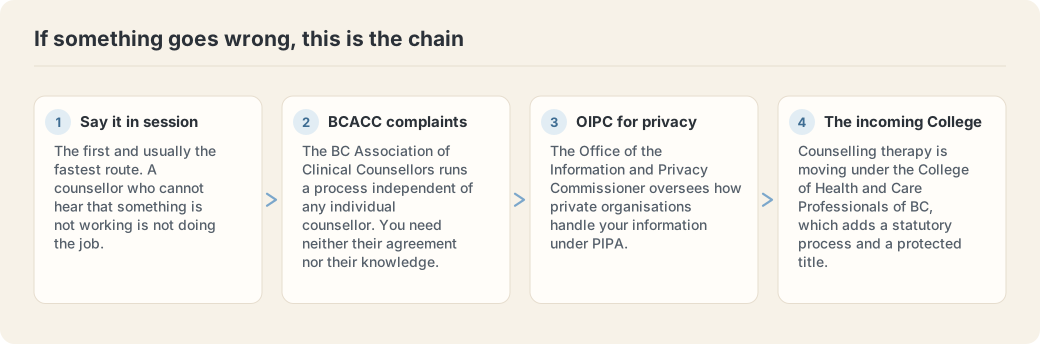
The first route is the simplest one: say so in session. A counsellor who cannot hear that something is not working is not doing the job. Plans get changed, approaches get dropped, and a referral elsewhere is always an available answer.
If that is not possible or not enough, you can raise a concern directly with the BC Association of Clinical Counsellors, which administers a complaints process independent of any individual counsellor. You do not need the counsellor's agreement or knowledge to do that.
A complaint about an RCC goes to BCACC, not to this practice, and the practice does not stand between you and BCACC.BCACC’s complaints and investigations page sets out how to file. The process runs mostly in writing, BCACC shares the complaint with the counsellor, and the counsellor must respond to BCACC in writing. It covers incidents within the last five years. To confirm a counsellor is an RCC before you file, or at any time, search the RCC Register by name or registration number.
If any part of this site or of a session is unusable with your assistive technology, the accessibility statement sets out what has been tested and what has not, and how to report a problem. For privacy-specific concerns: how your information was collected, used, stored or disclosed, the Office of the Information and Privacy Commissioner for British Columbia oversees private-sector organisations under the Personal Information Protection Act. See the privacy page for how information is handled here.
Questions about any of this are fair game before you commit to anything, ask them in a free 15-minute consultation.
Advertising standards this site is held to
Counselling advertising in BC is governed by the same ethical code as the clinical work. In practice that rules out a set of things this site will never do, whatever the marketing benefit:
- No testimonials or reviews, Soliciting testimonials from current or former counselling clients is prohibited under BCACC advertising standards, because a person in a therapeutic relationship cannot give uncoerced consent to be used as marketing. You will find none on this site, not because there is nothing good to say, but because publishing it would be unethical. What this practice publishes instead of reviews, and the reasoning behind it, is set out in full.
- No invented case studies, Composite or fictional client stories presented as real are misrepresentation. Where this site describes what tends to come up, it is describing patterns, not people.
- No outcome claims, No success rates, no "proven results", no before-and-after framing. Nothing on this site claims to cure, fix or guarantee.
- No fear-based urgency, No countdown offers, no scarcity language, no implication that delay will make things worse. If a page pressures you, it is selling rather than informing.
- Sources you can check, Where a page makes a factual claim about research, coverage or regulation, it links the primary source so you can read it yourself and disagree.
What to do if you are unsure whether something crossed a line
Most concerns about a counsellor are not dramatic. They are a persistent unease that something is slightly off, and people generally talk themselves out of it because they cannot name a rule that was broken.
A few things are worth knowing as reference points. A counsellor should not be a significant part of your life outside the room: social contact, business dealings, or a friendship developing alongside the work all compromise it, and the responsibility for maintaining that boundary is entirely theirs rather than yours.
Self-disclosure should be occasional and in your service. A counsellor mentioning something relevant is normal. A pattern of you attending to their difficulties is not, and it is one of the more common quiet boundary failures.
Sessions should start and end when they are supposed to, and repeated lateness or cancellation without notice is a professional issue rather than an inevitability.
Any sexual contact or romantic relationship with a client is prohibited, without exception, and remains prohibited after the work ends.
Fees should be agreed in advance and should not change without notice.
If something on that list is happening, or if something not on it is bothering you persistently, the first step is to raise it directly. If you cannot, or if raising it goes badly, the BC Association of Clinical Counsellors administers a complaints process independent of any individual counsellor, and you do not need that counsellor's knowledge or agreement to use it.
Sources
- BC Association of Clinical Counsellors, code of ethics and standards of clinical practice
- College of Health and Care Professionals of BC, regulating psychotherapy
- BC Government, Regulation of Psychotherapy Q&A (updated 27 August 2026)
- Office of the Information and Privacy Commissioner for BC
This page is general information about how the practice operates, not clinical or legal advice. If you are in crisis, call or text 9-8-8 (Canada, 24/7) or BC Mental Health Support at 310-6789.
Still deciding?
A free 15-minute consultation costs nothing and commits you to nothing. It is the fastest way to find out whether this is the right fit.
Book Free ConsultationNot ready to book? Send a line about what is going on. A reply comes within one business day, or read the guides first and come back when you want to.
Looking on behalf of someone else? What to send them, and what not to, including the funded routes most people do not know they qualify for.