Trust and transparency
Accessibility of this site and of sessions
Accessibility statements are usually written to be filed rather than read. This one names what has actually been done, and what has not.
Last reviewed
How this website is built
- Keyboard navigable throughout, Every link, button and expandable section can be reached and operated without a mouse, with a visible focus outline that is never removed for aesthetics.
- A skip link on every page, The first thing a keyboard or screen-reader user reaches is a link that jumps past the navigation straight to the main content.
- Real headings in real order, One H1 per page, no skipped levels, and headings used for structure rather than for making text bigger, which is what lets a screen reader offer a usable outline of the page.
- Text alternatives for every diagram, Each illustration on this site carries a written description of what the diagram shows, not a restatement of its caption. The description is stored with the artwork itself so the two cannot drift apart.
- Contrast and text sizing, Body text is deliberately larger than the web default, colour is never the only way information is conveyed, and text reflows rather than breaking when you zoom.
- Motion is opt-out by default, The site honours the operating-system "reduce motion" setting, and there is no autoplaying video, carousel or animation to disable in the first place.
- Wide diagrams scroll rather than shrink, On a phone, a wide diagram scrolls sideways inside its own box at a readable size instead of being squeezed until its labels are illegible. The page itself never scrolls sideways.
- Fast on a slow connection, Pages are prerendered HTML. The only third-party code is the booking calendar, which loads on /book when you ask for it, and Google Analytics, which loads only if you consent. That matters most on rural and mobile connections, a meaningful accessibility issue in much of British Columbia.
Accommodations in sessions
- Camera off, You are never required to be on camera to be in a session. It suits camera fatigue, lower bandwidth, and anyone who thinks better without being watched.
- Sessions in Punjabi, Working in the language you think in is an access issue, not a preference. Savneet Singh works in Punjabi. See Punjabi counselling.
- Sessions in Tagalog, The same holds for Tagalog: Camille Granda works in Tagalog and English. See Tagalog-speaking counselling.
- Pacing and breaks, Sessions can be paused, shortened, or restructured. For trauma work in particular, pacing is a clinical decision made with you rather than to you.
- Written summaries on request, Where it helps: memory difficulty, attention difficulty, or preferring things in writing, key points and between-session plans can be sent in writing afterward.
- Scheduling, Times depend on the counsellor, and the booking page shows what is open.
What this practice cannot currently offer
Naming the gaps is the part that makes the rest of the page credible:
- No ASL interpretation arranged in-house, This practice does not currently retain ASL interpreters. If you need one, say so during the consultation and the practice will work with you on arranging it or referring you to a service that provides it directly.
- Languages other than English, Punjabi and Tagalog, Sessions run in English, Punjabi or Tagalog only, and which of the three depends on which counsellor you see. The counsellors page says who works in what. Third-party interpretation changes the therapeutic relationship enough that it is worth discussing openly rather than assuming it will work.
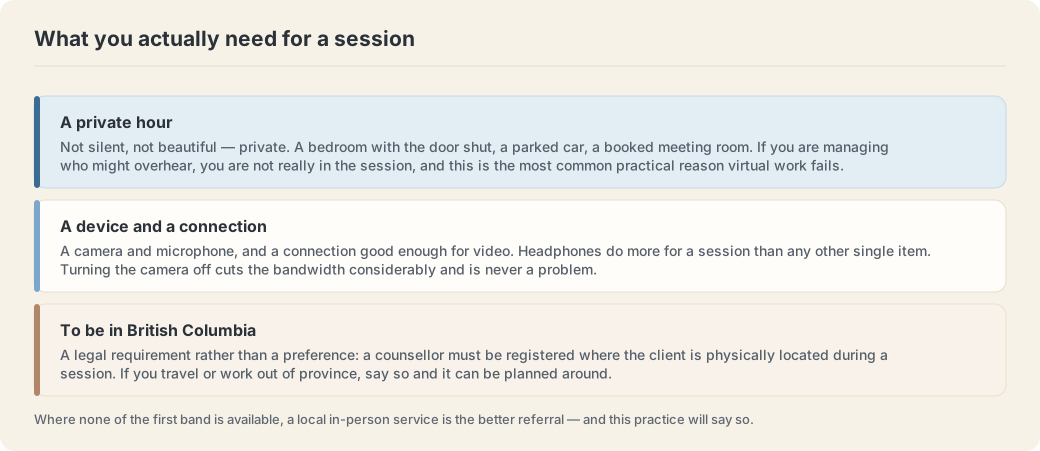
- No in-person option at all, This is a fully virtual practice. For someone without private space, a reliable device, or an internet connection, that is a genuine barrier, and in that case a local in-person service is the better referral. The BC resources directory lists starting points.
- No screen-reader testing has been done, This is the honest version of a sentence that used to say the opposite. The site is built to WCAG 2.1 AA principles and a great deal is checked automatically on every deploy. Every prerendered page, and the booking, fees, contact, search and sign-in pages, which are asked of the running site because they are built on request, is checked for a language declaration, a single main heading, a working skip link, labelled form fields, images with text alternatives, titled frames and a sensible heading order; on those request-built pages, links that open a new tab must also say so. Every colour pair is checked for contrast. Reflow was checked by measurement: no page scrolls sideways at a 320-pixel width, and doubling the text size loses no content. What has NOT happened is somebody sitting down with a screen reader and using this site. Automated checks find broken markup; they cannot tell you whether a page makes sense when heard, and claiming otherwise on the one page people rely on would be the worst place on this site to be inaccurate.
- This site has not had a formal third-party audit, No external certification has been obtained. Saying "WCAG compliant" without an audit would be a claim this practice cannot support.
Questions about any of this are fair game before you commit to anything, ask them in a free 15-minute consultation.
Telling us something is broken
If any part of this site is unusable with your assistive technology, or an accommodation you need is not listed, write to the address on the contact page and describe what happened and what you were using. Specific reports get fixed; general ones rarely can be.
Accessibility problems on this site are treated as defects rather than requests, and they go to the front of the queue.
How this site is tested, and by what standard
Specificity is what separates an accessibility statement from a disclaimer, so here is what has actually been done.
The site is built to the principles of WCAG 2.1 Level AA. It has not been formally audited by a third party, and so it does not claim compliance. A claim of compliance without an audit is one this practice cannot support.
What has been tested: keyboard-only navigation through every page and interactive element, with a visible focus indicator that is never removed for appearance. Heading structure verified programmatically across the whole site for a single H1 per page and no skipped levels. Alt text present on every image, verified across all pages rather than spot-checked. Colour contrast checked against the AA thresholds for body and secondary text. Layout verified at 375 pixels with no horizontal page scrolling. And the `prefers-reduced-motion` setting is honoured, on a site that has no autoplaying media to disable in the first place.
What has not been done: testing with every combination of screen reader and browser, testing with users with disabilities, and any formal certification. Those are real gaps rather than oversights, and naming them is more useful than an assurance.
The site is also deliberately static, with no third-party scripts and pages under 60 KB. That matters for cognitive load and for anyone on a slow or metered connection, which in much of British Columbia is a genuine accessibility question rather than a performance one.
This page is general information about how the practice operates, not clinical or legal advice. If you are in crisis, call or text 9-8-8 (Canada, 24/7) or BC Mental Health Support at 310-6789.
Still deciding?
A free 15-minute consultation costs nothing and commits you to nothing. It is the fastest way to find out whether this is the right fit.
Book Free ConsultationNot ready to book? Send a line about what is going on. A reply comes within one business day, or read the guides first and come back when you want to.
Looking on behalf of someone else? What to send them, and what not to, including the funded routes most people do not know they qualify for.