Guide · Work
Stress leave in BC: what it actually takes
A stress leave in BC needs certification from a physician or nurse practitioner. A Registered Clinical Counsellor cannot sign one, and any counsellor implying otherwise is misleading you. Income during leave usually comes from either EI sickness benefits (up to 26 weeks, 55% of insurable earnings to a maximum of $729 a week in 2026) or an employer short-term disability plan, and which applies depends on your plan rather than on your diagnosis. Counselling runs alongside that process; it is not the route into it.
The paperwork question and the clinical question are different, and most pages about this answer neither.
9 min read · Updated
Medical stress leave in BC: who can sign it, and who cannot
If you want the one-page answer first, with the paid-or-unpaid table source by source, stress leave in BC: how to get it, whether it is paid, and your rights at work has it. This guide is the longer walk-through: who signs, the order to do things in, and what to say at work.
A Registered Clinical Counsellor cannot certify a medical leave in British Columbia. Not for an employer, not for a short-term disability insurer, and not for EI. That requires a physician or a nurse practitioner (for EI, Service Canada also accepts a psychologist’s certificate), and it is worth saying plainly on a counselling website because a page that leaves it vague is quietly implying otherwise to somebody who is unwell and looking for the shortest route.
So the first call is to a doctor or a nurse practitioner, not to a counsellor. If you do not have a family doctor, a walk-in clinic, an urgent and primary care centre, or a virtual visit through your provincial coverage can all assess and certify. It is not necessary to have been seeing that clinician for years.
What counselling does do is run alongside. In practice it is often what the leave is for. A leave with nothing happening inside it tends to end with the same person returning to the same conditions in the same state. Insurers also frequently want to see that a person on a mental-health leave is engaged in treatment, and counselling records that engagement even where the counsellor is not the certifying clinician.
Mental health leave in BC: the same leave as stress leave
There is no separate "mental health leave" in BC law: a mental health leave and a stress leave are the same thing, a medical leave certified by a physician or nurse practitioner. The first five days of illness in a calendar year are paid by your employer under the Employment Standards Act once you have 90 days of service; after that, income comes from EI sickness benefits or a short-term disability plan, then long-term disability if the leave outlasts it. The leave is job-protected by the Employment Standards Act, for up to 27 weeks in a 52-week period, and by the duty to accommodate under the Human Rights Code.
So everything on this page applies whichever name you use. A mental health leave of absence, a medical leave for mental health and a stress leave ask a doctor for the same certificate, run on the same money, and end with the same return to work.
How does stress leave work in BC?
In one paragraph: a doctor or nurse practitioner certifies that you cannot work; you tell your employer you are on a medical leave and give them the certificate; your job is protected by the Employment Standards Act, for up to 27 weeks in a 52-week period, and by the duty to accommodate under the Human Rights Code; and income comes from paid sick days first, then a short-term disability plan or EI sickness benefits. The certificate runs for a set period and is reviewed and extended if needed. The rest of this page takes each of those in turn.
It is not a category in BC employment law. The phrase covers a medical leave taken for a mental-health reason, and which protections apply depends on the route.
The BC Employment Standards Act provides job-protected illness or injury leave of five paid and three unpaid days a calendar year for employees who have worked 90 days. That is the floor for a short absence. For a longer one, the Employment Standards Act also gives up to 27 weeks of unpaid, job-protected serious personal illness or injury leave in any 52-week period, regardless of how long you have worked there, with a certificate from a doctor, nurse practitioner or other designated health professional.
Longer leave usually sits under a combination of your employer's policies, an insurance plan, and the duty to accommodate a disability under the BC Human Rights Code. That duty sits alongside the 27-week leave and outlasts it: an employer must accommodate a disability to the point of undue hardship, and a mental-health condition supported by medical documentation is a disability for these purposes.
None of this is legal advice, and where an employer is disputing a leave or a termination follows one, an employment lawyer is the right call rather than a counsellor. Many offer a free initial consultation.
Which leave rules apply to you: BC, federal or union
Which law sets your leave depends on who regulates your employer, not on where you live. Most BC workplaces fall under the BC Employment Standards Act; banks, airlines, telecoms, interprovincial trucking and other federally regulated employers fall under the Canada Labour Code; and a unionised job adds whatever the collective agreement gives on top.
- BC-regulated job (most employers), Five paid and three unpaid sick days a calendar year after 90 days of employment, under the Employment Standards Act. For anything longer, the Employment Standards Act gives up to 27 weeks of unpaid, job-protected serious personal illness or injury leave in any 52-week period, with a certificate from a doctor, nurse practitioner or other designated health professional, with the duty to accommodate under the Human Rights Code on top. The sick days and mental-health days guide covers the short end.
- Federally regulated job, Up to 10 days of medical leave with pay a year under the Canada Labour Code (three after 30 days of continuous employment, then one a month), plus up to 27 weeks of unpaid, job-protected medical leave. The employer can ask for a medical certificate once a leave runs five consecutive days. BC-regulated jobs have a 27-week leave of their own under the Employment Standards Act, above.
- Unionised job, The collective agreement can only improve on the statutory floor, and often adds sick-leave banks or a short-term disability plan. Your steward will know the clause.
- Every route, Income beyond the paid days comes from a short-term disability plan or EI sickness benefits, which are federal and the same everywhere in Canada.
How to get stress leave in BC, step by step
To go on stress leave in BC: see a physician or nurse practitioner, describe what work is doing to you in functional terms, leave with a certificate that says you are unable to work and for roughly how long, give it to your employer, and start the money claim the same week. That is the whole application. There is no government form to request and no approval step beyond the certificate; what catches people is the order, and the first step is one a lot of people never use.
1. Know what you already have. Under the BC Employment Standards Act an employee who has been with an employer for 90 consecutive days is entitled to five paid and three unpaid days of illness or injury leave each calendar year. No diagnosis is required, and mental health counts. For a bad week this may be the whole answer, and it is job-protected.
2. Book with a physician or nurse practitioner. For anything longer, someone medically qualified has to certify it. A counsellor cannot, whatever your relationship with them. If you have no family doctor, a walk-in clinic or a virtual-care service can do this. It does not have to be somebody who knows you.
3. Tell your employer you need a medical leave, not why. They are entitled to know that you are unable to work and roughly for how long. They are not entitled to your diagnosis, your symptoms, or what you discuss in therapy.
4. Work out where the money comes from before you go, not after. If your employer has short-term disability, that is usually the first route and the plan has its own forms and its own deadlines. If not, EI sickness benefits pay 55% of insurable earnings up to $729 a week in 2026, for as much as 26 weeks, and the usual one-week unpaid waiting period is waived for new claims that start by 9 October 2027. The first payment arrives about 28 days after you apply, which is the detail that catches people out, and the stress leave pay calculator puts your own weekly figure on all of it.
5. Ask for the note to describe function, not diagnosis. "Unable to perform duties until [date], review on [date]" is what an employer and an insurer need. A named condition is neither required nor advisable on a document that will be read by several people at your work.
The order matters more than it looks. People commonly do step two first, discover in week three that they have no income, and go back to work before they are ready, which is how a leave ends up making things worse.
Counselling does not certify a leave, and it is frequently what makes one worth taking. A free 15-minute consultation can work out whether that is what you need, including if the answer is a doctor first. Book a free consultation.
Is stress or mental health leave paid in BC? Sick days, EI, STD and LTD
Partly. The first five days of illness in a calendar year are paid by your employer under the Employment Standards Act once you have 90 days of service. After that there is no automatic pay: you are on your employer's short-term disability plan if one exists, or on EI sickness benefits at 55% of insurable earnings to a maximum of $729 a week in 2026, for up to 26 weeks. Which route applies depends on your plan, not on your diagnosis, and it is worth establishing before the leave starts rather than three weeks in.
- EI sickness benefits, Federal. Up to 26 weeks, paying 55% of average insurable weekly earnings to a maximum of $729 a week in 2026. Requires a medical certificate and enough insurable hours. There is a waiting period, and some employers top it up. The EI guide has the eligibility mechanics and the deadline that costs people weeks.
- Short-term disability (STD), An employer plan, if you have one. Typically pays a higher percentage than EI and starts sooner, and the insurer sets its own forms and its own definition of disability. Where an STD plan exists it usually comes first and EI follows if the leave outlasts it.
- Long-term disability (LTD), Picks up where STD ends, on a stricter definition that often changes at the two-year mark from "your own occupation" to "any occupation". Worth knowing about early rather than discovering at the transition.
- Sick days and vacation, Often used to bridge the weeks before the first EI payment, which Service Canada says arrives about 28 days after you apply. Whether that is wise depends on how long the leave is likely to be, spending them early can leave nothing for the return, which is when flexibility matters most.
- Nothing at all, A real outcome for contractors, the self-employed without EI special benefits, and people short of insurable hours. Worth establishing before the leave starts rather than three weeks in.
How long can you be on stress leave in BC?
As long as a physician or nurse practitioner certifies that you are unable to work, reviewed in blocks. A first certificate commonly runs two to six weeks and is extended at review rather than written open-ended. The money sets the practical limits: EI sickness benefits pay for up to 26 weeks, a short-term disability plan typically runs 15 to 26 weeks before long-term disability is assessed, and the Employment Standards Act protects the job for up to 27 weeks in a 52-week period, with the duty to accommodate beyond that.
Two things follow. A note that says "indefinitely" is rare and causes problems with insurers, so a defined period with a review date is the normal shape, and the review is where a gradual return gets planned. And the length of a leave is not the measure of it: a short leave with treatment inside it and a long one spent waiting to feel ready are different leaves, whatever the calendar says.
What the doctor's note needs to say
Three things: that you have a medical condition, that you are unable to work, and when that will be reviewed. Functional limitations where they matter. Not your diagnosis.
Insurers and employers are not entitled to your diagnosis or your clinical detail. What they are entitled to is functional information: that you are unable to perform the duties of your job, what limitations exist, and an expected timeframe for review.
This distinction is worth holding onto, because forms are often written as though full disclosure were required and people frequently give far more than they need to. "Unable to sustain concentration for extended periods; unable to work in high-conflict settings; review in six weeks" is the shape of a useful medical note. A diagnosis is not required on it.
If a form appears to demand clinical detail, that is a question for the certifying clinician rather than something to fill in yourself. They deal with these forms constantly and know what is standard. The appointment itself, including what to say and what to do with no family doctor, has a page of its own.
What to say at work
That you are on a medical leave, from when, and that your doctor will review it on a date. Attach or offer the certificate. That is the whole message, and most people send a longer one than they should.
Your employer is entitled to know that you cannot work and roughly for how long, and may ask for reasonably sufficient proof, which the certificate is. They are not entitled to your diagnosis, your symptoms, or what you discuss in therapy, and a request for more detail goes back through the doctor, addressed to function. "I am on a medical leave from Monday. My doctor has certified it to [date], with a review then. I will confirm the return plan after the review." is a complete email.
What to say to colleagues is a separate choice and yours alone. "Medical reasons" is a full answer. Nobody at work needs the mental-health part unless you decide they should have it, and that decision does not need to be made in week one.
The return is the part nobody plans
Most difficulty with stress leave happens at the end rather than the beginning. A leave that removes someone from an intolerable situation without changing anything about it produces a return to exactly the same conditions, and a second leave inside a year is common.
A graduated return, reduced hours building back over four to eight weeks, is standard and is usually an accommodation an employer is required to consider. So are changes to duties, reporting line, or schedule where those are what made the work unsustainable. These are negotiated through the certifying clinician and the insurer rather than informally, and getting them in writing matters.
This is the part counselling is genuinely useful for, and it is worth starting well before the return date: what actually needs to be different, what can be asked for, what happens if the answer is no, and how to notice early signs rather than at the point of another collapse. The guide on going back to work after a mental health leave covers the graduated plan and the duty to accommodate in full.
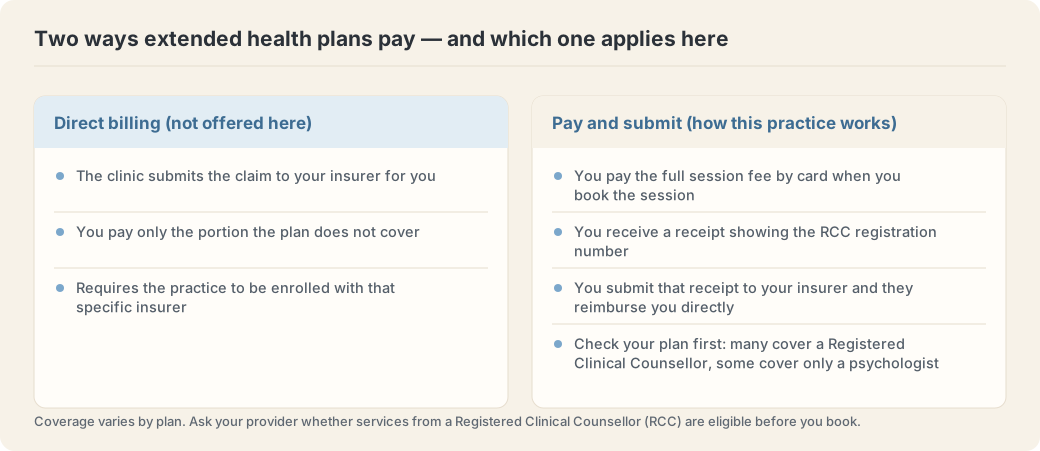
An individual session here is $140 for 50 minutes, by video from anywhere in BC, paid at booking with a receipt for your plan. Whether your plan keeps paying during a leave is a question for HR or the plan administrator, and the fees page has the rest.
If you are still working and reading this
A large share of people who search for this are not on leave and are trying to work out whether they need one. There is no test that settles it, but a few markers are worth taking seriously: sleep that no longer restores, physical symptoms with no medical explanation, mistakes at work that are not like you, dread that starts the evening before rather than in the morning, and drinking more to come down.
The question is worth taking to a doctor before it is urgent. A leave arranged in advance is a different experience from one arranged in a week where you could not go in, and the second is far more common, because most people wait for permission that never arrives.
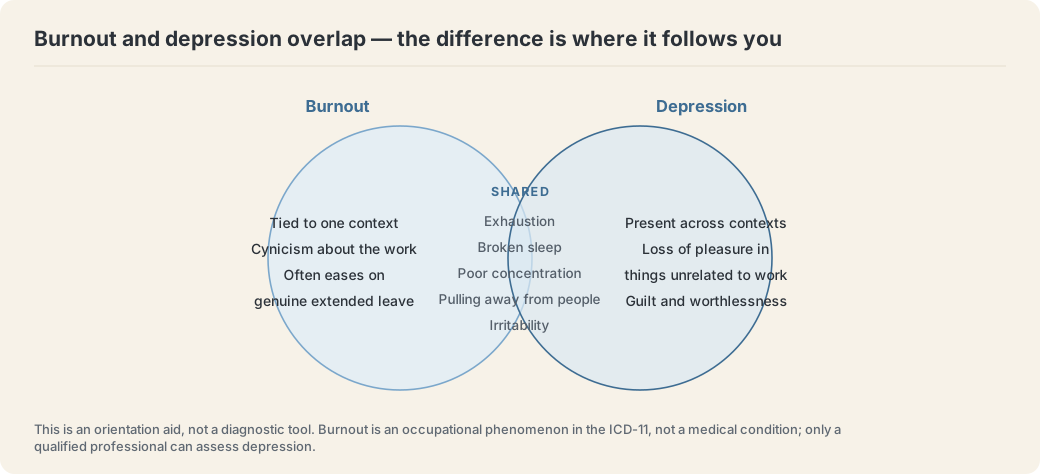
If you cannot tell whether it is the job or something that would come with you on a fortnight away, the burnout or depression check is seven questions, three minutes, and stores nothing. It reaches no verdict; it gives you a clearer description to take to the appointment.
If you are in immediate danger, call 9-1-1. For urgent mental-health support in BC at any hour, call or text 9-8-8, or call 310-6789.
Common questions
How do I take a mental health leave from work in BC?
The same way as a stress leave, because they are the same thing: there is no separate "mental health leave" in BC law, only a medical leave certified by a physician or nurse practitioner. See a doctor, describe what is happening to your ability to work, get a certificate saying you are unable to work and for roughly how long, and give it to your employer. Income comes from paid sick days first, then a short-term disability plan or EI sickness benefits.
How long can you be on stress leave in BC?
As long as a physician certifies you are unable to work, reviewed in blocks. Initial certificates commonly run two to six weeks and are extended on review. EI sickness benefits pay for up to 26 weeks; a short-term disability plan typically covers 15 to 26 weeks before long-term disability is assessed; and the Employment Standards Act protects the job for up to 27 weeks in a 52-week period, with the duty to accommodate under the Human Rights Code beyond that.
What do I say to the doctor to get a stress leave?
Describe function rather than asking for a document. What you can no longer do at work, how long it has been going on, what sleep and concentration are doing, what happens when you try to push through, and anything that has already been tried. A physician or nurse practitioner is deciding whether you are able to work, so what helps them is a clear account of the days, not a diagnosis you have picked in advance and not a request for a specific number of weeks. If it helps, write three lines down before the appointment; people under this much strain reliably understate it in the room.
Is a stress leave a WorkSafeBC claim?
Only when the work itself caused the injury. WorkSafeBC covers a mental disorder arising from a significant work-related stressor, such as a traumatic event or bullying and harassment, and that is a claim rather than a leave: you apply to WorkSafeBC, they decide, and the wage replacement comes from them. Ordinary overload and stress that is not tied to a specific work cause is not usually accepted, and goes down the medical-leave route instead. Our page on WorkSafeBC psychological injury claims sets out what is and is not accepted.
How do I apply for stress leave in BC?
See a physician or nurse practitioner, describe what is happening and how it affects your ability to work, and ask for a medical certificate stating that you are unable to work and for roughly how long. Give that to your employer, and if you have a short-term disability plan, start the insurer's claim at the same time; if not, apply for EI sickness benefits online as soon as you stop working, since the first payment comes about 28 days after you apply. A counsellor cannot certify the leave but can be part of the treatment the insurer will ask about.
How does stress leave work in BC?
There is no separate "stress leave" law. A leave for a mental-health reason is a medical leave: a doctor or nurse practitioner certifies that you cannot work, your job is protected under the Employment Standards Act for the sick days and for up to 27 weeks of unpaid serious illness or injury leave in any 52-week period, and beyond that by the duty to accommodate under the Human Rights Code, and income comes from sick days, a short-term disability plan, or EI sickness benefits, in roughly that order. The certificate is usually for a set period and is reviewed and extended if needed.
Is stress leave paid in BC?
Partly, and it depends how long you are off. The first five days in a calendar year are paid by your employer under the Employment Standards Act once you have 90 days service. Beyond that there is no automatic pay. You are relying on your employer's short-term disability plan if one exists, or on EI sickness benefits, which replace 55% of insurable earnings to a maximum of $729 a week in 2026 for up to 26 weeks. Many people are worse off than they expect, which is worth knowing before the leave starts rather than during it.
Can I get EI sickness benefits for a mental-health leave?
Yes. EI sickness benefits do not distinguish between a physical and a mental-health condition, what matters is that a medical practitioner certifies you are unable to work. Claims established since December 2022 can run to 26 weeks. Apply as soon as the leave is certified rather than waiting, because benefits are not backdated indefinitely, and the usual one-week unpaid waiting period is waived for new claims that start by 9 October 2027.
Is my job protected while I am off?
The Employment Standards Act sick days and its serious personal illness or injury leave, up to 27 weeks, are job-protected, and the BC Human Rights Code requires an employer to accommodate a disability, which a mental-health condition can be, to the point of undue hardship. That is a real protection and it is not unlimited. If you are being pressured to return, or your role changes while you are away, that is an employment-law question rather than a counselling one, and worth getting proper advice on early.
Does WorkSafeBC cover stress leave?
Only when the cause is the work itself. A WorkSafeBC claim for a mental-health injury generally requires either a traumatic event at work or a significant work-related stressor such as bullying or harassment, not the accumulated strain of a demanding job. It is a different process from EI or short-term disability, with its own evidence requirements, and the two are not interchangeable.
Is there a 27-week stress leave in BC?
Yes. The Employment Standards Act gives up to 27 weeks of unpaid, job-protected serious personal illness or injury leave in any 52-week period, regardless of how long you have worked there, with a certificate from a doctor, nurse practitioner or other designated health professional. It is separate from the five paid and three unpaid sick days a year, and it is taken in whole weeks. Federally regulated employees, such as those at banks, airlines and telecoms, have a 27-week medical leave under the Canada Labour Code instead, plus up to 10 paid medical leave days a year. Neither leave pays: EI sickness benefits, up to 26 weeks, or a disability plan provide the income.
Can a counsellor sign my stress leave forms?
No. In British Columbia a medical leave is certified by a physician or a nurse practitioner. A Registered Clinical Counsellor cannot sign for an employer, an insurer or EI, and any counsellor suggesting otherwise is misleading you. Counselling runs alongside the leave rather than being the route into it.
How long can a stress leave last?
It depends on the funding route rather than on a fixed rule. EI sickness benefits run to a maximum of 26 weeks. An employer short-term disability plan sets its own limit, commonly between 15 and 26 weeks, after which long-term disability may apply. The medical certificate itself usually sets a review date rather than an end date.
Does my employer get told my diagnosis?
No. An employer is entitled to functional information. That you cannot perform your duties, what the limitations are, and when this will be reviewed. They are not entitled to your diagnosis or your clinical notes. Insurers can ask for more than employers can, but still less than people usually give them.
Will taking a leave hurt my career?
That is a real question and it deserves a real answer rather than reassurance. It varies enormously by employer and industry, and the honest position is that people are frequently right to weigh it. What is also true is that an unmanaged deterioration ending in a longer absence is the more common career cost, and it is the one people notice too late.
What happens when I go back to work after stress leave?
Usually a graduated return: reduced hours or duties building back over several weeks, arranged through the certifying clinician and, where there is one, the insurer. An employer is generally required to consider accommodations that make the return sustainable, and getting the plan in writing matters. The return is where most leaves succeed or fail, which is why it is worth planning with your counsellor before the date rather than at it.
What if I do not have a family doctor?
A walk-in clinic, an urgent and primary care centre, or a virtual visit covered by MSP can all assess and certify a leave. You do not need an established relationship with the clinician signing it.
Sources
- Government of Canada, EI sickness benefits
- BC Employment Standards Act, illness or injury leave
- BC Human Rights Code, duty to accommodate
- WorkSafeBC, mental health
- Government of Canada, medical leave with pay (federally regulated employers, IPG-118)
- Province of BC, leaves of absence: serious personal illness or injury leave (read 15 Oct 2026)
- Canada Labour Code, s. 239, medical leave of up to 27 weeks
This guide is general information, not clinical advice, and it cannot diagnose anything or replace an assessment. If you are in crisis, call or text 9-8-8 (Canada, 24/7) or BC Mental Health Support at 310-6789.
If you want to talk it through with someone
Nothing needs deciding today. These are the counsellors taking new clients, by secure video across BC; the first conversation is a free 15 minutes and carries no obligation.

Camille Granda, RCC, CCC
English and Tagalog · Trauma, Anxiety and chronic stress, Grief, loss and life transitions
In her words: “I want sitting with me to feel like the biggest belly breath you have ever taken.”

Savneet Singh, RCC
English and Punjabi · Anxiety, Depression, Trauma and attachment
In her words: “Comforting, safe and supportive, is what I aim for.”
Individual sessions are $140 for 50 minutes, after a free 15-minute consultation; card at booking.
Many extended health plans reimburse a Registered Clinical Counsellor, depending on the plan, so check yours; MSP does not cover private counselling. All fees.
There is no wrong way to start.
A free 15-minute consultation over secure video, whenever you are ready for one. Nothing is committed by having it, and no card is needed to book it.
Book Free ConsultationNot ready to book? Send a line about what is going on. A reply comes within one business day.
Or a smaller step: Burnout, or depression? A reflection · What sessions cost · What the free 15 minutes is like
Looking on behalf of someone else? What to send them, and what not to, including the funded routes most people do not know they qualify for.
Keep reading
Related pages
Where this leads
If this is close to your own situation, there is a page written for it: Counselling for first responders in BC, Counselling for teachers in BC, Counselling for tradespeople and construction workers in BC and Counselling for rotational and camp workers.
Where you are
Online counselling across British Columbia
Every session is by secure video, so the counsellor you see does not depend on where you live. Each city page covers coverage, local public services and who is taking new clients there.