Resource · Work & money
Short-term disability, long-term disability, and counselling in BC
Short-term disability is an employer or insurer plan that replaces part of your income for the early months of a medical absence; long-term disability takes over when STD ends, typically replacing a percentage of salary while you remain unable to work. Three things decide mental-health claims more than anything else: whether you are under regular, appropriate care, which usually includes counselling or psychiatric treatment; the definition switch, where "unable to do your own job" becomes "unable to do any job" (commonly around the two-year mark); and paperwork discipline. None of this is uniform: the plan wording, not this page, is the contract.
Mental-health conditions are among the most common reasons for disability claims in Canada, and the system that pays them is the one working people understand least, because nobody reads the booklet until they need it.
7 min read · Updated
The relay: sick days → STD → LTD
The income side of a long medical absence is a relay with handoffs. The ESA sick days cover the first week-ish. Then either your employer’s short-term disability plan (where one exists) or EI sickness benefits carries the next stretch, STD plans commonly run around 15 to 26 weeks at a percentage of salary set by the plan. Long-term disability, where the employer offers it, picks up when STD or EI exhausts, typically replacing somewhere in the range of half to two-thirds of salary, with the exact figure, caps and taxability set by the policy.
Every handoff is an application, not an automatic transfer, and the LTD application in particular rewards being started well before STD ends, because insurer decisions take weeks. The single most preventable disaster in this system is an income gap caused by applying late to the next leg.
Two structural notes: if premiums for LTD were paid by you (check your pay stub), benefits are usually non-taxable; employer-paid premiums usually mean taxable benefits. And most LTD policies require you to apply for other benefits you may be entitled to, CPP disability chief among them, with the LTD amount offset against them. This is normal, not the insurer cheating; the sum is what the policy promises.
What mental-health claims turn on
- Regular, appropriate care, Every policy requires it, and for psychological claims insurers read it as: a physician involved, treatment underway, and usually counselling or psychiatric care consistent with the condition’s severity. A claim that says "too unwell to work" with no treatment record is the claim that gets denied, and honestly, treatment is also the route back to work after a mental health leave.
- Function, documented, Like everything in this cluster, the currency is function: what you cannot sustain: concentration, reliability, interaction, attested consistently by the people treating you. Vague letters lose to specific ones.
- The own-occupation switch, Most policies pay for the first period (commonly two years) if you cannot do YOUR job, then switch to paying only if you cannot do ANY job you are reasonably suited for. Mental-health claims are re-examined hard at that switch, and knowing the date matters.
- Surveillance-proof honesty, Insurers investigate. The claimant who is consistent, with their doctors, their forms and their actual life, has nothing to manage. Exaggeration sinks valid claims; so does the heroic minimising that says "fine, coping" to the insurer’s nurse on a bad week.
Whether the claim is starting, dragging, or being fought. The treatment half of it can begin this week, from home. Book a free consultation.
Where counselling sits, practically
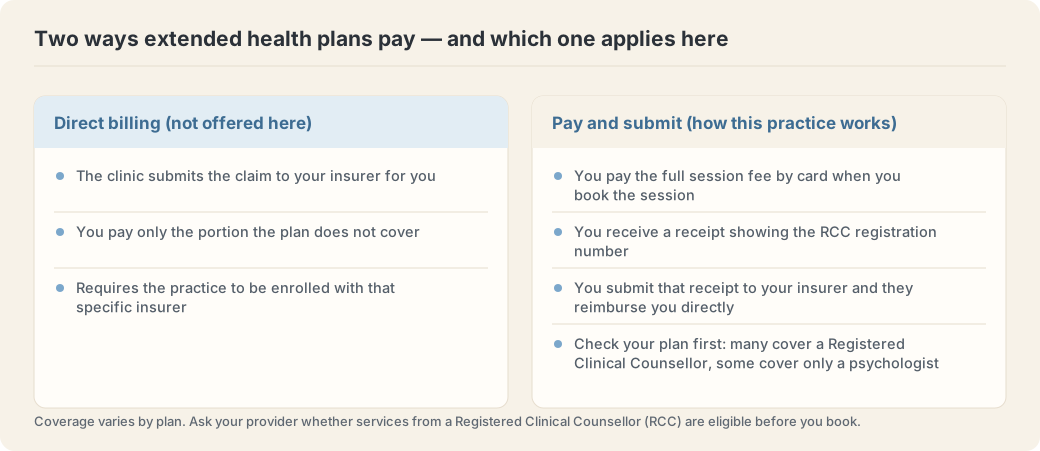
For an STD/LTD mental-health claim, counselling is usually part of the "appropriate treatment" picture, often alongside a family doctor and sometimes psychiatry or a formal assessment. Where work itself caused the injury, a WorkSafeBC stress claim is a separate route with its own test. Some insurers cover or arrange treatment; more commonly you fund it through extended health, which typically continues during an approved leave. Receipts and attendance records from a Registered Clinical Counsellor are ordinary supporting evidence insurers accept.
Worth saying from this side of the desk: therapy during a disability leave has a different job than the paperwork it also feeds. The claim needs documentation; you need treatment. When those are the same sessions, good, but a claim managed so carefully that treatment becomes performance is treating the insurer, not the person. A counsellor’s notes stay confidential; what goes to an insurer is what you and your clinicians agree goes, usually via forms addressed to function.
And if a claim is denied or cut off, common at the own-occupation switch. The sequence is: internal appeal with better functional evidence, then advice. Community legal resources and plaintiff-side disability lawyers (most consult free) exist precisely for LTD terminations, and limitation periods make speed matter.
Common questions
How much does short-term disability pay in BC?
Whatever your plan says, and nothing is set by the province. Most employer short-term disability plans replace a percentage of salary, commonly somewhere between half and two-thirds, for a defined period, often 15 to 26 weeks, before long-term disability is assessed. The plan booklet states the figure; if there is no plan, EI sickness benefits are the fallback at 55% of insurable earnings to a weekly maximum.
Is short-term disability mandatory in BC?
No. No BC law requires an employer to offer short-term disability; it is an insurance plan an employer chooses to buy, and its terms are in the plan booklet. Where there is no plan, the public fallback is EI sickness benefits, which pay 55% of insurable earnings, to a weekly maximum, for up to 26 weeks once a medical practitioner certifies that you cannot work.
Is short-term disability available for stress leave in BC?
Yes, if you have a plan and a physician certifies that you cannot work. Insurers treat mental-health conditions the same way as physical ones in principle, and in practice ask for more: a diagnosis from the certifying doctor, evidence of treatment, and often a treatment plan. Counselling with a Registered Clinical Counsellor is usually accepted as treatment for that purpose.
Can I get disability benefits for depression or anxiety in BC?
Yes, mental-health conditions are among the most common bases for STD and LTD claims in Canada. What the claims turn on is a diagnosed condition, documented functional limitations, and being under regular appropriate care, which usually includes counselling or psychiatric treatment.
Do I have to be in therapy to keep LTD benefits?
Policies require appropriate treatment for the condition, and for psychological claims insurers generally expect ongoing care, commonly a physician plus counselling or psychiatry. Refusing all treatment is a standard reason for termination of benefits. The wording of your policy governs; "appropriate" is judged against your condition’s severity.
What is the two-year change in my LTD?
The own-occupation to any-occupation switch: many policies pay first because you cannot do your own job, and later only if you cannot do any job you are reasonably suited to by education and experience. Claims are commonly reassessed and sometimes terminated at that point, diarise the date and tighten the functional evidence before it.
Does counselling with an RCC count as treatment for my claim?
Generally yes as part of a care picture: receipts, attendance and functional letters from a Registered Clinical Counsellor are ordinary evidence, usually alongside a physician’s involvement. Some policies specify practitioner types for particular purposes, so as always, the plan wording wins.
My LTD was cut off. Now what?
Appeal internally with stronger functional documentation, and get advice quickly, plaintiff-side disability lawyers mostly consult free, and limitation periods apply to court action. Do not let a termination letter become the end of treatment either; the condition does not read the insurer’s mail.
Sources
- Government of Canada, EI sickness benefits (the STD fallback)
- Government of Canada, CPP disability benefits
- Canadian Mental Health Association, BC Division
General information, not clinical, financial, or legal advice. Coverage and service details change, verify anything decision-critical directly with the provider or insurer. If you are in crisis, call or text 9-8-8 (Canada, 24/7) or 310-6789 for BC Mental Health Support.
Who you would talk to
Taking new clients and seeing people across BC by secure video. Each is a Registered Clinical Counsellor; the registration is on the profile and can be checked on the BCACC register.

Camille Granda, RCC, CCC
English and Tagalog · Trauma, Anxiety and chronic stress, Grief, loss and life transitions
In her words: “I want sitting with me to feel like the biggest belly breath you have ever taken.”

Savneet Singh, RCC
English and Punjabi · Anxiety, Depression, Trauma and attachment
In her words: “Comforting, safe and supportive, is what I aim for.”
Individual sessions are $140 for 50 minutes, after a free 15-minute consultation; card at booking.
Many extended health plans reimburse a Registered Clinical Counsellor, depending on the plan, so check yours; MSP does not cover private counselling. All fees.
Questions about cost or coverage?
A free 15-minute consultation is a good place to ask them, before committing to anything.
Book Free ConsultationNot ready to book? Send a line about what is going on. A reply comes within one business day.
Or a smaller step: What counselling costs in BC · What sessions cost · What the free 15 minutes is like
Looking on behalf of someone else? What to send them, and what not to, including the funded routes most people do not know they qualify for.
Keep going
More BC resources
Where you are
Online counselling across British Columbia
Every session is by secure video, so the counsellor you see does not depend on where you live. Each city page covers coverage, local public services and who is taking new clients there.