Individual Therapy
Individual Therapy: 1:1 sessions for the everyday weight of being human.
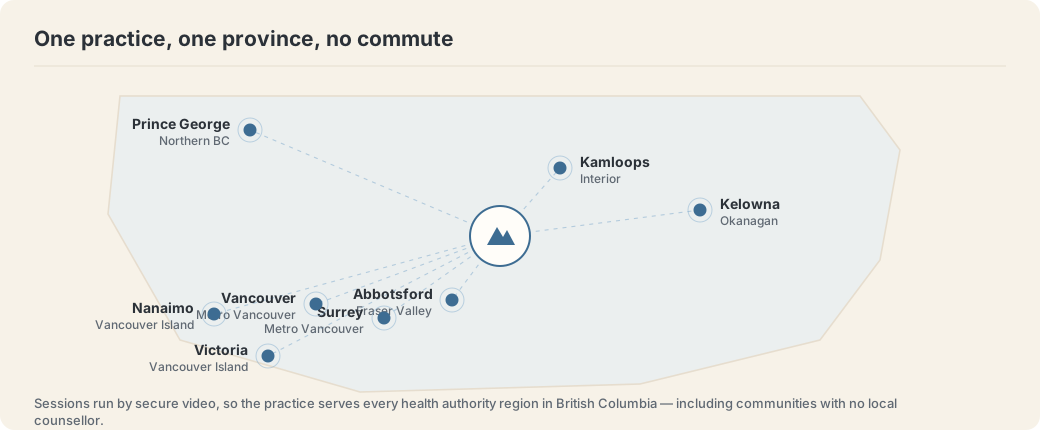
Individual therapy at Westpeak Wellness is one-to-one counselling delivered by secure video anywhere in British Columbia, provided by a Registered Clinical Counsellor registered with the BC Association of Clinical Counsellors. Sessions run 50 minutes, weekly or fortnightly. It suits anxiety, low mood, burnout, self-criticism, life transitions and long-standing patterns that have stopped responding to the obvious fixes. A free 15-minute consultation comes first, and there is no referral, diagnosis or waitlist required.
- 50 minutes per session
- Secure video sessions
- Free 15-min consult
- $140 per session
- Registered Clinical Counsellor · BCACC registered
Individual therapy is space that belongs entirely to you: to think out loud, make sense of what you're carrying, and work toward what "better" looks like on your terms. Sessions are 50 minutes, weekly or biweekly, and always online so you can meet from wherever you feel most at ease in BC.
Updated
How do we approach it?
The work is warm, direct, and paced to you. We start with your story and your goals, then draw on evidence-based approaches: CBT, EMDR, trauma-informed care, matched to what you actually need, not a one-size-fits-all script.
What individual therapy is actually for
Individual therapy has a reputation problem: it gets imagined either as crisis intervention or as an indulgence. In practice most of it is neither. It is a regular hour with someone whose only job in that hour is to pay attention to your situation, and who has no stake in any particular outcome.
That matters more than it sounds. Most of the people in your life are inside your situation: partners, family, friends, colleagues all have a position on what you should do, and you manage their reactions while you talk. A counsellor does not need managing. You can say the ugly version of the thought, the one you have edited out of every other conversation, and find out what it actually looks like once it is out of your head.
You do not need a diagnosis or a crisis to qualify. A great deal of useful work happens with people whose lives look fine from outside and feel heavier than they should from inside.
Who you would see for individual therapy
Taking new clients and seeing people across BC by secure video. Each is a Registered Clinical Counsellor; the registration is on the profile and can be checked on the BCACC register.

Camille Granda, RCC, CCC
English and Tagalog · Trauma, Anxiety and chronic stress, Grief, loss and life transitions
In her words: “I want sitting with me to feel like the biggest belly breath you have ever taken.”

Savneet Singh, RCC
English and Punjabi · Anxiety, Depression, Trauma and attachment
In her words: “Comforting, safe and supportive, is what I aim for.”
Might be a fit if
What people tend to arrive with
The same pattern keeps repeating
Different job, different relationship, same outcome, and enough self-awareness to notice it without being able to interrupt it.
You are functioning and exhausted
Everything gets done and none of it feels good. Often the version described on high-functioning anxiety.
A decision you cannot make
Career, relationship, whether to move, whether to stay, going in circles for months without getting closer.
Something changed and you have not caught up
A loss, a diagnosis, a separation, an ending. Not necessarily traumatic, just larger than you have had space to process.
You do not recognise your own reactions
Anger, numbness, or panic arriving out of proportion to what is in front of you.
You have nowhere to say it
Genuinely common in adulthood, a full life and no one available for the actual conversation.
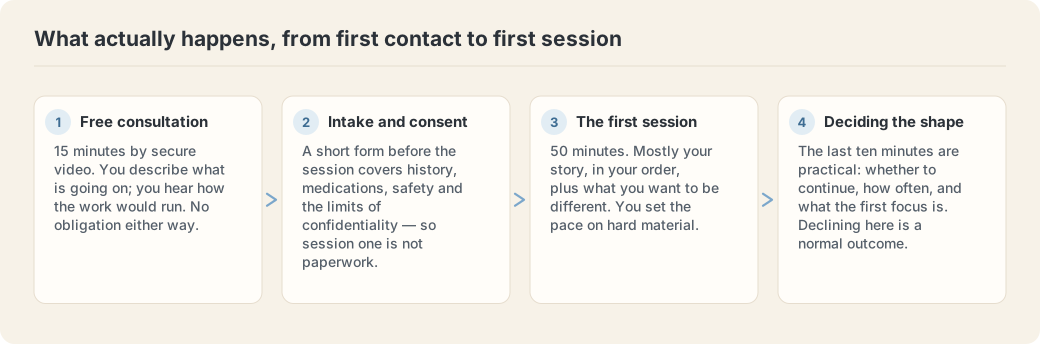
Recognise several of these? A free 15-minute consultation is the least committal way to find out whether this is the right approach, including if the answer turns out to be something else.
What the sessions look like
Sessions are 50 minutes, usually weekly at first, moving to every other week as things settle. Weekly is not a rule. It is that momentum is hard to build at longer intervals early on, and easy to maintain later.
The first session is mostly orientation: what brought you, some history, and what you want to be different. You are not expected to arrive with it organised, and "I don't know where to start" is a normal opening. There is a full walkthrough in the guide on what to expect in a first session.
After that, sessions tend to alternate between working on what is live that week and returning to the pattern underneath it. Some weeks are practical and skills-focused; some are not. Where the work touches trauma, it slows down deliberately, pacing is a clinical decision, not a delay.
On length: some people come for six sessions with a specific stuck problem and finish. Others work for a year. Both are legitimate, and it is a reasonable thing to ask about directly rather than leaving open-ended.
Questions
More on how this work runs
What the first month tends to look like
Individual therapy is the least specific thing on this list, which makes it the hardest to describe honestly. What follows is the shape it usually takes rather than a promise about yours.
Week one is orientation. Your account, in your order, plus the practical frame: confidentiality and its limits, how sessions run, what you want to be different. Most people talk more than they expected to and leave more tired than they expected to.
Weeks two and three are where a working focus emerges, and it is frequently not the one you arrived with. People come in for the job and find the job is the place a much older pattern is currently expressing itself. That is not a bait and switch; it is what happens when someone with training listens to two hours of your life.
Week four is usually the first review. What are we aiming at, is the approach right, and how often should we be meeting. If nobody has raised those questions by session five or six, raise them yourself.
A word on what individual therapy is not. It is not advice, and a counsellor who spends sessions telling you what to do about your life has drifted into something else. It is also not a place where you are assessed as a person. The material is patterns and circumstances, not character. And it is not open-ended by default: work with a clear target ends, and ending on purpose is part of it.
Online anxiety counselling in BC
Online anxiety counselling is available anywhere in British Columbia as individual therapy: 50-minute sessions by secure video with a Registered Clinical Counsellor, after a free 15-minute consultation, with no referral or diagnosis needed. Every counsellor taking new clients sees anxiety, and the booking page lets you choose between them.
For anxiety specifically, online counselling solves a problem the condition itself creates: the appointment is reachable on the days the anxiety says the drive, the waiting room, or the unfamiliar building is too much. Nobody white-knuckles a commute to get help with the thing the commute triggers.
The evidence base for video-delivered anxiety treatment is among the strongest in all of online therapy, structured approaches like CBT translate almost without loss, and the skills-practice between sessions happens in the exact environment the anxiety lives in, which is a quiet advantage over learning calm in an office you will never be anxious in. The effectiveness guide covers the research; the free consultation is how you test the fit for yourself.
Safety behaviours, and why they keep anxiety alive
Most people with long-standing anxiety have built a set of small habits that make feared situations tolerable. Sitting near an exit. Carrying water. Having a friend on standby. Over-preparing to a degree nobody asked for. Rehearsing the first sentence of a conversation. Checking something a fourth time.
These are called safety behaviours, and they are the reason people can attend the meeting for years and still be terrified of it. The problem is subtle: they let you into the situation while preventing the situation from teaching you anything. Because you got through it with the water bottle, the water bottle keeps the credit, and the underlying belief that you could not have coped otherwise survives intact.
They also tend to multiply. Each one relieves anxiety slightly, which reinforces it, which makes the next one easier to add. Over a few years this produces a life with a large number of quiet conditions attached to it, none of which felt significant when it was adopted.
A significant part of anxiety work is identifying them, which is harder than it sounds because they are usually experienced as sensible preparation rather than as avoidance. The test is a useful one: would I still do this if I were not anxious? Preparing for a presentation is reasonable. Rehearsing it eleven times is not preparation.
Dropping them is done gradually and deliberately, usually alongside graded exposure, and the discomfort of doing so is the mechanism rather than a side effect. The point is to accumulate direct evidence that you got through it and nothing carried you.
Reassurance-seeking, the quietest maintaining factor
Alongside avoidance, the most reliable maintainer of anxiety is reassurance, and it is far harder to spot, because everyone involved experiences it as support.
It takes several forms. Asking a partner repeatedly whether something is fine. Searching symptoms. Re-reading an email to confirm it was not rude. Checking a lock, a stove, a booking. Asking the same question in slightly different words so it does not sound like the same question.
The mechanism is identical to avoidance: each instance produces immediate relief, and the relief teaches the brain that the check was necessary. Anxiety returns slightly stronger and the interval to the next check shortens. Over a year this produces someone who cannot tolerate uncertainty for more than a few minutes.
It is also corrosive to relationships, in a way neither party usually names. The person providing reassurance is doing something kind that is making things worse, and they typically sense it before they can articulate it, which produces irritation, then guilt about the irritation.
The treatment is to reduce it deliberately rather than eliminate it overnight: agreeing with a partner that they will answer once and not again, extending the interval before checking, and tolerating the discomfort that follows. That discomfort is the mechanism. It falls on its own if nothing intervenes, and demonstrating that repeatedly is what teaches the system it does not need the check.
Online depression counselling in BC
Online depression counselling is available anywhere in British Columbia as individual therapy: 50-minute sessions by secure video with a Registered Clinical Counsellor, after a free 15-minute consultation, with no referral or diagnosis needed. Every counsellor taking new clients sees depression and low mood, and the booking page lets you choose between them.
For depression specifically, online counselling removes the tax the condition itself levies on getting help: the shower-dress-drive-waiting-room sequence that can consume a whole day’s capacity. A session you can attend from the corner of the couch is not a lesser session. It is the one that actually happens during the weeks when the alternative was cancelling, the darkest weeks of a BC winter included.
Video-delivered treatment for depression carries one of the stronger evidence bases in online therapy, and behavioural approaches adapt naturally: the work happens in the environment where the patterns live. The honest caveat runs the other way, where isolation is a driver, sessions should be a bridge back toward the world, not a reason never to re-enter it, and a decent counsellor holds that line deliberately. The effectiveness research covers the evidence in full.
Why activity comes before motivation
The most counter-intuitive thing about treating depression is the sequence. Everyone assumes motivation comes first and action follows. In depression that order does not return on its own, and waiting for it is the trap the condition sets.
What happens instead is a downward loop with a simple structure. Low mood removes the desire to do things. Doing less removes the sources of reward, contact and meaning that were propping mood up. Mood drops further. Doing less becomes easier to justify. Nobody in that loop is being lazy; the loop is a feature of the condition rather than of the person.
The intervention: behavioural activation: inverts the assumption. Activity is scheduled in advance, in small specific amounts, and performed regardless of how you feel on the day. Not as discipline, but because doing the thing is what generates the mood change, rather than the other way round.
It works best when the activities are chosen for two properties rather than enjoyment: mastery (a sense of having accomplished something, however small) and connection (involving another person). Enjoyment is unreliable early on, because anhedonia flattens it, which is why "do things you enjoy" is such useless advice to someone who currently enjoys nothing.
The scale matters. Ten minutes outside is a legitimate target. A gym membership is not, at the start, because failing it produces evidence against yourself and that evidence is expensive. Targets get raised as capacity returns.
And where depression is severe enough that even this is not accessible, that is a signal to involve a physician alongside the counselling rather than to try harder: see therapy, medication, or both.
The thinking patterns that come with it
Depression changes cognition in specific and recognisable ways, and knowing the shapes helps, because it converts a set of apparently self-evident conclusions into symptoms.
Overgeneralisation. One instance becomes a rule. A single awkward conversation becomes evidence about your whole social competence. The give-away is the words always and never.
Discounting anything positive. Good outcomes get reclassified as luck, timing, or other people being kind. This is why encouragement does not land. It is processed and discarded before it registers.
Mind-reading. Confident conclusions about what other people think, treated as observations rather than as guesses. Almost always negative and almost never checked.
Fortune-telling. Certainty about how something will go, which then justifies not attempting it, and the non-attempt is read afterwards as confirmation.
Personalising. Assuming responsibility for outcomes with many causes, including other people's moods.
The clinical point is not that these thoughts are irrational. It is that depression makes them feel like perception rather than interpretation. They arrive with the weight of an observation. Learning to catch them as they happen, write them down and check them against evidence is unglamorous, repetitive, and among the better-evidenced interventions available.
How to get more out of the hour
- Arrive with the week, not a report, The most useful opening is frequently the thing that happened on Tuesday that you have not stopped thinking about, not a tidy summary. Tidiness is a form of editing, and the edited version is usually less useful than the messy one.
- Say the thing you almost did not say, Most sessions contain one. It is nearly always the most productive sixty seconds available, and deferring it week after week is the single most common way therapy stalls.
- Disagree out loud, If an interpretation does not fit, saying so is not rudeness. It is the correction that makes the next one accurate. A counsellor who cannot be contradicted is not much use.
- Note things during the week, The material worth bringing arrives on Wednesday and is gone by Friday. Three lines on a phone is enough.
- Do the between-session thing badly, A failed attempt is better material than no attempt. Reporting that you did not manage it, and what got in the way, is genuinely more useful than a clean success.
- Say when something is not working, Early rather than at month five. It changes the plan instead of ending the work.
Before you book
How do I know if I need therapy?
There is no threshold you have to cross. A useful question instead: is something taking up more of your attention than you want it to, and have your own attempts to shift it stopped working? If so, it is a reasonable use of an hour.
How many sessions will I need?
It varies with what you are bringing. A specific, contained difficulty often takes six to twelve sessions. Long-standing patterns or trauma take longer. Your counsellor should be able to give you a rough sense after two or three sessions.
What if I do not like my counsellor?
Say so, or leave. Both are acceptable. Fit predicts outcomes more reliably than technique does, and staying with a poor fit out of politeness wastes your money and your time.
Is it confidential from my employer or family?
Yes. The only limits are risk of serious harm to you or someone else, a child or vulnerable adult at risk of abuse or neglect, or a court order. These get explained in the first session.
How much does individual counselling cost, and will insurance cover it?
An individual session is $140 for 50 minutes, after a free 15-minute consultation. MSP does not cover private counselling. Many extended health plans reimburse a Registered Clinical Counsellor, depending on the plan, so check yours. This practice is pay-and-submit: you pay at booking and submit the receipt, which carries the counsellor’s registration number, to your plan. Does my plan cover counselling? gives the one question to ask your insurer.
More in the full FAQ, or see fees and extended health coverage.
Explore more
Other ways we can work together
Family Counselling
For the pattern between you, not the person you think is the problem.
Family Counselling in BCKeep going
Other counselling services
Individual Therapy, starting with a conversation.
Book a free 15-minute consultation over secure video. No pressure, just a chance to see if we’re a good fit.
Book Free ConsultationNot ready to book? Send a line about what is going on. A reply comes within one business day, or read the guides first and come back when you want to.
Looking on behalf of someone else? What to send them, and what not to, including the funded routes most people do not know they qualify for.