For · Healthcare and shift work
Counselling for healthcare and shift workers in BC
Counselling for healthcare and shift workers in BC, with sessions by video, booked around the roster, so a rotation does not end the work. Covers moral injury, the particular exhaustion of caring work, and sleep that never resets, without treating burnout as a personal failure of resilience.
You are good in a crisis. That is exactly why nobody notices when you are in one.
6 min read · Updated
Open times don’t fit your rotation? Ask for one, and the counsellor replies with a time that is not on the calendar yet.
Many extended health plans reimburse a Registered Clinical Counsellor, depending on the plan, so check yours; MSP does not. Receipts are issued for every session, and the fees are published in full. On a calendar-year plan, sessions held by 31 December count against this year: using benefits before the plan year ends.
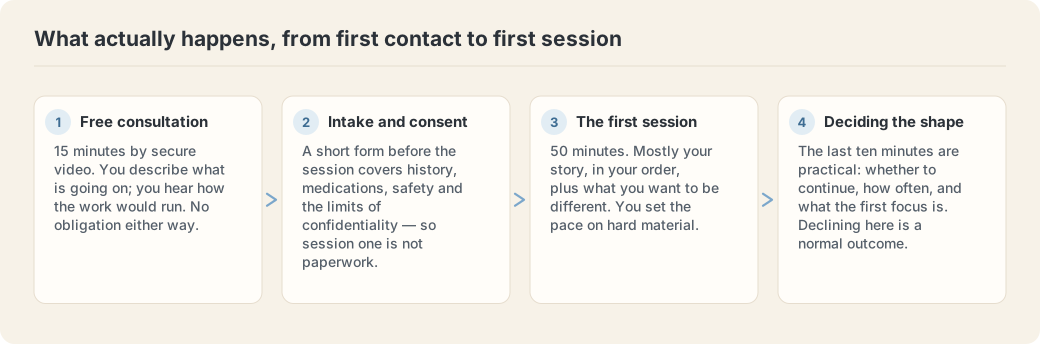
Individual sessions are $140 for 50 minutes, after a free 15-minute consultation.
Healthcare and emergency work select for people who function under pressure and keep going. Those are genuine strengths, and they are also the reason distress in this workforce goes unnoticed for years, including by the person carrying it. Competence is effective camouflage.
The pressures here are not the ordinary ones. Rotating shifts that put your body permanently out of phase. Decisions made with insufficient information and real consequences. Exposure to other people's worst days as a routine feature of the job. Short staffing that turns every shift into triage. And a workplace culture where saying you are struggling can feel like admitting you are not up to it.
A note on cost: in BC, mental-health conditions arising from work-related traumatic events can be compensable through WorkSafeBC, and for eligible first responders and certain other occupations a presumption applies, meaning the condition may be presumed work-related rather than requiring you to prove it. If your difficulty is connected to what you have seen at work, it is worth finding out what you are entitled to before paying privately. Your union or professional association is usually the fastest route to that answer.
What comes up
The things people actually say
"I should be able to handle this"
The belief that training makes you exempt, and that struggling means you were never suited to it. This keeps more people out of therapy in this field than anything else.
Moral injury, not just stress
The particular damage of being required to act against your own sense of right: sending someone home too early, rationing time, following a policy you believe is wrong. It behaves differently from ordinary burnout and responds to different work.
Compassion that has gone flat
Finding yourself detached from patients or clients you would once have cared about, and then feeling ashamed of that. It is a recognised feature of sustained exposure, not a character defect.
Sleep that never resets
Nights, then days, then nights. Your circadian rhythm has not been in phase for years, and disrupted sleep both causes and imitates anxiety and depression.
Bringing it home
Being physically present and mentally still on the ward. Partners noticing before you do. The specific guilt of having nothing left for the people you actually chose.
The debrief that never happened
A bad call, a bad outcome, a death that stayed with you, and a shift that continued afterward, because there was nobody to cover you.
If you have been meaning to deal with this since a shift you can still name, that is usually the signal. Book a free consultation.
Moral injury is not the same as burnout
This distinction matters because the two need different work and get conflated constantly.
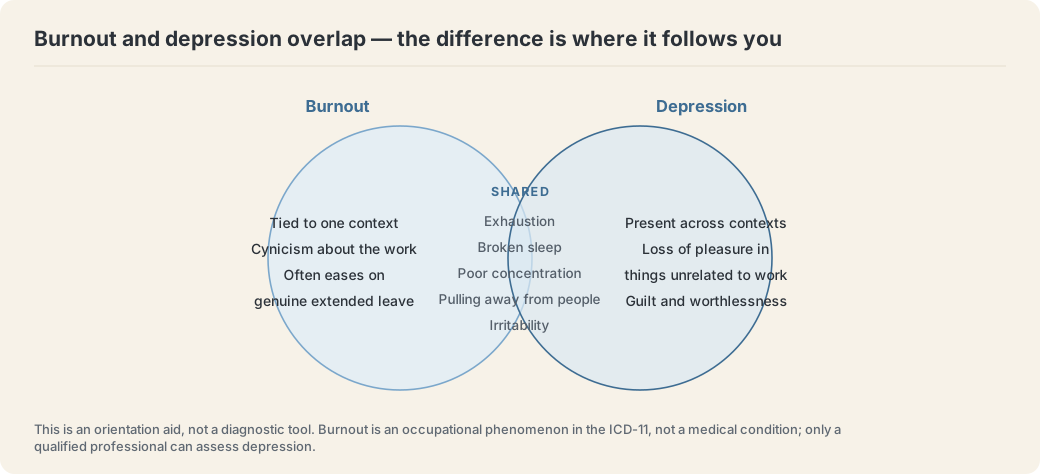
Burnout is depletion. The WHO describes it as exhaustion, mental distance from the job, and reduced effectiveness arising from chronic unmanaged workplace stress. It responds to changes in load, recovery, and boundaries. There is more in the guide on burnout versus depression.
Moral injury is different. It is the damage done by participating in, witnessing, or failing to prevent something that violates your own moral code. Rest does not touch it, because the problem is not depletion. It is a conflict between what you did or could not do and who you understand yourself to be. It shows up as guilt, shame, and a loss of trust in the institution or in yourself, and it needs to be worked through rather than recovered from.
A great deal of what gets labelled burnout in healthcare is actually this. Being offered a wellness webinar for it is, understandably, infuriating.
Why the usual advice does not apply
Standard mental-health guidance assumes a life you can adjust: keep regular sleep, exercise in the morning, protect your evenings. If you work rotating twelve-hour shifts, most of that is not available, and being told it repeatedly starts to feel like being blamed.
Useful work here starts from the actual constraints. What recovery is possible inside a rotation rather than in an imagined stable schedule. How to protect the transition between shift and home when there is no commute to decompress in. What can be done about the specific incidents that are still with you. And how to hold boundaries in a workplace that will absorb every hour you offer it.
Scheduling that fits a rotation
The practical barrier for this workforce is almost always scheduling. A weekly Tuesday-at-four appointment is unusable when your rotation moves. A virtual practice removes travel from the equation, which makes an appointment on a day off far more feasible.
It also means sessions can happen from home rather than requiring you to be presentable and somewhere else, which, on the fourth day of a stretch, is often the deciding factor between attending and cancelling.
Who you would see
Taking new clients and seeing people across BC by secure video. Each is a Registered Clinical Counsellor; the registration is on the profile and can be checked on the BCACC register.

Camille Granda, RCC, CCC
English and Tagalog · Trauma, Anxiety and chronic stress, Grief, loss and life transitions
In her words: “I want sitting with me to feel like the biggest belly breath you have ever taken.”

Savneet Singh, RCC
English and Punjabi · Anxiety, Depression, Trauma and attachment
In her words: “Comforting, safe and supportive, is what I aim for.”
Where to start
Sleep advice that survives a rotating roster
Standard sleep hygiene assumes a consistent schedule, which makes most of it useless on rotation. The adapted version is different in specific ways.
Anchor sleep beats total sleep. Where a fully consistent schedule is impossible, keeping a fixed core block, four or five hours at the same clock time across as many days as the roster allows, stabilises the body clock far better than chasing eight hours at variable times.
Light is the lever, in both directions. Bright light during the shift, and dark glasses on the commute home after nights, do more than anything else. The drive home in morning sun is the single most disruptive twenty minutes in a night worker's day and the easiest to fix.
Protect the sleep environment properly. Blackout, earplugs, phone genuinely off, and a household that understands that daytime sleep is sleep rather than a nap. This is a negotiation with the people you live with as much as a technical fix.
Use naps deliberately. A short nap before a night shift is well supported. A long unplanned nap after one usually makes the following night worse.
Caffeine has a timeline. It has a long half-life, and the last dose of a night shift is frequently the reason the subsequent sleep fails.
And treat the anxiety separately. Where sleep is disrupted by rumination rather than by the roster, no amount of scheduling fixes it, see anxiety and sleep.
What to do after a bad shift
Debriefs happen or they do not, and either way the processing mostly occurs afterwards, alone, at 3 a.m. A small amount of structure in the first forty-eight hours makes a measurable difference.
Do not go straight to sleep on it if you can avoid it. Twenty minutes of something ordinary between the shift and bed. A walk, a shower, a conversation, gives the system a transition. Going directly from an event to sleep is associated with more intrusive material afterwards.
Say it out loud once, to one person. Not repeatedly, and not in detail to everyone. A single coherent account to someone who can hear it does more than either silence or repeated retelling, which can entrench rather than settle.
Move. The physiological load from an acute event is real and it metabolises with activity considerably better than with stillness.
Watch the alcohol. It is the standard post-shift decompression and it degrades exactly the sleep that would otherwise help process the event.
And notice the two-week mark. Intrusive images, disturbed sleep and heightened startle in the first days after a serious event are a normal response rather than a disorder. Persisting past a fortnight, or getting worse rather than better, is the point at which it is worth speaking to someone, see what trauma actually means.
Services that tend to fit
Trauma therapy
For critical incidents, cumulative exposure, and the calls that stayed with you.
EMDR therapy
For specific incidents that still intrude, and it requires less detailed retelling than talk-based approaches.
Depression counselling
For the flatness, detachment, and loss of meaning that follow sustained exposure.
Anxiety counselling
For hypervigilance, dread before shifts, and sleep that will not come.
Couples therapy
For the strain that shift work and emotional depletion put on a relationship.
Common questions
Will this affect my licence or my employer?
No. Private counselling is confidential and is not reported to your employer, your union, or your regulatory college. The limits are the standard ones: risk of serious harm, a child at risk, or a court order, and those apply to everyone.
Is this covered by WorkSafeBC?
It may be, where the condition arises from work-related traumatic exposure, and a presumption applies for eligible first responders and certain other occupations. Your union or professional association can usually tell you quickly. Worth checking before paying out of pocket.
I only have random days off. Can that work?
Yes. Appointments do not have to be the same slot every week, and virtual sessions remove travel, which is the part that usually makes an irregular rotation unworkable. If none of the open times on the calendar fall on your days off, ask for a time and the counsellor replies with one that is not on the calendar yet.
Does my EAP not cover this already?
Often it covers a set number of sessions, and for many people that is the right starting point. Its limits are session caps and sometimes limited choice of practitioner, private therapy makes sense when you need longer work or a specific fit.
Sources and further support
- WorkSafeBC, mental health claims and presumptions
- World Health Organization, burn-out as an occupational phenomenon
- CMHA BC, workplace mental health
General information, not clinical advice, and not a diagnosis. If you are in crisis, call or text 9-8-8 (Canada, 24/7) or BC Mental Health Support at 310-6789. In immediate danger, call 911.
Where you are
Online counselling across British Columbia
Every session is by secure video, so the counsellor you see does not depend on where you live. Each city page covers coverage, local public services and who is taking new clients there.
One conversation, no commitment.
A free 15-minute consultation over secure video, including an honest answer if something other than counselling would serve you better.
Book Free ConsultationNot ready to book? Send a line about what is going on. A reply comes within one business day, or read the guides first and come back when you want to.
Looking on behalf of someone else? What to send them, and what not to, including the funded routes most people do not know they qualify for.