Resource · Getting started
Before your first consultation: what to expect, what to bring
The free consultation is a 15-minute video call with your counsellor, not a therapy session, not an intake interview, and not a commitment. You will be asked, gently, what brings you; you can ask anything about how the work runs; and both of you are deciding fit. Preparation is one sentence: what you would want to be different. The tech is any device with a camera and a private-enough corner. Nerves are the normal state on this call, and mentioning them is allowed. It tends to help.
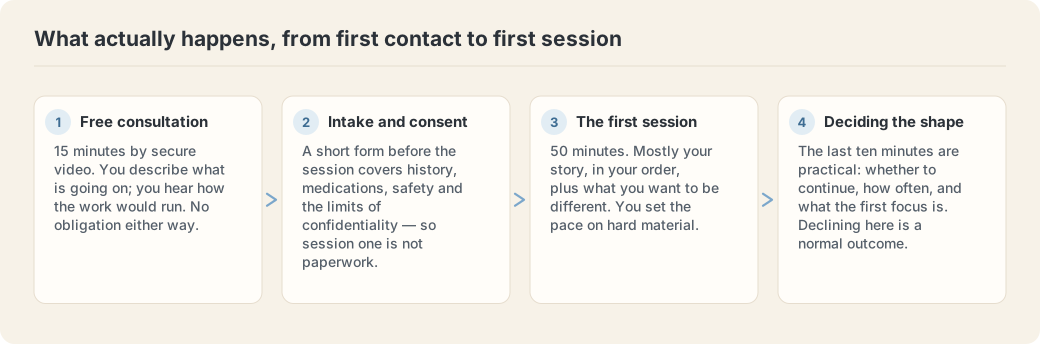
Fifteen minutes, no card, no couch. Here is the whole shape of it, so the only unknown left is whether the fit feels right, which is the one thing the call exists to find out.
4 min read · Updated
What the fifteen minutes actually contain
The shape is consistent: a hello that is allowed to be awkward, a question like "what has you reaching out now?", space for whatever version of an answer you have, your questions about how sessions work, and, if you want it. A concrete next step. Nothing is diagnosed, nothing is decided on the call, and "I want to think about it" is a fully respectable ending. So is "I don’t think this is the right fit," said by either of you; the call exists to make that discovery cheap.
You do not need a tidy story. "Things have been heavy and I don’t know exactly why" is a complete and common opening. If it helps to prepare something, prepare one sentence: what you would want to be different in three months. Everything else can be found together later.
Questions worth asking, if you want a list to steal from: how sessions typically run, experience with what you are bringing, fees and how coverage works, and anything from the questions-to-ask guide. A counsellor who bristles at being interviewed is answering a question too.
The practical checklist
- Online only, Nothing to travel to. There is no office to come to; the call is by secure video, from wherever you can be private.
- A device with a camera, Phone, tablet or laptop. Nothing to install; the confirmation email carries the video link. Headphones help more than people expect, for privacy and for feeling less like a broadcast.
- A private-enough corner, A bedroom, a parked car, an office with a door. It needs to be private for fifteen minutes, not soundproofed for a lifetime, and saying "I only have semi-privacy today" is fine.
- The location question, Sessions are for people physically in Canada: British Columbia with any counsellor, anywhere in the country with Camille. A registration and insurance boundary, not a preference, so say where you are when you book.
- Language, The consultation can run in English, Punjabi or Tagalog, depending on the counsellor: English with either, Punjabi with Savneet, Tagalog with Camille, or a mix. Nothing needs translating for the counsellor’s benefit.
- If the time stops working, Rescheduling with at least 24 hours’ notice is free; with less notice, or for a no-show, 50% of the fee is kept. A life that needed counselling is exactly the kind of life that sometimes needs to move an appointment.
That is the whole shape of it. The only remaining step is the fifteen minutes. Book a free consultation.
On being nervous
Almost everyone is. Reaching out took most people months, and the call carries a weight far beyond its fifteen minutes, which is worth saying because the nervousness is often read, from inside, as evidence of not being ready. It is evidence of the opposite: things that do not matter do not make people nervous.
Two reframes that help. The call is mutual. You are assessing fit as much as being assessed, and fit predicts outcomes better than credentials do. And the worst realistic outcome is a slightly awkward quarter-hour that cost nothing and taught you what you are looking for. People survive far worse Tuesdays.
Common questions
Is the consultation actually free?
Yes. No card is taken and nothing is billed. It exists because fit matters and should be testable before money changes hands, and because deciding not to proceed is a normal outcome the practice plans for.
Will I have to talk about the hardest thing?
No. You choose what to share on the call, and a one-line version: "family stuff", "anxiety, mostly": is plenty. The hard material belongs to actual sessions, at a pace set clinically, once you have decided to work together.
What if I freeze or cry?
Both happen on these calls regularly and neither is a problem, a counsellor’s working day contains more tears than most professions’ working years. Freezing usually passes with one gentle question. There is no performance standard to meet.
Can someone join me on the call?
For individual work, the consultation is best one-to-one, though a support person nearby is fine. For couples work, both partners on the call is the normal arrangement, say so when booking.
What happens after the call?
The next day you get one short email from the practice: the link to book a session with the same counsellor, what sessions cost, and a note that not going ahead is a fine outcome. It is the only one of its kind, with no sequence behind it. If it felt right, you book from that link. If you want to think, you think. If it was not the right fit, you will be told honestly and, where possible, pointed somewhere better.
Sources
General information, not clinical, financial, or legal advice. Coverage and service details change, verify anything decision-critical directly with the provider or insurer. If you are in crisis, call or text 9-8-8 (Canada, 24/7) or 310-6789 for BC Mental Health Support.
Who you would talk to
Taking new clients and seeing people across BC by secure video. Each is a Registered Clinical Counsellor; the registration is on the profile and can be checked on the BCACC register.

Camille Granda, RCC, CCC
English and Tagalog · Trauma, Anxiety and chronic stress, Grief, loss and life transitions
In her words: “I want sitting with me to feel like the biggest belly breath you have ever taken.”

Savneet Singh, RCC
English and Punjabi · Anxiety, Depression, Trauma and attachment
In her words: “Comforting, safe and supportive, is what I aim for.”
Individual sessions are $140 for 50 minutes, after a free 15-minute consultation; card at booking.
Many extended health plans reimburse a Registered Clinical Counsellor, depending on the plan, so check yours; MSP does not cover private counselling. All fees.
Questions about cost or coverage?
A free 15-minute consultation is a good place to ask them, before committing to anything.
Book Free ConsultationNot ready to book? Send a line about what is going on. A reply comes within one business day.
Or a smaller step: What sessions cost
Looking on behalf of someone else? What to send them, and what not to, including the funded routes most people do not know they qualify for.
Keep going
More BC resources
Where you are
Online counselling across British Columbia
Every session is by secure video, so the counsellor you see does not depend on where you live. Each city page covers coverage, local public services and who is taking new clients there.