Guide · Burnout
Burnout or depression: how to tell the difference
Burnout is tied to work; depression is not. The World Health Organization classifies burn-out as an occupational phenomenon: exhaustion, mental distance from your job, and reduced effectiveness, explicitly not a medical condition. Depression is a diagnosable condition that colours everything, not only work. The most useful practical test: if a genuine two-week break with no work contact changes things substantially, it points toward burnout. If it changes nothing, that points elsewhere.
They feel similar from inside, they need different things, and the distinction is not always clean.
6 min read · Updated
What burnout officially is
In ICD-11 the WHO defines burn-out as a syndrome resulting from chronic workplace stress that has not been successfully managed, with three dimensions: energy depletion or exhaustion, increased mental distance from one's job or feelings of cynicism about it, and reduced professional efficacy.
Two things in that definition matter. First, it is specifically occupational. The WHO states it should not be applied to experiences in other areas of life. Second, it is not classified as a medical condition; it is an occupational phenomenon. So while a doctor can sign you off sick for the exhaustion (how stress leave works in BC covers that route), "burnout" itself is not a diagnosis they are making.
That framing has a consequence people find either clarifying or infuriating: burnout is a description of what a situation has done to a person. The situation is part of the problem, and no amount of self-care resolves an unsustainable workload.
Where they differ
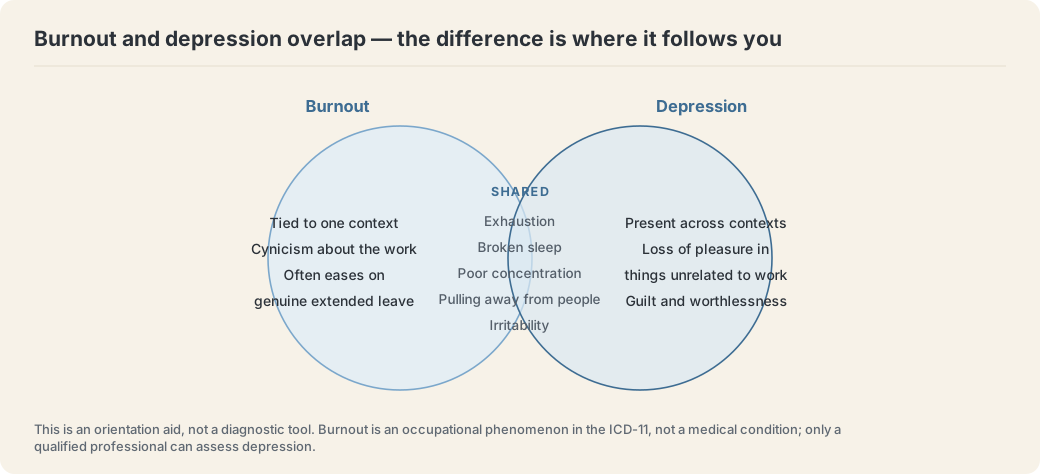
- Scope, Burnout is tied to work, people often find that things they enjoy outside it still function. Depression tends to flatten everything, including what used to be reliable.
- Self-regard, Depression frequently carries worthlessness and guilt that reach into who you are as a person. Burnout is more often about capacity, "I cannot do this anymore" rather than "I am worthless."
- Response to distance, Real time away, with no email, often shifts burnout noticeably. Depression usually travels with you.
- Cynicism, The mental distancing in burnout has a specific flavour, detachment and irritation towards the work and sometimes the people in it. That is characteristic of burnout rather than depression.
- Hope, Burnout tends to hold onto the idea that a different job or a different load would help. Depression often removes the sense that anything would.
Where the distinction breaks down
This is the part most articles skip. Prolonged burnout frequently develops into depression, and the two overlap enough that separating them cleanly is often not possible, or particularly useful.
Two things make a real difference to how urgent it is. If there are thoughts of self-harm or of not wanting to be here, that is not burnout, whatever else is also true, and it needs medical attention rather than a holiday. And if you cannot recall the last time anything felt good, including outside work, including things that used to be reliable. That is a stronger signal for depression than for occupational burnout.
If you are not sure, that is a legitimate thing to bring rather than something to resolve before you get help. Your GP is the right person for the medical question, since counsellors in BC cannot diagnose.
What each actually needs
Burnout responds to changes in conditions, which is unwelcome news when the conditions are not fully yours to change. The work usually involves recovering the capacity to notice your own limits, rebuilding boundaries that eroded gradually, and being honest about which parts of the load are structural. Therapy helps with the psychology of that, particularly the beliefs that made overwork feel obligatory, which is where it overlaps with high-functioning anxiety. It cannot reduce your caseload.
Depression responds to treatment, and the evidence base is strong for therapy, medication, or both depending on severity. Depression counselling works on the patterns and the meaning; a physician handles the medical question. The two run perfectly well in parallel.
For people in caregiving and shift-based work: healthcare, first response, social services. The picture is usually both at once, plus a workplace culture that treats the exhaustion as a personal failing. That is covered on the page for healthcare and shift workers.
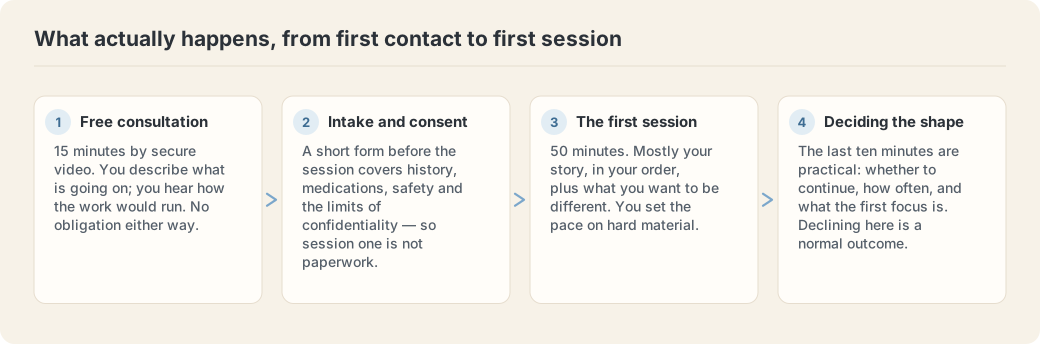
If you cannot tell which of these it is, that is a good use of a free 15-minute call rather than a reason to wait. Book a free consultation.
Why the distinction matters practically
This is not a taxonomic argument. The two point to different first moves, and getting it wrong wastes months.
If the picture is burnout, the leverage is largely in the situation. Workload, autonomy, recognition, fairness, and the gap between what the job demands and what you value. These are the recognised drivers, and none of them is fixed by a resilience workshop. The uncomfortable implication is that the most effective interventions are frequently structural, and the person experiencing it often has limited control over them. Counselling in that case works on what you can influence: boundaries, the decision about whether to stay, and the recovery.
If the picture is depression, the leverage is different. A holiday will not fix it, because it will follow you onto the holiday. What helps is treatment: structured psychological work with an evidence base, sometimes alongside medication, prescribed by a physician rather than a counsellor. Waiting for circumstances to improve is not a plan.
And the two coexist constantly. Prolonged burnout is a risk factor for depression, which is exactly why "it is just work" becomes a costly conclusion when it stops being accurate.
The test that separates them
- What happens on genuine extended leave, The most useful single question. Burnout tends to ease with real time away, not a long weekend, but a proper stretch. Depression follows you, and coming back from a fortnight off unchanged is significant information.
- Does pleasure still work elsewhere?, Burnout usually leaves capacity for enjoyment outside the work context. Depression flattens things you used to like regardless of where they happen.
- Is there self-blame?, Burnout typically produces cynicism directed outward: at the organisation, the clients, the system. Depression more often produces guilt and worthlessness directed inward.
- What is the sleep doing?, Both disrupt it. Early-morning waking with a mood dip, or sleeping far more than usual and waking unrefreshed, lean toward depression.
- Has anything about the situation changed?, If the job improved, the workload dropped, or you changed roles, and the state persisted regardless. That is a strong signal the condition has become independent of its cause.
Recovering from burnout when you cannot leave the job
Most burnout advice assumes an exit. A sabbatical, a change of role, a resignation. For a great many people none of those is available in any near timeframe, and advice premised on them lands as another thing they are failing at.
What is actually available is narrower and not nothing. Recovering the boundary between work and not-work is usually the highest-value move, because burnout erodes it first: notifications off at a fixed hour, a genuine transition ritual at the end of the day, and one day a week with no work contact at all. That is not a cure and it slows the decline measurably.
Reclaiming autonomy anywhere it exists. Lack of control is one of the strongest drivers of burnout, and small recovered decisions: what order things get done in, how a meeting runs, which one thing you say no to, have an effect out of proportion to their size.
Reducing the number of things done to an unrequested standard. Much of the load in burnout is self-imposed excellence on tasks nobody is measuring. Identifying two of those and deliberately doing them adequately is uncomfortable and frees real capacity.
Protecting recovery rather than filling it. Time off spent on the other job: chores, admin, obligations, is not recovery. Some of it has to be genuinely unclaimed to count.
And it is worth being honest about the ceiling. Where the driver is a structurally impossible workload or a hostile environment, no personal strategy fixes it, and the useful work becomes about the decision to leave and what has to be true first. That is a legitimate thing to spend sessions on, and considerably better than spending two more years testing whether resilience is the missing ingredient.
Common questions
Can I get a doctor's note for burnout?
A physician can certify you unfit for work based on your symptoms. They will document it in whatever terms are clinically appropriate, burn-out itself is classified as an occupational phenomenon rather than a medical condition, but the exhaustion and its effects are real and documentable.
How long does burnout take to recover from?
It varies widely and depends heavily on whether the conditions change. Recovery that consists of resting and then returning to an unchanged workload tends not to hold.
Should I take time off work for burnout?
Sometimes, and it is a decision to make with a physician, who decides whether you are fit for work and can certify sick leave on the symptoms. Time off helps burnout most when something about the conditions you return to changes; rest followed by an unchanged workload tends not to hold. If a break of two weeks or more changes nothing, mention that to the physician as well, because it points toward depression. Stress or mental health leave in BC covers who signs the note, whether it is paid, and planning the return.
Is burnout a type of depression?
No. The World Health Organization lists burn-out in ICD-11 under factors influencing health status, not as a medical condition, and defines it only in relation to work; depression is a diagnosable mental health condition that reaches every area of life. They overlap, and prolonged burnout can develop into depression, which is why a physician should hear about symptoms that persist away from work.
Is burnout just stress?
No. Stress usually involves over-engagement and urgency. Burnout is closer to the opposite: depletion, disengagement, and blunting. Chronic unmanaged stress is the route to it, but they are different states.
What if I cannot change my job?
That is the common situation. The work then focuses on what is genuinely within your control: boundaries, recovery, the internal rules that make overwork feel non-negotiable, while being honest that this manages the cost rather than removing the cause.
Sources
- World Health Organization, burn-out as an occupational phenomenon (ICD-11)
- CMHA BC, workplace mental health
- HereToHelp BC, depression info sheet
This guide is general information, not clinical advice, and it cannot diagnose anything or replace an assessment. If you are in crisis, call or text 9-8-8 (Canada, 24/7) or BC Mental Health Support at 310-6789.
Who you would talk to
Taking new clients and seeing people across BC by secure video. Each is a Registered Clinical Counsellor; the registration is on the profile and can be checked on the BCACC register.

Camille Granda, RCC, CCC
English and Tagalog · Trauma, Anxiety and chronic stress, Grief, loss and life transitions
In her words: “I want sitting with me to feel like the biggest belly breath you have ever taken.”

Savneet Singh, RCC
English and Punjabi · Anxiety, Depression, Trauma and attachment
In her words: “Comforting, safe and supportive, is what I aim for.”
Individual sessions are $140 for 50 minutes, after a free 15-minute consultation; card at booking.
Many extended health plans reimburse a Registered Clinical Counsellor, depending on the plan, so check yours; MSP does not cover private counselling. All fees.
Still deciding?
A free 15-minute consultation is the least committal way to find out whether this is a fit. No pressure, and no obligation to book a session afterward.
Book Free ConsultationNot ready to book? Send a line about what is going on. A reply comes within one business day.
Or a smaller step: Burnout, or depression? A reflection · What sessions cost · What the free 15 minutes is like
Looking on behalf of someone else? What to send them, and what not to, including the funded routes most people do not know they qualify for.
Where this leads
Online depression counselling and therapy across BC
The practice is virtual, so the same counsellors see people in every one of these cities. Each page says what the service involves there and who is taking new clients.
If this is close to your own situation, there is a page written for it: Counselling for tech workers in BC and Counselling for truck drivers in BC.
Where you are
Online counselling across British Columbia
Every session is by secure video, so the counsellor you see does not depend on where you live. Each city page covers coverage, local public services and who is taking new clients there.