Guide · Supporting someone
When someone you love is drinking
You cannot control another adult's drinking, and most of the strategies that feel like trying: monitoring, pouring it away, ultimatums you will not enforce, reliably make things worse while exhausting you. What does help: changing what you do rather than what they do, getting support in your own right, and knowing that withdrawal from alcohol can be medically dangerous and is not something to manage at home.
You cannot make someone stop. That is the hardest sentence in this and the one everything else follows from.
7 min read · Updated
The medical fact that comes first
Before anything else: withdrawal from alcohol can be medically dangerous, unlike withdrawal from most other substances. Sudden cessation after heavy, sustained drinking can produce seizures and delirium tremens, which can be fatal.
That means "just stop" is not only unhelpful advice, it can be unsafe advice. Someone drinking heavily every day needs medically supervised withdrawal rather than willpower, and that is a health service rather than a counselling one.
Signs that warrant urgent medical attention include shaking, sweating, confusion, hallucinations or a seizure after cutting down. That is 9-1-1 or an emergency department, not a booking.
For non-urgent routes, every health authority in BC runs substance use services with withdrawal management, and access generally begins with a phone call rather than a referral. 8-1-1 reaches HealthLink BC at any hour and can point you to the local service.
What reliably does not work
- Monitoring and counting, Checking bottles, tracking units, searching for hidden supplies. It consumes enormous energy, and it converts you into the enforcement mechanism, which changes the relationship into a surveillance arrangement without changing the drinking.
- Pouring it away, Produces conflict and, where the person is physically dependent, can be unsafe. It also reliably escalates concealment.
- Ultimatums you will not enforce, The single most damaging move. An unenforced ultimatum teaches that your limits are negotiable, and each one after it is worth less. Do not state a consequence you are not prepared to carry out.
- Covering for them, Calling in sick on their behalf, paying the fine, smoothing it over with family. Understandable, kind, and it removes the consequences that might otherwise register.
- Arguing while they are drinking, Nothing said to an intoxicated person is retained or agreed to in any meaningful way. The conversation has to happen sober or not at all.
- Waiting for rock bottom, A popular idea with weak support. People do not reliably improve after catastrophe, and the catastrophe can be permanent.
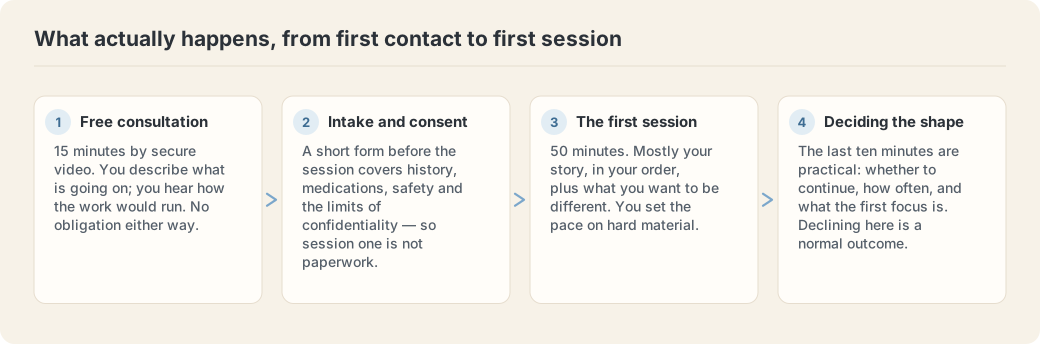
If you have been holding this alone for a long time, a free 15-minute consultation is available to you too.
What tends to help?
Change your own behaviour rather than theirs. This is the core of the better-evidenced approaches for family members. What you stop doing: covering, arguing, absorbing consequences, is within your control, and it changes the environment the drinking exists in. That is not manipulation; it is the only lever you actually have.
Speak to the person, not the drinking, and do it sober. Specific, factual, about your own experience. "On Tuesday you did not remember the conversation and I was frightened" lands differently from "you have a problem". The second invites a defence; the first is not disputable.
Be concrete about what you will do. Not what they must do. "If you drive after drinking, I am not getting in the car and neither are the children" is a boundary you can enforce, see setting boundaries with family.
Protect the children's reality. Where children are involved, the most protective thing available is frequently an accurate, age-appropriate explanation that it is not their fault and not their responsibility. Children in this position construct explanations, and the ones they construct alone are usually worse.
And get your own support. Not as a fallback. Family members of people who drink heavily experience significant strain in their own right, and support is available to you whether or not they ever change anything.
Support for you, in your own right
This is the part most people skip, on the grounds that they are not the one with the problem. It is worth stating plainly that you do not need to be the person drinking to need support.
Health authority substance use services in BC generally offer family support alongside treatment, and access does not require the drinking person to be engaged with them. There are also peer support groups specifically for family members, available in person and online across the province.
310-6789 reaches BC Mental Health Support at any hour, no area code needed, and is a legitimate number to call about someone else. 8-1-1 reaches HealthLink BC for navigation.
Individual counselling for yourself is also entirely appropriate here, and it is not disloyalty. What it works on is your own exhaustion, the anger, the guilt, the hypervigilance of waiting for the next episode, and the decisions you may be deferring, see how to support someone who is struggling.
And if there is violence, or you are frightened, that is a different and urgent situation: 9-1-1 in immediate danger, and VictimLinkBC at 1-800-563-0808, twenty-four hours a day.
Common questions
Should I give an ultimatum?
Only one you are certain you will carry out. An unenforced ultimatum devalues every limit you set afterwards, which leaves you with less influence than before.
Can I get counselling if they refuse to?
Yes. Support for family members is legitimate in its own right, and changing your own responses is the only lever genuinely available to you.
Is it my fault?
No. Another adult's drinking is not caused by you and is not within your control, however much the pattern implies otherwise.
What if they want to stop?
That is a medical conversation before anything else, because withdrawal from alcohol can be dangerous. Health authority substance use services and a physician are the right first calls.
Sources
This guide is general information, not clinical advice, and it cannot diagnose anything or replace an assessment. If you are in crisis, call or text 9-8-8 (Canada, 24/7) or BC Mental Health Support at 310-6789.
Individual sessions are $140 for 50 minutes, after a free 15-minute consultation; card at booking.
Many extended health plans reimburse a Registered Clinical Counsellor, depending on the plan, so check yours; MSP does not cover private counselling. All fees.
There is no wrong way to start.
A free 15-minute consultation over secure video, whenever you are ready for one. Nothing is committed by having it, and no card is needed to book it.
Book Free ConsultationNot ready to book? Send a line about what is going on. A reply comes within one business day.
Or a smaller step: Which kind of counselling fits? · What sessions cost · What the free 15 minutes is like
Looking on behalf of someone else? What to send them, and what not to, including the funded routes most people do not know they qualify for.
Where you are
Online counselling across British Columbia
Every session is by secure video, so the counsellor you see does not depend on where you live. Each city page covers coverage, local public services and who is taking new clients there.