Guide · Patterns
Procrastination that has nothing to do with laziness
Procrastination is best understood as short-term mood repair rather than poor time management. The task produces an unpleasant feeling: dread, boredom, self-doubt, and avoiding it removes the feeling immediately. That relief is the reward that trains the pattern, which is why better planning tools so consistently fail to fix it.
The people who procrastinate hardest are frequently the ones who care most about the outcome.
6 min read · Updated
Why time-management advice does not work
If procrastination were a planning problem, planning tools would solve it. Most chronic procrastinators have tried a great many of them, and the pattern persists, which is reasonably strong evidence that the diagnosis is wrong.
The better account is that procrastination is about how the task makes you feel right now. Approaching it produces something unpleasant: dread, boredom, confusion about where to start, or the specific discomfort of possibly producing something inadequate. Turning away removes that feeling instantly.
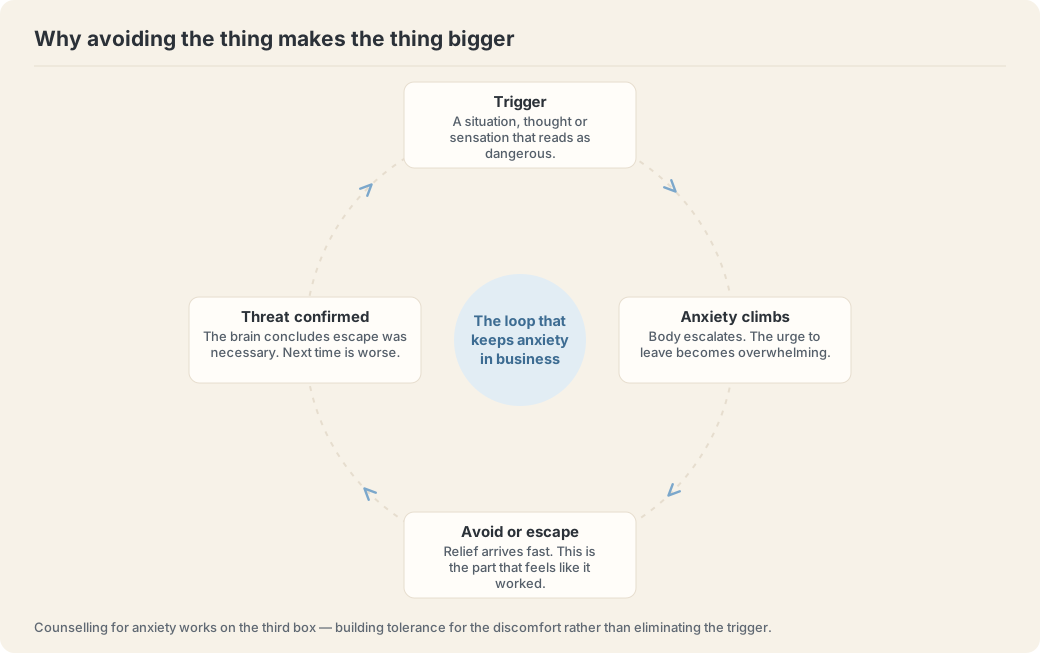
That is a genuine reward, delivered immediately, every single time. The cost arrives later and is heavily discounted by a brain that treats now as more real than Thursday. This is the same architecture as any avoidance loop, see the avoidance cycle.
It also explains the specific and otherwise baffling observation that people will do genuinely unpleasant things, cleaning the oven, reorganising files, in order to avoid the task. It is not that they want to be idle. It is that the avoided task carries a particular feeling the alternatives do not.
The feelings underneath, and which one is yours
- Fear of an inadequate result, The perfectionist version. Starting creates the possibility of producing something not good enough; not starting postpones that indefinitely. See perfectionism and self-criticism.
- Not knowing where to begin, A task too vaguely defined to have a first action. The mind reads ambiguity as threat and turns away. The fix is decomposition rather than motivation.
- Boredom, which is genuinely aversive, Under-discussed and real. For some people a tedious task produces a physically uncomfortable restlessness that is hard to sit through.
- Resentment, Tasks imposed by someone else, or work you no longer believe in. Procrastination here is closer to passive refusal, and no technique fixes it because it is carrying a message.
- The task means something about you, Where the outcome would be evidence about your ability, your career or your worth, avoidance protects the self-concept. Common with applications, creative work and anything being judged.
- Exhaustion, Sometimes it is not psychological. A depleted person avoiding demanding tasks is a body making a reasonable allocation decision, and the answer is rest rather than strategy.
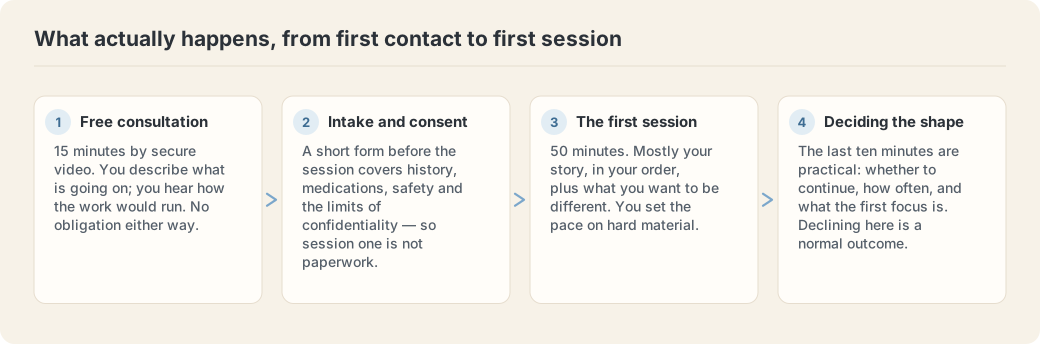
If the same thing has been on the list for six months, that is a reasonable use of a free consultation.
What actually helps
Shrink the first step until it is absurd. Not "write the report" but "open the document and write one bad sentence". The threshold that matters is the one for starting, because starting reliably changes the feeling. Most people report that the dread drops sharply within a few minutes of beginning.
Name the feeling before the task. Thirty seconds of identifying what specifically is unpleasant about it: dread, boredom, not knowing where to start, measurably reduces the pull to avoid, because the avoidance was operating below awareness.
Separate the deciding from the doing. A great deal of procrastination is spent deciding whether to start. Deciding once, in advance, at a specific time, removes the repeated decision that keeps being lost.
Reduce self-attack about it. This is counter-intuitive and reasonably well supported: harsh self-criticism about procrastinating makes the next episode more likely, because it adds another unpleasant feeling to the task. Being straightforward rather than punitive with yourself is not indulgence. It removes fuel.
And check whether it is a message. Chronic procrastination on one specific thing, while functioning well elsewhere, is frequently information about the thing rather than about you. That is worth taking seriously rather than techniquing around.
When it is something else
Procrastination that is global rather than task-specific: everything, for months, including things you used to enjoy, is worth examining as low mood rather than as a habit. The loss of initiation is a recognised feature of depression, and treating it as a discipline problem adds self-blame to an illness.
Lifelong, pervasive difficulty starting and finishing, alongside disorganisation and difficulty sustaining attention, is a different picture again and one that warrants assessment rather than strategy, see adult ADHD.
And where the avoided task is genuinely frightening rather than merely unpleasant. An unopened envelope, a medical result, a conversation that will change something. The relevant work is on the fear rather than the scheduling. Money stress and mental health covers the most common version of that.
Common questions
Is procrastination a mental health problem?
Not in itself. It becomes clinically relevant when it is causing real harm to your work, finances or health, or when it is a symptom of something else such as low mood or anxiety.
Does discipline fix it?
Rarely, on its own, because the mechanism is emotional rather than motivational. Approaches that work on the feeling attached to the task tend to outperform approaches that work on the schedule.
Why do I do it with only some tasks?
Because it is about the specific feeling a specific task produces. Task-specific procrastination alongside general functioning is usually information about that task.
Is being hard on myself about it helping?
The evidence points the other way. Self-criticism adds another aversive feeling to the task, which increases avoidance rather than reducing it.
Sources
- Canadian Mental Health Association, BC Division
- HealthLink BC, mental health and substance use
- Anxiety Canada
This guide is general information, not clinical advice, and it cannot diagnose anything or replace an assessment. If you are in crisis, call or text 9-8-8 (Canada, 24/7) or BC Mental Health Support at 310-6789.
Who you would talk to
Taking new clients and seeing people across BC by secure video. Each is a Registered Clinical Counsellor; the registration is on the profile and can be checked on the BCACC register.

Camille Granda, RCC, CCC
English and Tagalog · Trauma, Anxiety and chronic stress, Grief, loss and life transitions
In her words: “I want sitting with me to feel like the biggest belly breath you have ever taken.”

Savneet Singh, RCC
English and Punjabi · Anxiety, Depression, Trauma and attachment
In her words: “Comforting, safe and supportive, is what I aim for.”
Individual sessions are $140 for 50 minutes, after a free 15-minute consultation; card at booking.
Many extended health plans reimburse a Registered Clinical Counsellor, depending on the plan, so check yours; MSP does not cover private counselling. All fees.
Still deciding?
A free 15-minute consultation is the least committal way to find out whether this is a fit. No pressure, and no obligation to book a session afterward.
Book Free ConsultationNot ready to book? Send a line about what is going on. A reply comes within one business day.
Or a smaller step: Burnout, or depression? A reflection · What sessions cost · What the free 15 minutes is like
Looking on behalf of someone else? What to send them, and what not to, including the funded routes most people do not know they qualify for.
Where you are
Online counselling across British Columbia
Every session is by secure video, so the counsellor you see does not depend on where you live. Each city page covers coverage, local public services and who is taking new clients there.