Who we work with
Counselling for rotational and camp workers
Counselling for rotational, camp and fly-in-fly-out workers in BC. Sessions by video from camp or from home, scheduled around a rotation rather than a weekday, for the specific strain of a life split between two places and a relationship conducted mostly by phone.
Fourteen days on, fourteen days off, and a counselling system that assumes you can make Tuesday at four every week.
7 min read · Updated
Open times don’t fit your rotation? Ask for one, and the counsellor replies with a time that is not on the calendar yet.
Many extended health plans reimburse a Registered Clinical Counsellor, depending on the plan, so check yours; MSP does not. Receipts are issued for every session, and the fees are published in full. On a calendar-year plan, sessions held by 31 December count against this year: using benefits before the plan year ends.
Individual sessions are $140 for 50 minutes, after a free 15-minute consultation.
A great deal of British Columbia’s work happens on rotation: mining, forestry, energy, marine, remote construction, wildfire crews, and the trades that follow them (the site side has a page of its own, on counselling for tradespeople). It pays well and it structures a life around a calendar that almost no service in the province is designed for. In the Peace it is the ordinary working week, which is why counselling in Fort St. John is set up around a rotation.
The counselling problem is straightforward and rarely solved. Weekly appointments do not survive a two-week rotation. Camp connectivity is unreliable. There is frequently no counsellor within two hours of site. And the fortnight at home is already spoken for by the family, the house, and everything deferred while you were away.
What tends to bring people here is not the job itself. It is that the pattern has started costing something at home, and the two weeks off have stopped feeling like time off.
What comes up
The things people actually say
The re-entry problem
Coming home and not slotting back in. The household developed a rhythm without you and reorganises when you return, which is disruptive for everyone and almost never said out loud.
Two people running parallel lives
Both partners competent and increasingly separate. Not conflict, divergence. It usually shows up as a fight about something small.
Sleep that never settles
Night shifts, rotating shifts, camp noise, then a completely different schedule at home for a fortnight. The body clock never gets a stable signal.
Drinking as the transition ritual
The thing that marks the end of a rotation, and the thing that gradually becomes load-bearing.
Isolation that does not look like isolation
Surrounded by people constantly and with nobody to say anything real to. Camp is crowded and it is not company.
What you have seen at work
Serious injuries, fatalities, near misses. Incidents get a debrief and then everyone goes back to the face. The processing happens later, alone, or not at all.
Guilt in both directions
Guilt about missing things at home, guilt about the relief of leaving. Both are common and neither gets much air.
No local option
A community of two thousand people, no counsellor, and the nearest service is a four-hour drive that also requires explaining where you are going.
If the schedule is the reason you have never started, a free 15-minute consultation can be booked around the rotation.
How the scheduling actually works here
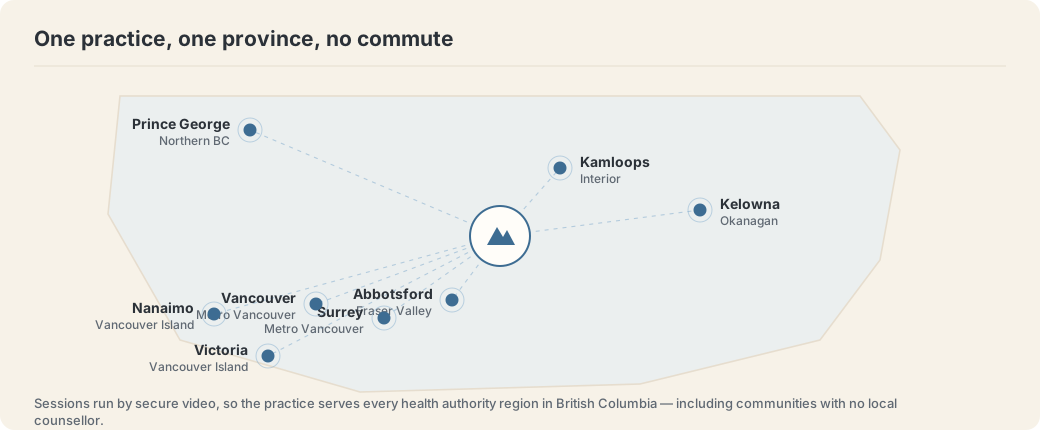
Sessions run by secure video anywhere in British Columbia, which removes the geography problem entirely. That still leaves the rhythm problem, and the answer is to stop pretending a weekly cadence is possible.
What tends to work is a schedule built around the rotation rather than against it: sessions concentrated in the days at home, or sessions from camp where connectivity allows, or a mixed pattern that changes with the shift. The booking calendar shows each counsellor’s real open times, and turning the camera off cuts what a camp connection has to carry.
It is worth being honest that a fortnight between sessions is not ideal for every kind of work, trauma reprocessing in particular is difficult to do well with long gaps. Where that is what you need, it is better to plan an intensive block during a stretch at home than to run it thinly across six months.
Confidentiality, which is the real question
In a small crew or a small town, the thing that stops people getting help is not stigma in the abstract. It is that everybody knows everybody, and a counsellor in a community of two thousand may also be somebody’s cousin.
A virtual practice based elsewhere in the province removes that entirely. Nobody at site knows, nobody at home has to be told, and there is no waiting room to be recognised in. What is discussed is confidential within the legal limits set out in writing before the first session, and an employer receives nothing.
That holds even where an employer funds the sessions through an assistance programme, providers report aggregate usage, not names or content. EFAP vs private counselling sets out the trade-off, and for anyone with a programme available it is genuinely worth using first.
What the work usually focuses on
Three things come up more than anything else. The first is the re-entry transition itself, which is a skill rather than a mood. There are concrete things that make the first forty-eight hours home go better, and most of them involve lowering expectations on both sides rather than trying harder.
The second is sleep, because rotation wrecks it and because sleep loss makes everything else worse in a measurable way. Anxiety and sleep covers the loop, with the caveat that standard sleep-hygiene advice is largely unusable on a rotating schedule and has to be adapted rather than repeated.
The third is whatever has been carried from work and never unpacked. Where that is a specific incident, trauma therapy and EMDR are the direct routes; where it is cumulative, years of near misses and a body that never fully stands down. The work looks more like widening capacity than processing a single memory.
Where the strain has landed on the relationship rather than the individual, couples work by video is often the only format two schedules can actually sustain.
If something happened at work
Mental-health claims arising from work are handled by WorkSafeBC, and they are accepted in defined circumstances, most clearly following a traumatic event experienced at work, and in some cases for cumulative work-related stressors. It is a separate system from disability benefits and from workplace accommodation, and the three are routinely confused.
Mental health and work in BC sets out how they differ and what an employer is entitled to know, which is your functional limitations rather than your diagnosis. A counsellor does not diagnose and cannot provide the medical documentation those processes require; that comes from a physician or psychologist.
If it is urgent rather than administrative, the crisis services are free and immediate from anywhere in the province: 9-8-8 by call or text, or 310-6789 for BC Mental Health Support, both twenty-four hours a day.
Who you would see
Taking new clients and seeing people across BC by secure video. Each is a Registered Clinical Counsellor; the registration is on the profile and can be checked on the BCACC register.

Camille Granda, RCC, CCC
English and Tagalog · Trauma, Anxiety and chronic stress, Grief, loss and life transitions
In her words: “I want sitting with me to feel like the biggest belly breath you have ever taken.”

Savneet Singh, RCC
English and Punjabi · Anxiety, Depression, Trauma and attachment
In her words: “Comforting, safe and supportive, is what I aim for.”
Where to start
The first forty-eight hours home
Re-entry is the part of rotational life that causes the most damage and gets the least attention, and it is unusually responsive to a small amount of planning.
What is actually happening is two adjustments colliding. You are decompressing from a fortnight of structure, noise and no autonomy. The household has been running a functioning system without you and is now reorganising around your return. Both of those are legitimate, and neither is about the other person.
A few things reliably help. Say what you need in advance rather than on arrival, a few hours of quiet, or the opposite, but stated before the drive rather than negotiated in the doorway. Do not make decisions in the first day. The conversations that get deferred for two weeks tend to be waiting at the door, and the worst possible time to have them is at the end of a rotation.
Take over one specific thing rather than all of it. Arriving and reorganising a system that has been working without you reads as criticism, however it is meant. One agreed handover is better than a general resumption of authority.
And build a marker that is not a drink. Rotational drinking frequently starts as a transition ritual and becomes load-bearing. Something else that reliably marks the change. A walk, a specific meal, an hour alone, occupies the same slot without the eventual cost.
Most of this is negotiated once, before the next rotation, and then repeated. It is not therapy so much as logistics; it just happens to be logistics that no one is ever taught.
Drinking, and where the line usually moves
Alcohol occupies a specific structural role in rotational life, and naming it plainly is more useful than a warning.
On the way in, it marks the end of the days off. On the way out, it marks the end of the rotation. In camp, where drinking is restricted or prohibited, the pattern frequently compresses into the days at home instead, which produces a two-week abstinence and a two-week concentration that looks like moderation on a weekly average and is not.
The line usually moves in three recognisable stages. First it becomes the transition ritual, which is common and not in itself a problem. Then it becomes the thing that makes the transition possible, which is a change in function rather than quantity. Then it becomes what happens whether or not there is a transition to mark.
The questions that actually separate those: does the amount increase when the fortnight has been harder? Is it the first thing you plan on the way home? Has anyone at home mentioned it more than once? Do you drink alone at the end of the day off as well as at the start?
None of that is a diagnosis, and a counsellor does not provide one. What it is is worth raising early rather than at the point where it has become the largest thing on the list, and where withdrawal management is needed, that is a medical service rather than a counselling one. The BC resource directory lists the routes.
Services that tend to fit
Individual therapy
The main container for re-entry, isolation, sleep and what the job has cost.
Trauma therapy
For incidents at work that got a debrief and never got processed.
Couples therapy
When the rotation has quietly turned two people into parallel operations.
Online counselling
The format that makes any of this possible from camp or a remote community.
Depression counselling
When the days off have stopped feeling like time off.
Common questions
Can I do sessions from camp?
Where the connection allows, yes, and turning the camera off cuts what the connection has to carry. The bigger constraint is usually privacy rather than bandwidth, so it is worth working out where you can talk uninterrupted before the first appointment.
What if I can only do sessions every two weeks?
That is workable for a lot of the work and less suited to trauma reprocessing, which prefers shorter gaps. Where an intensive piece is needed, planning a block during a stretch at home usually beats spreading it thin.
I work out of province on rotation. Does that matter?
Yes, and it is worth raising early. A counsellor must be registered where you are physically located during a session, so sessions run while you are in BC. It can be planned around once it is known.
Will my employer find out?
No. Sessions are confidential within the legal limits, and an employer receives nothing, including where an assistance programme funds the sessions, since providers report only aggregate usage.
Sources and further support
- WorkSafeBC, mental health injury claims
- Canadian Mental Health Association, BC Division
- HealthLink BC, mental health and substance use
General information, not clinical advice, and not a diagnosis. If you are in crisis, call or text 9-8-8 (Canada, 24/7) or BC Mental Health Support at 310-6789. In immediate danger, call 911.
Where you are
Online counselling across British Columbia
Every session is by secure video, so the counsellor you see does not depend on where you live. Each city page covers coverage, local public services and who is taking new clients there.
One conversation, no commitment.
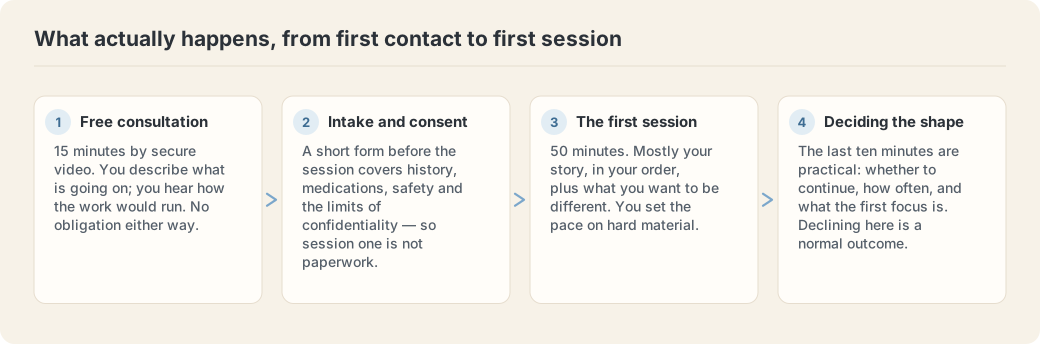
A free 15-minute consultation over secure video, including an honest answer if something other than counselling would serve you better.
Book Free ConsultationNot ready to book? Send a line about what is going on. A reply comes within one business day, or read the guides first and come back when you want to.
Looking on behalf of someone else? What to send them, and what not to, including the funded routes most people do not know they qualify for.