For · Teachers
Counselling for teachers in BC
Counselling for BC teachers, education assistants and TTOCs, online, booked into whichever open time the timetable leaves. The recurring material is specific: the September cliff, classroom composition and behaviour load that has outgrown the supports, marking that colonises evenings, compassion fatigue from carrying students’ home lives, and the guilt-laced question of whether to stay in the profession. Many school-district extended health plans reimburse Registered Clinical Counsellor sessions, depending on the plan.
Everyone thinks they know what teaching is like because everyone went to school. The version you are living. The composition of one actual classroom, at 8:40 on a Tuesday, is another thing entirely.
6 min read · Updated
Many extended health plans reimburse a Registered Clinical Counsellor, depending on the plan, so check yours; MSP does not. Receipts are issued for every session, and the fees are published in full. On a calendar-year plan, sessions held by 31 December count against this year: using benefits before the plan year ends.
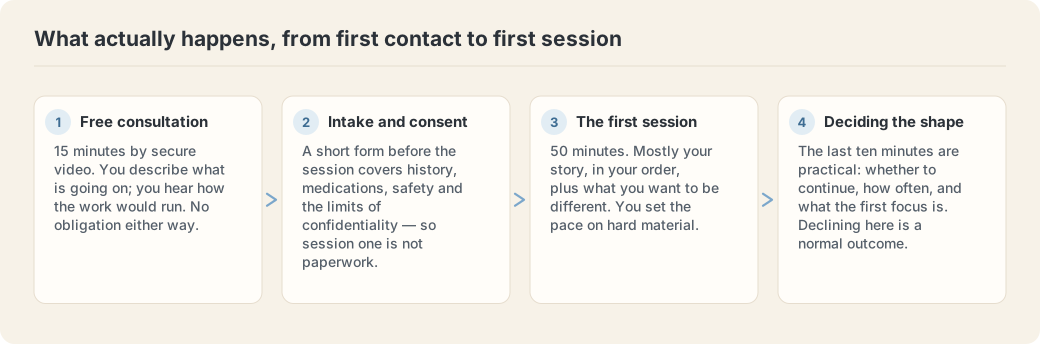
Individual sessions are $140 for 50 minutes, after a free 15-minute consultation.
Teaching has a strain profile most jobs do not: a performance that cannot be phoned in, delivered to an audience whose needs exceed the resources in the room, on a calendar that resets every September regardless of what last June cost you. The profession also runs on a myth of vocation that makes admitting struggle feel like betraying the calling, which is how burnout in teachers gets narrated, by teachers, as personal failure.
Sessions are booked from the times the calendar actually shows, and nothing said in them reaches a district, a principal, or a professional registry. The limits of confidentiality are the ordinary legal ones, stated before you share anything. A bar teachers, of all people, will recognise the shape of.
What comes up
The things people actually say
The September cliff
August dread that starts mid-July, the first-week adrenaline, and the October crash. A yearly cycle so predictable it can be planned for, which almost nobody does.
Composition and behaviour load
Classrooms whose designations, needs and behaviours have outgrown the support hours attached to them. The daily arithmetic of who gets you is a moral weight, not just a workload.
Work that follows you home
Marking, prep, report cards, the 9 pm parent email. When the job has no natural edge, the person becomes the edge, and it wears.
Other people’s trauma
Teachers carry disclosures, hungry kids, and home situations they can neither fix nor forget. Compassion fatigue is an occupational exposure here, not a weakness.
TTOC precarity
The on-call years: 6 am phone roulette, new rooms daily, income that will not sit still, and doing all of it without a school community of your own.
The staying question
"Can I do this for twenty more years?", asked guiltily, because leaving feels like abandoning the kids. A question worth examining somewhere the answer has no audience.
A free 15-minute consultation fits in a spare block, and July exists. Either works. Book a free consultation.
Why the usual advice lands wrong on teachers
Generic burnout advice: set boundaries, leave work at work, take breaks, assumes a job where those levers exist. A teacher cannot step away from a classroom at 10:15 because their capacity is low, cannot decline the IEP meeting, and cannot make thirty adolescents asynchronous. The profession’s structure removes exactly the controls the self-help literature assumes, and being told to use levers you do not have is its own small demoralisation.
What counselling offers instead is work on the levers that do exist: the September cycle planned for rather than survived; the difference between the job’s real demands and the perfectionism stacked on top of them; the marking that expands to fill guilt rather than need; the recovery that summers should provide and often do not because July is spent convalescing and August anticipating. And underneath, for many teachers, the identity work, because "teacher" is who you are in a way "account manager" rarely is, which is precisely why the strain cuts so deep.
The practical fit
Sessions are online and booked from what the counsellor has open, and summer is often when the timetable finally allows sustained work. Many district extended-health plans reimburse Registered Clinical Counsellor sessions, depending on the plan; the coverage checklist has the two questions to ask your plan. Where a district EFAP exists, it is a legitimate free first stop, and the EAP comparison is honest about where its session caps bite for anything longer than a rough patch.
If the strain has already reached the point of medical leave, the page on mental health and work in BC covers the mechanics: sick days, the doctor’s note, EI, the return. For a teacher the income comes in a set order: district sick leave first, as your collective agreement sets it, then the BCTF Salary Indemnity Plan, whose short-term benefit begins on the first working day after sick leave runs out and pays 50% of the salary your district reports, non-taxable, for up to 120 days on any one claim (the BCTF’s Salary Indemnity Plan page, read 16 Oct 2026). Teachers use those pages every September; the aim of this one is fewer of them needing to.
Using teacher benefits for counselling
Many BC teachers can put counselling here through their own benefits, depending on the plan, and the place to start is the extended health plan. For most districts that plan is administered by Pacific Blue Cross, and it usually lists Registered Clinical Counsellors as eligible practitioners. Check two things in your booklet or the Pacific Blue Cross member portal: that the counselling line names "Registered Clinical Counsellor" or "clinical counsellor", and what the annual maximum is.
Separately, the BCTF Health and Wellness Program is a case-management program for members whose health is affecting their teaching, whether or not they are off work. A rehabilitation consultant works with you and your health care providers, and the program can help fund services such as counselling where it is part of that plan. It is a referral, not an automatic benefit, so ask the program directly what it would cover for you.
Teachers teaching on call should check whether they are enrolled at all: the BCTF benefits page sets out TTOC eligibility for extended health, and enrolment is not always automatic. However you are covered, this practice does not bill the plan directly: you pay when you book, get a receipt for every session, and submit it yourself. Whether and how much is reimbursed is always a question for your plan.
Who you would see
Taking new clients and seeing people across BC by secure video. Each is a Registered Clinical Counsellor; the registration is on the profile and can be checked on the BCACC register.

Camille Granda, RCC, CCC
English and Tagalog · Trauma, Anxiety and chronic stress, Grief, loss and life transitions
In her words: “I want sitting with me to feel like the biggest belly breath you have ever taken.”

Savneet Singh, RCC
English and Punjabi · Anxiety, Depression, Trauma and attachment
In her words: “Comforting, safe and supportive, is what I aim for.”
Where to start
Services that tend to fit
Individual therapy
The core fit: burnout, anxiety, the staying question, and the perfectionism the profession selects for.
Anxiety counselling
For the Sunday-night dread and the performance anxiety that never fully leaves the room.
Depression counselling
For the Octobers that do not lift, and the flatness that outlasts the term.
Common questions
Can you see me only during summer?
Yes. A compressed stretch of weekly summer sessions is a legitimate shape for this work, and common among teachers. Better still is a plan that survives September: summer depth, then lighter touchpoints through the term at after-school times.
Is this confidential from my district and the TRB?
Sessions are confidential within the ordinary legal limits: risk of serious harm, children at risk, court orders, which are explained before you share anything. Attending counselling is not reportable to anyone, and no information flows to employers or regulators without your written consent.
Does my extended health cover this?
Many district plans reimburse Registered Clinical Counsellor sessions, depending on the plan. Check your plan wording for "RCC" or "clinical counsellor" and the annual maximum. Receipts are issued for every session; most teachers pay and submit.
Can I use my BCTF or district benefits here?
Usually, depending on your plan. Most district extended health plans for teachers are administered by Pacific Blue Cross and list Registered Clinical Counsellors; check the counselling line and the annual maximum. The BCTF Health and Wellness Program can also help fund counselling as part of a case-managed plan. There is no direct billing: you pay at booking and submit the receipt.
I think I might need a leave. Is that a different conversation?
It is a connected one. The stress-leave, doctor’s-note and EI pages on this site map the mechanics, and counselling is both part of what a certified leave typically involves and the work that makes the return hold. Reading in advance costs nothing; so does a consultation.
Do you understand the classroom reality, or will I spend sessions explaining it?
You will not need to argue that composition, marking load and the September cycle are real. They are the starting premises here, not claims to defend. The work starts from your actual Tuesday, not from a brochure version of teaching.
Sources and further support
- Canadian Mental Health Association, BC Division
- Anxiety Canada
- BCTF, health and dental benefits
- BCTF, Health and Wellness Program
General information, not clinical advice, and not a diagnosis. If you are in crisis, call or text 9-8-8 (Canada, 24/7) or BC Mental Health Support at 310-6789. In immediate danger, call 911.
Where you are
Online counselling across British Columbia
Every session is by secure video, so the counsellor you see does not depend on where you live. Each city page covers coverage, local public services and who is taking new clients there.
One conversation, no commitment.
A free 15-minute consultation over secure video, including an honest answer if something other than counselling would serve you better.
Book Free ConsultationNot ready to book? Send a line about what is going on. A reply comes within one business day, or read the guides first and come back when you want to.
Looking on behalf of someone else? What to send them, and what not to, including the funded routes most people do not know they qualify for.