Guide · Patterns
Perfectionism, and the voice that comes with it
The clinically relevant part of perfectionism is almost never the high standard. It is the self-criticism attached to missing it, and a scoring system in which meeting the standard is neutral and falling short is catastrophic. That asymmetry is what produces the exhaustion, the procrastination and the inability to enjoy anything, and it is the part that can change without lowering the standard at all.
Nobody wants to give up the thing that got them here. That is exactly why it is difficult to work on.
7 min read · Updated
The scoring system, not the standard
Ask a perfectionist what happens when they do something well, and the answer is usually some version of: nothing. It was what was required. The scoring system only registers shortfalls, meeting the bar is a non-event and missing it is a verdict.
That asymmetry does all the damage. It means effort never produces satisfaction, only the temporary absence of failure, which is why people with genuinely impressive records describe feeling as though they are permanently behind. It also means the internal cost keeps rising while the external record keeps improving, so nobody notices.
This is why the usual advice: lower your standards, be kinder to yourself, lands badly. It sounds like an instruction to become worse at things, and it is asking someone to give up the strategy that has demonstrably worked. The more workable target is the scoring, not the standard.
What it looks like from inside
- Procrastination that makes no sense, Not laziness. The opposite. Starting means risking a result that is not good enough, so the task stays unstarted. Perfectionism is one of the largest causes of procrastination and one of the least suspected.
- An inability to finish, Continuing to adjust something well past the point of return, because releasing it means it can be judged.
- Discounting anything you achieved, Every success reclassified after the fact as luck, timing, or an easier task than it looked. The bar quietly moves so it is never actually cleared.
- All-or-nothing execution, If it cannot be done properly it is not done at all. Which means the gym, the writing and the phone call get abandoned entirely after one missed week.
- Difficulty delegating, Not control for its own sake. An unwillingness to have your name on something you did not verify. It is a major driver of overload in senior roles.
- Exhaustion nobody understands, The work looks manageable from outside. What is not visible is that everything is being done to a standard nobody asked for.
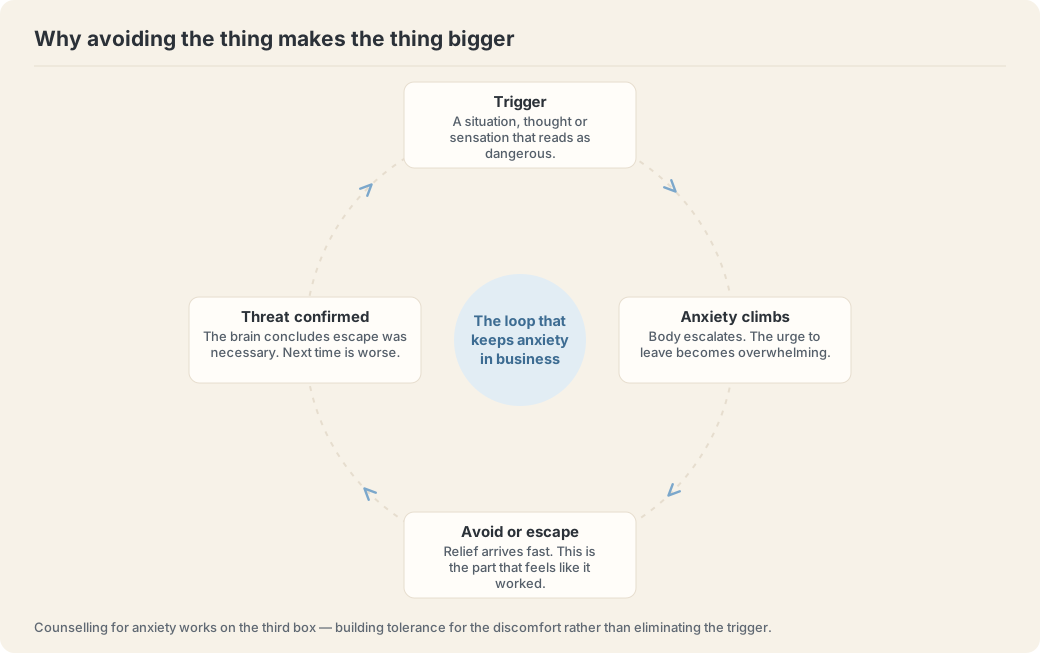
Where it usually comes from
Most perfectionism is a solution to something rather than a personality trait. Frequently it developed in an environment where performance was the reliable route to approval, safety or attention. A household where achievement was what got noticed, a school that sorted people early, a family under enough pressure that being the one who caused no problems was a genuine contribution.
That matters because it explains the resistance. Giving up perfectionism is not experienced as relief; it is experienced as risk, because at some point the strategy was doing real protective work. Anyone who has been told to just relax about it has felt how little that recognises what is actually at stake.
It is also why the work usually goes further back than the current deadline. The self-criticism has a voice, and the voice is frequently recognisable. Identifying whose it is does not fix it, and it does reliably change your relationship to it.
What tends to shift it
- Separating the standard from the punishment, You can keep the high bar. What is negotiable is what happens internally when you miss it. Most people have never considered these as two separate things.
- Deliberate imperfection, at low stakes, Sending the email without the fourth read. Turning something in at good-enough on purpose. Uncomfortable by design, and the discomfort is the point. It demonstrates that the predicted catastrophe does not arrive.
- Noticing the discounting as it happens, Catching the exact moment an achievement gets reclassified as luck. Once visible, it becomes considerably harder to do automatically.
- Defining "done" in advance, Writing down what finished looks like before starting, so completion is a criterion rather than a feeling, which it will otherwise never become.
- Working on the self-criticism directly, Structured approaches exist for this. It is not a matter of positive self-talk, which most perfectionists find hollow and rightly reject.
- Treating what it fuels, Perfectionism frequently sits underneath anxiety and low mood rather than beside them. See high-functioning anxiety and anxiety counselling.
If nothing you achieve has felt like enough for a long time, a free 15-minute consultation is a place to start.
What you do not have to give up
Caring about the quality of your work is not the problem, and this is worth stating clearly because it is the objection almost everyone raises. High standards, conscientiousness and pride in doing something properly are genuine assets, and nothing in this work requires trading them away.
What changes is the cost structure. Doing excellent work without an internal tribunal attached to every outcome is possible, and the people who get there generally report producing more rather than less, largely because the procrastination and the inability to finish were themselves products of the fear.
If the pattern is entangled with family expectations, obligation, or a background in which achievement carried the weight of a whole family's migration, counselling for first-generation South Asian adults and counselling for women both cover versions of that specific bind.
The experiment that does more than any insight
Perfectionism is unusually resistant to understanding alone. People arrive already able to explain where it came from and what it costs, and the explanation changes nothing, because the belief underneath it is predictive rather than historical: if I let the standard slip, something bad happens.
A prediction can be tested, which is why the most effective move is behavioural. Pick something genuinely low-stakes. An internal email, a form, a message to a friend, and deliberately do it at eighty per cent. Send it without the extra read. Then write down, before you send it, exactly what you expect to happen.
Then record what actually happened. Almost invariably: nothing. Nobody notices, nobody comments, the work is received as normal. Doing this a dozen times across different contexts produces something that argument cannot, direct evidence that the standard was doing far less protective work than it claimed.
Two things make this work. Predict specifically beforehand, "they will think I am careless", because a vague dread cannot be disconfirmed and will quietly rewrite itself afterwards. And do not start with something that matters, because a bad outcome at high stakes will set the whole exercise back.
The discomfort is the mechanism rather than a side effect. Sending something you know could be better is genuinely unpleasant for anyone with this pattern, and tolerating that discomfort while nothing bad happens is precisely what updates the belief. Insight tells you why you are like this; this tells your nervous system that it is safe not to be.
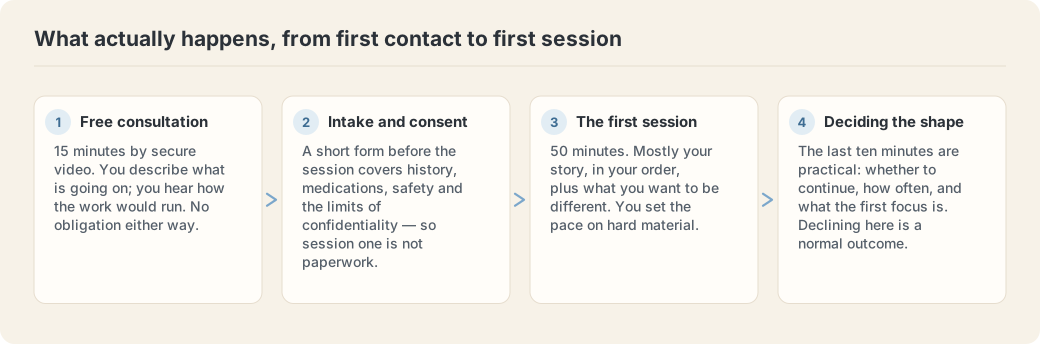
The self-critical voice, and what to do about it
Most people with this pattern have tried and abandoned positive self-talk, and they were right to. Telling yourself you are doing well when you do not believe it produces nothing except a further judgement about being unable to do the exercise.
What tends to work is different in kind. Separate the voice from yourself. Noticing "the critical thing is running" rather than "I am useless" creates a gap that is small and consequential, because a thought you are observing is one you can decline to act on.
Identify whose voice it is. Frequently it is recognisable. A parent, a teacher, a specific person at a specific age. That recognition does not remove it and it reliably reduces its authority, because it reframes it as an inherited recording rather than an assessment.
Test its accuracy as a prediction, not as a judgement. "I will humiliate myself" is checkable. "I am not good enough" is not. Rewriting the criticism into something falsifiable, then checking, is what makes it addressable.
Apply the standard you would apply to someone else. Not as a warm exercise, as a consistency check. If a colleague described the same performance, would you reach the same verdict? The gap between the two answers is the distortion, and it is usually enormous.
And expect it to get quieter rather than to stop. The realistic outcome is a voice that still arrives and no longer runs the decision. People waiting for silence generally conclude the work failed while it was in fact working.
Common questions
Is perfectionism a diagnosis?
No. It is a pattern, not a disorder, though it frequently accompanies anxiety, depression and obsessive-compulsive presentations. A counsellor does not diagnose any of those.
Will therapy make me less ambitious?
That is the standard fear and it does not match what tends to happen. The target is the self-criticism and the all-or-nothing scoring, not the standard itself.
Why do I procrastinate if I care so much?
Because you care so much. Starting creates the possibility of an inadequate result, and not starting postpones that. Procrastination in perfectionism is avoidance, not indifference.
How long does this take to change?
It is a long-standing pattern rather than a recent difficulty, so it usually takes longer than a bounded problem. How long therapy takes sets out what determines that.
Sources
- Canadian Mental Health Association, BC Division
- Anxiety Canada
- HealthLink BC, mental health and substance use
This guide is general information, not clinical advice, and it cannot diagnose anything or replace an assessment. If you are in crisis, call or text 9-8-8 (Canada, 24/7) or BC Mental Health Support at 310-6789.
Who you would talk to
Taking new clients and seeing people across BC by secure video. Each is a Registered Clinical Counsellor; the registration is on the profile and can be checked on the BCACC register.

Camille Granda, RCC, CCC
English and Tagalog · Trauma, Anxiety and chronic stress, Grief, loss and life transitions
In her words: “I want sitting with me to feel like the biggest belly breath you have ever taken.”

Savneet Singh, RCC
English and Punjabi · Anxiety, Depression, Trauma and attachment
In her words: “Comforting, safe and supportive, is what I aim for.”
Individual sessions are $140 for 50 minutes, after a free 15-minute consultation; card at booking.
Many extended health plans reimburse a Registered Clinical Counsellor, depending on the plan, so check yours; MSP does not cover private counselling. All fees.
Still deciding?
A free 15-minute consultation is the least committal way to find out whether this is a fit. No pressure, and no obligation to book a session afterward.
Book Free ConsultationNot ready to book? Send a line about what is going on. A reply comes within one business day.
Or a smaller step: Burnout, or depression? A reflection · What sessions cost · What the free 15 minutes is like
Looking on behalf of someone else? What to send them, and what not to, including the funded routes most people do not know they qualify for.
Where this leads
If this is close to your own situation, there is a page written for it: Counselling for tech workers in BC.
Where you are
Online counselling across British Columbia
Every session is by secure video, so the counsellor you see does not depend on where you live. Each city page covers coverage, local public services and who is taking new clients there.