Guide · Seasonal
Low mood through a British Columbia winter
Seasonal patterns in mood are real and, in a province this far north, common. The strongest single lever is light: getting daylight early, deliberately, even when it is grey. Beyond that, the same things that treat low mood generally apply, and the key judgement is whether what you have is seasonal at all: if it does not lift in April, it is not the winter.
Five months of low cloud on the coast, and five hours of daylight in the north. They are not the same problem.
7 min read · Updated
Two different winters
British Columbia produces two distinct seasonal problems and they get discussed as one. On the south coast: Vancouver, the Fraser Valley, Victoria: daylight hours are not extreme, but the cloud is relentless. Weeks pass without direct sun, everything is wet, and the effect is less a sharp seasonal dip than a long grey flattening that people describe as being slightly switched off from November to March.
North of Prince George the problem is genuinely astronomical. Daylight contracts to a few hours, you leave for work in the dark and return in the dark, and for stretches of the winter you do not see the sun during a working week at all. That produces a sharper, more classically seasonal pattern, and it is a standing topic for anyone looking for therapy in Prince George or counselling in Fort St. John.
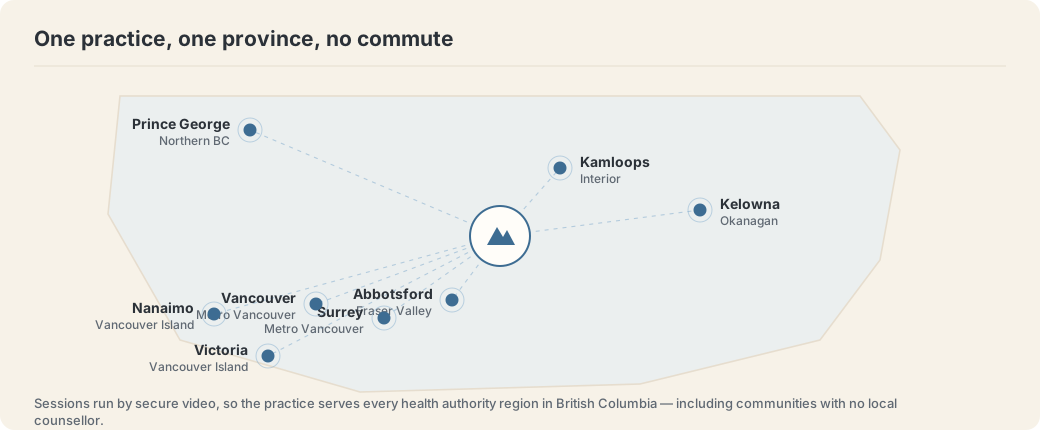
The interior adds cold and isolation to the mix, and communities without a local counsellor add a third layer: the season when you would most benefit from support is also the season when driving four hours for it is least appealing. That is a substantial part of why a virtual practice matters in this province specifically, areas served across BC covers the reach.
What actually helps
- Daylight early, even when it is grey, The single highest-leverage habit. Outdoor light on an overcast morning is still far brighter than any indoor lighting, and morning light is the strongest signal your body clock receives. Twenty minutes, before ten if possible.
- A fixed wake time, More important than bedtime, and more important in winter than at any other point in the year, because the natural cues that anchor the clock are largely absent.
- Activity scheduled rather than waited for, Low mood removes motivation first and the activity second, so waiting to feel like it guarantees the withdrawal deepens. Scheduling movement and social contact in advance is the core of the best-evidenced behavioural treatment for depression.
- Protecting social contact deliberately, Winter isolation is largely logistical. Nobody wants to drive in it. Standing arrangements survive weather better than spontaneous ones.
- Light therapy, discussed with a clinician, Light boxes are an established treatment for seasonal patterns and are not appropriate for everyone. They can be contraindicated with certain eye conditions and can destabilise bipolar presentations. Worth raising with a physician rather than ordering blind.
- Vitamin D, also with a clinician, Insufficiency is common at this latitude. Whether supplementation helps mood is less settled than the internet suggests, and dosage is a medical question rather than a counselling one.
How to tell whether it is actually seasonal
The distinguishing feature of a seasonal pattern is that it lifts. It arrives in a recognisable window, follows a predictable shape, and resolves in spring, and it has done so across more than one year.
If low mood persists through May and June, it is not the winter, whatever it feels like in January. Similarly, low mood that appeared for the first time this year alongside a major life change is more likely about the change than the season. Getting this distinction right matters, because it determines what to do about it.
It is also worth ruling out the physical. Thyroid problems, anaemia, sleep apnoea and vitamin deficiencies all present convincingly as winter low mood, and the fatigue is indistinguishable from inside. A physician is the right first stop for anyone whose energy has dropped substantially without an obvious cause.
If this is the third or fourth winter that has gone like this, a free 15-minute consultation is a reasonable place to start.
Where counselling fits
Counselling does not change the daylight, and it is worth saying that plainly rather than implying otherwise. What it works on is the part that is not weather: the withdrawal that compounds it, the thinking patterns that a flat mood makes more convincing, and the practical structure of a season that has to be planned for rather than endured.
For a genuinely seasonal pattern, the most useful sessions are frequently the ones in October, building the structure before the descent rather than trying to construct it in January with no energy. People who have been through three or four of these usually know their own onset window better than any general guidance.
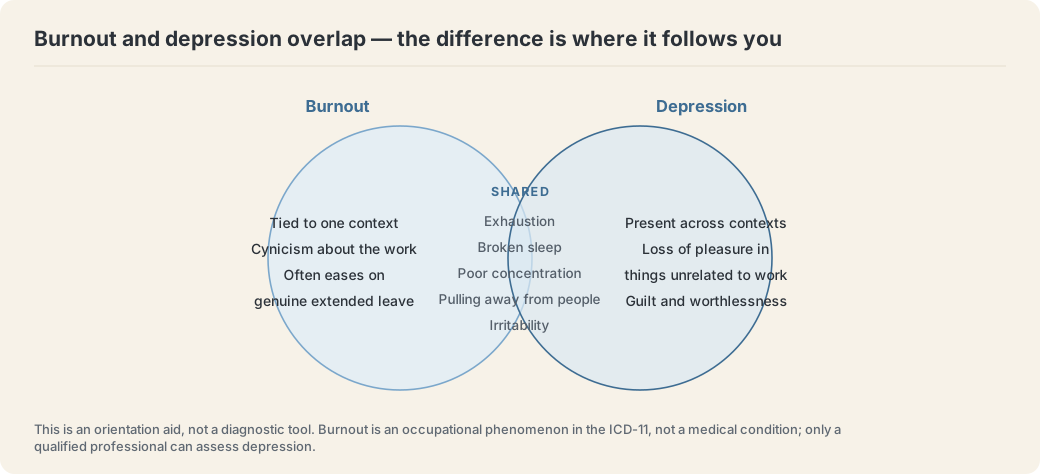
Where it turns out not to be seasonal, depression counselling and burnout vs depression are the more relevant places to start. And if it reaches thoughts of not wanting to be here, that needs support now: 9-8-8 by call or text, or 310-6789, both twenty-four hours a day.
Building the October plan
If your pattern is genuinely seasonal, the most valuable work happens before the descent rather than during it, for the plain reason that assembling structure in January, with no energy and no daylight, is considerably harder than assembling it in October with both.
A workable plan has five parts. Your onset window, which after two or three winters you probably know better than any general guidance. The week the change is usually noticeable is the week the plan starts, not the week you first feel bad.
The light routine, scheduled as an appointment. Twenty minutes outdoors within an hour of waking, every day, weather irrelevant. Made concrete in advance, which route, what coat, where it goes in the morning, because a plan requiring decisions in January will not survive January.
Two fixed social commitments a week that already exist in the calendar. Standing arrangements survive winter; spontaneous ones do not, because nobody initiates in February.
Movement you can actually do in the rain or the dark. A plan built on outdoor summer activity fails in November by design. Something indoors, close, and low-friction.
A named review date in January and one person who knows the plan. The point of both is that seasonal low mood degrades exactly the judgement needed to notice it is happening, so the decision to escalate is better made in advance by a version of you with more capacity.
Where a medical component may be involved: light therapy, vitamin D, or a medication review. Those conversations are also easier in October, when a physician appointment is a plan rather than a crisis.
When the winter is not the whole story
Seasonal attribution is convenient and it can conceal something that needs a different response. A few patterns are worth taking seriously rather than filing under the weather.
It did not lift in spring. The single clearest signal. A seasonal pattern resolves; if May and June are unchanged, the season was a coincidence or a contributor rather than a cause.
It is the first winter it has happened. A pattern requires more than one instance. A first bad winter following a significant life change is more likely about the change.
It is getting worse each year despite the same conditions. Seasonal patterns are broadly stable. Escalation across years suggests something accumulating underneath.
There are symptoms that are not mood. Significant unexplained weight change, profound fatigue disproportionate to the mood, cognitive changes, or new physical symptoms all point toward a medical assessment first. Thyroid problems, anaemia and sleep apnoea are all common and all present convincingly as winter flatness.
Alcohol has increased. Winter drinking creeps up quietly and is itself a depressant, which makes it both a symptom and a cause. It is frequently the single largest modifiable factor and the one least likely to be mentioned unprompted.
None of these means counselling is the wrong route. They mean a physician should be part of the picture rather than something to get to eventually.
Common questions
Is seasonal affective disorder a real diagnosis?
Seasonal patterns in mood are formally recognised as a specifier on depressive disorders. Diagnosis requires a qualified professional. A Registered Clinical Counsellor does not diagnose.
Do light boxes work?
They have a genuine evidence base for seasonal patterns, and they are not suitable for everyone. Raise it with a physician before buying one, particularly if you have an eye condition or any history of bipolar presentation.
Is it worse in northern BC?
The daylight contraction is far more extreme in the north, while the south coast produces a longer, greyer version. Both are real, and they tend to need slightly different responses.
Should I start counselling in autumn rather than winter?
If your pattern is predictable, yes, building structure before the descent is considerably easier than assembling it with no energy in January.
Does ending the time change affect winter low mood?
It changes the clock, not the light. From 1 November 2026 most of BC no longer turns its clocks back, so winter sunrise and sunset come an hour later by the clock than in past winters, and the daylight on any given day is the same length. Morning light is the strongest signal the body clock receives, so the practical difference is when that light is available: on a December working day it may be mid-morning or midday rather than before work. The change takes effect this winter, so there is no BC experience of it to report yet, and this guide makes no prediction about it. The steps above apply either way.
Sources
- HealthLink BC, light therapy
- UBC Mood Disorders Centre, seasonal affective disorder
- Government of British Columbia, permanent daylight saving time
- National Research Council Canada, sunrise and sunset calculator
This guide is general information, not clinical advice, and it cannot diagnose anything or replace an assessment. If you are in crisis, call or text 9-8-8 (Canada, 24/7) or BC Mental Health Support at 310-6789.
Who you would talk to
Taking new clients and seeing people across BC by secure video. Each is a Registered Clinical Counsellor; the registration is on the profile and can be checked on the BCACC register.

Camille Granda, RCC, CCC
English and Tagalog · Trauma, Anxiety and chronic stress, Grief, loss and life transitions
In her words: “I want sitting with me to feel like the biggest belly breath you have ever taken.”

Savneet Singh, RCC
English and Punjabi · Anxiety, Depression, Trauma and attachment
In her words: “Comforting, safe and supportive, is what I aim for.”
Individual sessions are $140 for 50 minutes, after a free 15-minute consultation; card at booking.
Many extended health plans reimburse a Registered Clinical Counsellor, depending on the plan, so check yours; MSP does not cover private counselling. All fees.
Still deciding?
A free 15-minute consultation is the least committal way to find out whether this is a fit. No pressure, and no obligation to book a session afterward.
Book Free ConsultationNot ready to book? Send a line about what is going on. A reply comes within one business day.
Or a smaller step: What sessions cost · What the free 15 minutes is like
Looking on behalf of someone else? What to send them, and what not to, including the funded routes most people do not know they qualify for.
Where this leads
Online depression counselling and therapy across BC
The practice is virtual, so the same counsellors see people in every one of these cities. Each page says what the service involves there and who is taking new clients.
Where you are
Online counselling across British Columbia
Every session is by secure video, so the counsellor you see does not depend on where you live. Each city page covers coverage, local public services and who is taking new clients there.