Guide · Anxiety
Social anxiety that nobody around you can see
Social anxiety is fear of being evaluated, and of the signs of that fear being noticed. In adults it is often invisible, because the avoidance is well managed: declining, arriving late, leaving early, taking the role that requires less exposure. It responds well to structured treatment, and the treatment involves dropping the coping strategies rather than improving them.
Most adults with social anxiety are not visibly anxious. They have built a life with fewer and fewer situations in it.
7 min read · Updated
Why it gets missed
The stereotype is someone visibly nervous. Most adults with significant social anxiety do not look like that at all. They look competent, and quiet, and slightly unavailable.
What has usually happened is that the anxiety has been managed by design rather than endured. The role that involves less presenting. The seat at the end. Arriving after things have started so there is no unstructured mingling. Leaving before it gets to the part where people linger. Declining, with a plausible reason, often enough that people stop asking.
From outside this reads as preference. They are private, they are not a big social person, they like their own company. From inside it is a life that has been quietly narrowed over fifteen years, and the narrowing is rarely experienced as a decision.
The other reason it is missed is that social anxiety is often at its worst in the anticipation and the aftermath rather than during. The event itself may go fine. The three days of dread beforehand and the two hours of replaying afterwards are where the condition actually lives, and neither is visible to anybody.
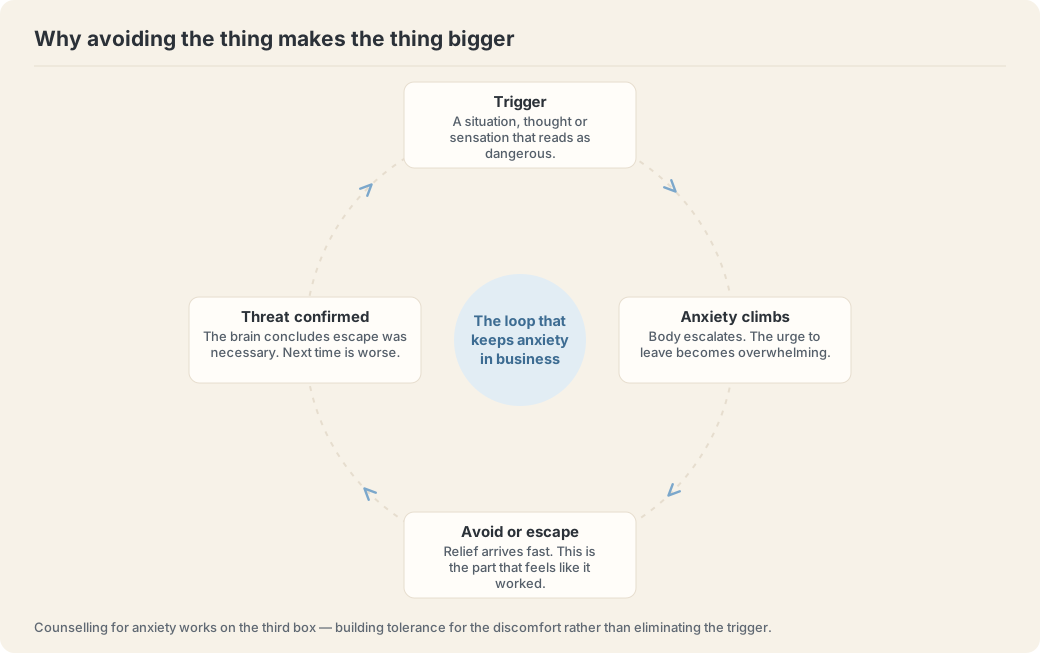
The mechanics: what keeps it running
- Self-focused attention, The central mechanism. In a feared situation, attention turns inward: monitoring your voice, your face, whether you are sweating, which means you are processing an internal impression of yourself rather than the actual room. That impression is invariably worse than reality, and it is what gets remembered.
- Safety behaviours, Rehearsing sentences, holding a drink to occupy your hands, staying near one known person, avoiding eye contact, over-preparing. Each makes the situation survivable and prevents it from disconfirming anything.
- Post-event processing, The extended review afterwards, itemising everything that could have been read badly. It feels like learning and functions as rehearsal for the next round of dread.
- Avoidance that looks like preference, The most consequential of the four, because it is invisible even to the person doing it.
- Anticipatory rumination, Days of imagining it going badly, which primes the self-focus before the event has even started.
If your world has been getting quietly smaller for years, a free 15-minute consultation is a low-exposure place to start.
What treatment actually involves
Social anxiety responds well to structured cognitive-behavioural work, the kind individual counselling is built around, and the shape of that work surprises people, because it involves doing less rather than coping better.
Attention training comes first. Deliberately moving attention outward in a feared situation, onto what the other person is actually saying, onto details of the room, rather than onto your own performance. This alone changes the experience substantially, and it is trainable.
Then dropping safety behaviours, deliberately and one at a time. Speaking without the rehearsed sentence. Not holding the glass. Making eye contact. This is uncomfortable by design, and the discomfort is the mechanism. It is what allows a situation to demonstrate that you were fine without the prop.
Then behavioural experiments rather than exposure alone. Not enduring a situation, but testing a specific prediction: "if I pause mid-sentence, people will visibly judge me." Then checking. The predictions are almost never confirmed, and the accumulation of that evidence is what shifts the belief.
Video feedback is sometimes used, and it is startling. People with social anxiety consistently rate their own performance far worse than observers do, and seeing the gap is one of the more powerful single interventions available.
The adult version, specifically
Social anxiety that has run since adolescence has usually shaped concrete things by adulthood. A career chosen partly for how little exposure it required, a social circle that has thinned by attrition, a relationship in which the other person handles anything requiring a phone call.
That makes the work broader than symptom reduction. Some of it is rebuilding capacity that was never developed, because the situations that build it were avoided for two decades. Nobody arrives fluent at something they have spent fifteen years not doing, and expecting to be is its own trap.
It also means the gains are unusually visible when they come. People frequently describe the change less as feeling calmer and more as their life getting larger: accepting things, saying something in a meeting, having a conversation that used to be unthinkable.
Working remotely has complicated this in both directions. It removes a great deal of daily exposure, which is a relief and also a way for the avoidance to become total without anyone noticing. Where that is the pattern, it is worth naming, see when therapy is not working if you have already tried and stalled.
At work, specifically
- Meetings, The fear is usually not of speaking but of the pause before speaking, and of visibly deciding whether to. A useful first target is contributing once, early, on something low-stakes, because the dread compounds across a meeting in which you have said nothing.
- The unstructured parts, Before a meeting starts, the lift, the kitchen. Frequently harder than the meeting itself because there is no role to occupy. These are worth targeting deliberately rather than engineering around.
- Video calls, A mixed picture. Self-view amplifies the self-focused attention that maintains social anxiety, turning it off is a useful intervention. Cameras off entirely is a safety behaviour that will make the return harder.
- Asking for something, A raise, a deadline extension, help. Frequently avoided entirely and quietly expensive over a career. Worth working on directly rather than treating as a separate confidence issue.
- Being watched working, Someone standing behind you, a review, a shared screen. Performance genuinely degrades under observation for most people; social anxiety adds an interpretation of that as exposure.
- Social events attached to work, The obligation to attend combined with no defined role. Declining every one is noticed over time, which adds a second, career-shaped cost to the avoidance.
Common questions
Is social anxiety just shyness?
No. Shyness is a temperament; social anxiety is a fear of evaluation that produces avoidance and shrinks a life. Plenty of outgoing people have it, and plenty of shy people do not.
Can I do this by video if talking to people is the problem?
Yes, and many people find video an easier entry point. It is worth naming that as part of the work rather than as a permanent arrangement, since the goal is a wider life rather than a more manageable one.
Will I have to do public speaking?
Only if that is one of your targets. Exposure work is built from your own list, graded from the bottom, and you set the pace.
Does alcohol make it worse?
It is one of the most common safety behaviours in social anxiety and it functions exactly like any other: short-term relief, long-term maintenance, and a rising baseline. It is worth raising honestly rather than leaving out.
Sources
- Anxiety Canada
- Canadian Mental Health Association, BC Division
- HealthLink BC, mental health and substance use
This guide is general information, not clinical advice, and it cannot diagnose anything or replace an assessment. If you are in crisis, call or text 9-8-8 (Canada, 24/7) or BC Mental Health Support at 310-6789.
Who you would talk to
Taking new clients and seeing people across BC by secure video. Each is a Registered Clinical Counsellor; the registration is on the profile and can be checked on the BCACC register.

Camille Granda, RCC, CCC
English and Tagalog · Trauma, Anxiety and chronic stress, Grief, loss and life transitions
In her words: “I want sitting with me to feel like the biggest belly breath you have ever taken.”

Savneet Singh, RCC
English and Punjabi · Anxiety, Depression, Trauma and attachment
In her words: “Comforting, safe and supportive, is what I aim for.”
Individual sessions are $140 for 50 minutes, after a free 15-minute consultation; card at booking.
Many extended health plans reimburse a Registered Clinical Counsellor, depending on the plan, so check yours; MSP does not cover private counselling. All fees.
Still deciding?
A free 15-minute consultation is the least committal way to find out whether this is a fit. No pressure, and no obligation to book a session afterward.
Book Free ConsultationNot ready to book? Send a line about what is going on. A reply comes within one business day.
Or a smaller step: A reflection on how things have been · What sessions cost · What the free 15 minutes is like
Looking on behalf of someone else? What to send them, and what not to, including the funded routes most people do not know they qualify for.
Where this leads
Online anxiety counselling and therapy across BC
The practice is virtual, so the same counsellors see people in every one of these cities. Each page says what the service involves there and who is taking new clients.
If this is close to your own situation, there is a page written for it: Counselling for teens and young adults in BC.
Where you are
Online counselling across British Columbia
Every session is by secure video, so the counsellor you see does not depend on where you live. Each city page covers coverage, local public services and who is taking new clients there.