Guide · Anxiety
Intrusive thoughts and what they actually mean
Unwanted, disturbing thoughts that arrive uninvited are close to universal: studies of people with no mental-health difficulty find the great majority experience them, including violent, sexual and blasphemous content. What separates a passing oddity from a persistent problem is not the thought but the reaction to it: the meaning attached, and the effort spent trying to prevent it.
The thoughts that frighten people most are the ones they have never told anyone. They are also, almost always, entirely ordinary.
7 min read · Updated
How common are intrusive thoughts?
This is the single most useful fact available and almost nobody knows it. Research asking people without any diagnosis whether they experience unwanted intrusive thoughts consistently finds that the large majority do, and that the content maps closely onto the content reported by people who have sought treatment for exactly this.
The themes are consistent enough to be predictable. Harm coming to someone you love. Doing something violent. Sexual content that is repugnant to you. Something blasphemous in a place of worship. Jumping, or swerving, or letting go. A new parent picturing something terrible happening to their baby.
That last one is worth stating plainly, because it causes enormous silent suffering. Intrusive thoughts about harm coming to an infant are extremely common in new parents, are not a risk indicator, and are one of the most reliably unreported experiences in perinatal mental health. Parents conclude they are dangerous and say nothing to anybody, sometimes for years.
The distinguishing feature of an intrusive thought is that it is ego-dystonic. It runs against everything you value, which is exactly why it produces such distress. A thought you find abhorrent is evidence about your values, not about your intentions.
Why they stick for some people
If nearly everyone has them, the clinical question is not why they occur but why they persist. The answer is about the response rather than the thought.
Most people register an odd thought, register it as odd, and move on. The mind produces a great deal of noise and most of it is discarded without inspection.
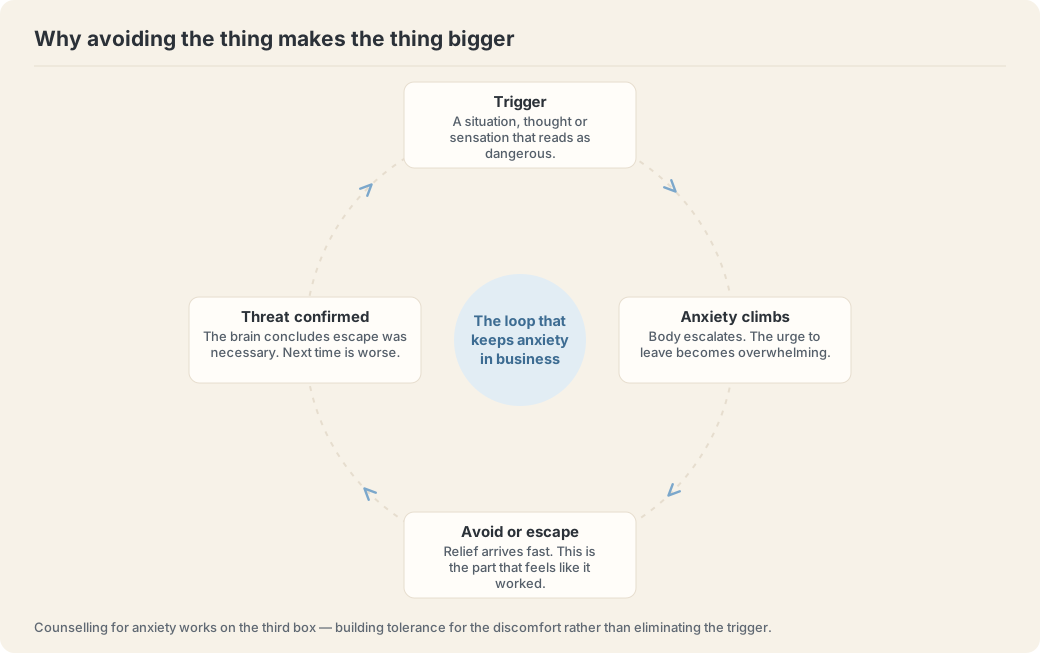
The pattern that produces trouble is different. The thought is treated as meaningful, as a signal about what kind of person you are, or as a warning. That interpretation produces alarm. Alarm makes the thought salient. Salience makes it recur. And then the person begins working to prevent it: suppressing it, checking, avoiding situations that might trigger it, seeking reassurance, mentally reviewing whether they would ever actually do it.
Every one of those responses increases the frequency. Thought suppression in particular is well studied and reliably backfires, instructing yourself not to think something is an instruction that requires monitoring for the thought, which guarantees you find it.
This is the same architecture as any anxiety loop: a short-term relief behaviour that teaches the system the threat was real. See the avoidance cycle.
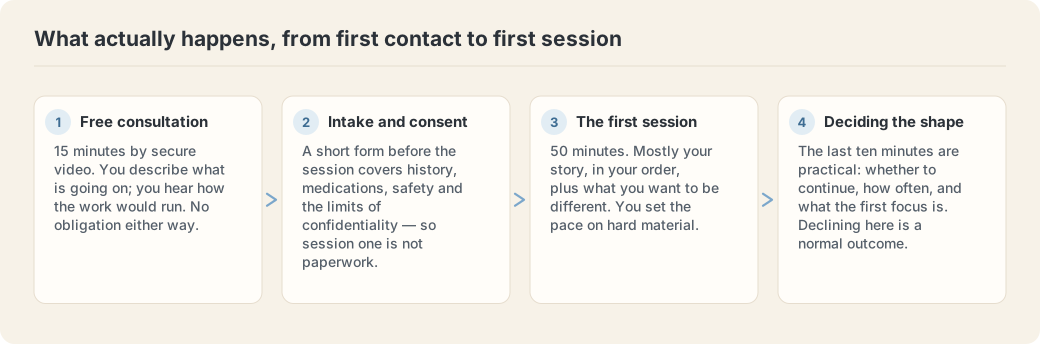
If this has been going on privately for a long time, a free 15-minute consultation is a place to say it out loud.
What helps, and what makes it worse
- Stop trying not to have them, Counter-intuitive and central. Allowing a thought to be present without engaging it reduces its frequency far more reliably than suppression, which is a monitoring instruction in disguise.
- Change the relationship, not the content, The workable move is treating it as mental noise rather than as information. "That is an intrusive thought" said internally, then continuing what you were doing.
- Drop the checking, Mentally reviewing whether you would ever act on it, checking your reaction to a trigger, or testing yourself all provide brief relief and strengthen the loop.
- Drop the reassurance-seeking, Asking a partner repeatedly whether you are a good person works for about ten minutes. The interval shortens each time.
- Stop avoiding triggers, Avoiding knives, bridges, being alone with a child, or a place of worship narrows a life and confirms the danger. Graded re-entry is the treatment.
- Say it out loud once, to someone qualified, The shame of the content is frequently the heaviest part, and it survives on never being tested. A counsellor will not be shocked, and will almost certainly have heard the same theme this month.
When it is more than an intrusive thought
Where intrusive thoughts have become the organising feature of a day: hours of checking, mental reviewing, or rituals to neutralise them. That pattern has a name and a specific, well-evidenced treatment, and it is worth getting the right treatment rather than general counselling.
The relevant approach is exposure and response prevention, a structured protocol delivered by a clinician trained in it. General supportive counselling can inadvertently make this worse by providing reassurance, which is the behaviour that maintains it. A counsellor who understands this will say so and refer rather than proceed.
A Registered Clinical Counsellor does not diagnose, so nothing here identifies a condition. What it does is flag the pattern that warrants assessment: a physician, psychiatrist or registered psychologist can make that call, see psychiatry and assessment in BC.
And to be unambiguous about the fear underneath the question: intrusive thoughts about harming someone are not associated with an increased likelihood of doing so. The distress they cause is the evidence. If you are genuinely concerned about acting on something, that is a reason to speak to someone now, 9-8-8, or 9-1-1 in immediate danger, and that is a different experience from the one this page describes.
Why the theme is usually the thing you care most about
One of the more revealing features of intrusive thoughts is how reliably their content tracks a person's values. This is not a coincidence and it is useful to understand.
A devoted new parent gets thoughts about harm coming to their baby. Someone whose faith matters gets blasphemous content in a place of worship. A person who would never hurt anyone gets violent images. Someone whose sexuality is a settled part of who they are gets thoughts that contradict it.
The pattern is consistent: the mind produces intrusions on the subject you would find most unbearable. That is what makes them alarming and, once seen, what makes them interpretable. A thought is disturbing in proportion to how much it violates what you actually care about, which means the distress is a measurement of your values rather than a warning about your intentions.
This also explains why reassurance from other people rarely settles anything. Being told you would never do it addresses the wrong question. The person is not usually seeking evidence about their behaviour; they are trying to resolve an unresolvable question about what having the thought means. Which is exactly why the treatment targets the relationship to the thought rather than the answer to the question.
It is worth noticing, too, that people almost never report intrusive thoughts about things they are indifferent to. The absence is as informative as the presence.
Common questions
Does having these thoughts mean I want to do it?
No. Intrusive thoughts are characteristically the opposite of what a person values, which is why they cause distress. The distress is the evidence that they run against you rather than expressing you.
Should I tell my counsellor the actual content?
You can, and it usually helps. Counsellors hear these themes routinely and will not be shocked. You are also not obliged to give detail you are not ready to give.
Will telling someone get me reported?
Disclosing an unwanted thought is not a risk indicator and does not trigger a report. The limits of confidentiality concern genuine risk of serious harm, which is a different thing, see privacy.
Why do they get worse when I am tired or stressed?
Load lowers the threshold for almost every anxiety symptom, and it reduces the capacity to let a thought pass without engaging it. Frequency tracking sleep and stress is expected rather than significant in itself.
Sources
- Anxiety Canada
- Canadian Mental Health Association, BC Division
- HealthLink BC, mental health and substance use
This guide is general information, not clinical advice, and it cannot diagnose anything or replace an assessment. If you are in crisis, call or text 9-8-8 (Canada, 24/7) or BC Mental Health Support at 310-6789.
Individual sessions are $140 for 50 minutes, after a free 15-minute consultation; card at booking.
Many extended health plans reimburse a Registered Clinical Counsellor, depending on the plan, so check yours; MSP does not cover private counselling. All fees.
There is no wrong way to start.
A free 15-minute consultation over secure video, whenever you are ready for one. Nothing is committed by having it, and no card is needed to book it.
Book Free ConsultationNot ready to book? Send a line about what is going on. A reply comes within one business day.
Or a smaller step: What sessions cost · What the free 15 minutes is like
Looking on behalf of someone else? What to send them, and what not to, including the funded routes most people do not know they qualify for.
Where you are
Online counselling across British Columbia
Every session is by secure video, so the counsellor you see does not depend on where you live. Each city page covers coverage, local public services and who is taking new clients there.