Who we work with
Counselling for women in British Columbia
Counselling for women across BC, online in English, Punjabi or Tagalog. Covers the load that does not show up on any list, anger that has had nowhere to go, and the particular exhaustion of being the person everyone else is fine because of.
A great deal of what arrives here has been carried competently for years. Competence is exactly why nobody noticed.
8 min read · Updated
Many extended health plans reimburse a Registered Clinical Counsellor, depending on the plan, so check yours; MSP does not. Receipts are issued for every session, and the fees are published in full. On a calendar-year plan, sessions held by 31 December count against this year: using benefits before the plan year ends.
Individual sessions are $140 for 50 minutes, after a free 15-minute consultation.
There is a particular version of struggling that is hard to get taken seriously, including by the person doing it. Everything is handled. The household runs, the work gets delivered, the family is held together, and the whole structure rests on somebody who has not had an unclaimed hour in four years.
Nothing in that picture looks like a problem from outside, which is the problem. Help tends to arrive in response to visible collapse, and a system that only responds to collapse teaches people to hold on until they do.
This is not a claim that these experiences belong only to women, and this practice works with adults of any gender. It is a page about a set of patterns that show up here often enough to be worth naming directly, because the people living inside them are frequently the last to count them as reasons to book anything.
What comes up
The things people actually say
The invisible load
Not the tasks. The tracking. Knowing when the prescription runs out, which child needs new shoes, whose birthday is coming, what the deadline is. It is cognitive work that never appears on any list and cannot be handed over in an afternoon.
Anger with nowhere to put it
Often the most difficult thing to say out loud, because it arrives with guilt attached. Anger that has been unexpressed for years does not disappear; it converts into resentment, exhaustion, or a flatness that gets mistaken for calm.
Being the one who is fine
The person everyone else brings things to. It becomes an identity, and identities are difficult to put down, asking for something yourself can feel like a breach of contract you never signed.
Perfectionism that gets rewarded
A standard where meeting it is neutral and missing it is catastrophic. Difficult to give up precisely because the world keeps paying for it.
Caregiving from both directions
Children who still need everything and parents who have started to. The generation in the middle carries two sets of appointments and is usually working full time between them.
Not being believed
Years of symptoms attributed to stress, or to being tired, or to nothing. Being disbelieved by systems you have to keep using is its own injury, and it makes people slow to raise the next thing.
Identity after a transition
After a birth, after a separation, after the children leave, after a career ends or changes. The question of who you are when the organising role has gone is a genuine one and it is rarely given any room.
Relationships where the effort is uneven
Not necessarily unhappy, often affectionate and lopsided. The asymmetry accumulates quietly and usually surfaces as something else entirely.
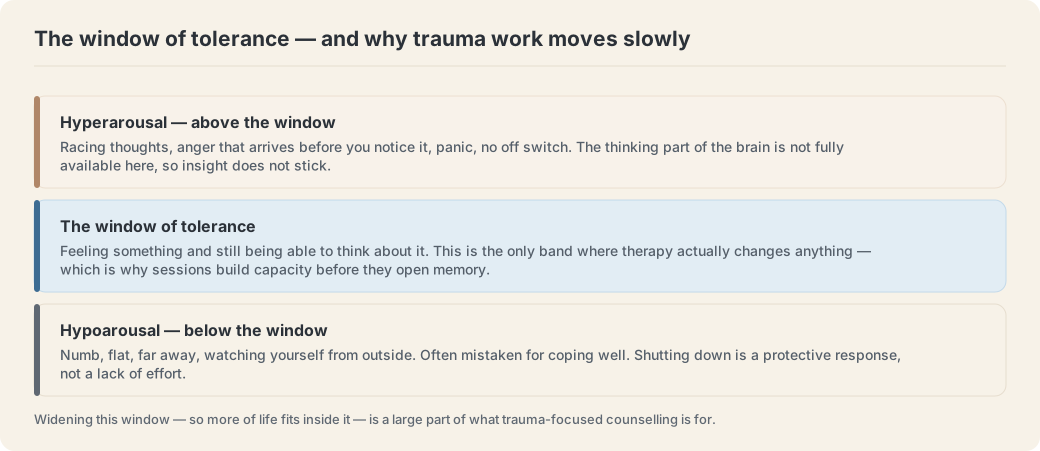
If most of this was familiar and none of it has ever been said out loud, a free 15-minute consultation is a place to start.
Why this is difficult to bring anywhere
There is no incident. Nothing happened that would sound serious if you described it. The honest summary is something like "I am tired and I am angry and I do not know why, and I have a good life", which is a hard sentence to say to anyone who is going to try to solve it.
That is also why the usual responses do not land. Suggestions to take some time for yourself, or to delegate more, mostly add another task to the person who was already holding the list. Advice presumes the problem is organisational. Frequently it is not.
What tends to be more useful is somewhere the account can be given without being immediately fixed, tidied, or reframed as gratitude. Quite a lot of the early work is establishing that the load is real and has a size, because it has usually never been counted.
Anger, and where it goes when it is not allowed
Anger is the emotion most often edited out. It arrives already labelled: as unfair, as disproportionate, as unbecoming, and gets converted into something more permissible on the way to being expressed. The most common conversions are guilt, exhaustion, and a sort of managerial patience that everyone reads as being fine.
The difficulty is that the conversion is lossy. Anger carries information about boundaries: what is too much, what is not acceptable, what needed to be said two years ago. Suppress it consistently and you lose the data, not just the outburst.
Working with it in counselling is less about permission to express it and more about recovering what it is pointing at. That is frequently uncomfortable, because what it points at is often a relationship, a workload or an arrangement that would be inconvenient to change.
Reproductive and life-stage transitions
Some of the largest psychological transitions in a life are treated as routine because they are common. Pregnancy and the year after it, pregnancy loss, infertility and treatment, and perimenopause all involve significant physiological change happening at the same time as significant change in role, identity and relationships.
Each of these has a well-worn script attached, how you are supposed to feel, and for how long, and the script is frequently unrelated to what is actually happening. People experiencing something outside it usually conclude the problem is them.
Counselling does not treat the physiology, and anything with a possible medical component belongs with a physician alongside this work rather than instead of it. What it can address is the part that is psychological: the grief, the ambivalence, the loss of a former self, and the relationships that are being renegotiated under load. Counselling for new parents covers the perinatal period specifically.
What the work tends to involve
Early sessions are usually about getting an accurate picture rather than an efficient one: what is actually being carried, by whom, and at what cost. That sounds obvious and it is often the first time anyone has laid it out, including the person carrying it.
From there the work varies. Where the difficulty is anxiety or low mood, structured approaches with a good evidence base apply directly, see anxiety counselling and depression counselling. Where the pattern is older than the current situation, the work goes further back, because a difficulty with saying no at thirty-eight usually did not begin at thirty-eight.
Boundaries come up constantly and are rarely as simple as being told to set them. Setting a boundary with people who have never encountered one has consequences, and doing it well involves deciding what you are prepared to absorb. That is a strategy conversation as much as a therapeutic one.
And where something has been carried from an earlier period, a relationship, an assault, a childhood organised around someone else's state, trauma therapy or EMDR may be the more direct route than talking around it for another year.
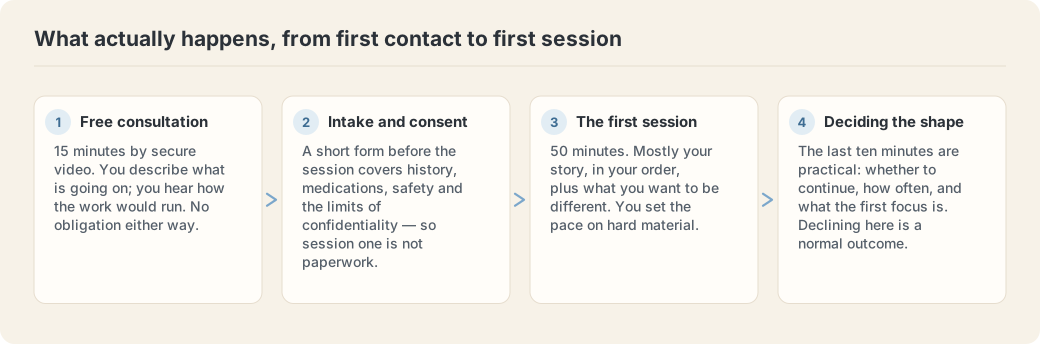
The practical part
The most common obstacle is not ambivalence about therapy. It is the hour. A weekly appointment requiring travel, parking and childcare is a fourth commitment on top of three, and it is usually the first thing to be cancelled when something else gives.
Sessions here are online across British Columbia, which removes the commute rather than the appointment, and the booking calendar shows each counsellor’s real open times. For people whose only reliable private hour is after the house is asleep or in a parked car outside the school, that is frequently the difference between attending and intending to.
Sessions run in English, Punjabi or Tagalog. Where family expectations are part of the picture, and they often are, being able to describe them without translating the context first saves a considerable amount of session time. Counselling in Punjabi covers that in more detail.
Who you would see
Taking new clients and seeing people across BC by secure video. Each is a Registered Clinical Counsellor; the registration is on the profile and can be checked on the BCACC register.

Camille Granda, RCC, CCC
English and Tagalog · Trauma, Anxiety and chronic stress, Grief, loss and life transitions
In her words: “I want sitting with me to feel like the biggest belly breath you have ever taken.”

Savneet Singh, RCC
English and Punjabi · Anxiety, Depression, Trauma and attachment
In her words: “Comforting, safe and supportive, is what I aim for.”
Where to start
Being taken seriously in a medical setting
A specific and common thread in this work is a history of not being believed: years of symptoms attributed to stress, to being tired, or to nothing. That has two costs. It delays diagnosis of physical conditions, and it teaches people to under-report, which compounds the first problem.
Counselling cannot fix a system, and there are things that measurably improve how these appointments go.
Bring a written timeline rather than a description. Dates, what changed, what has been tried, what effect it had. Written material is treated differently from spoken material, and it is harder to compress into "stress".
Lead with function, not feeling. "I have missed nine days of work in two months" lands differently from "I have been exhausted". Both are true; only one is difficult to dismiss.
Ask for the reasoning, not the conclusion. "What else was on your list, and what ruled it out?" is a reasonable question that changes the shape of a consultation without confrontation.
Ask for it in the record. "Could you note that I have raised this?" is a small request with real effects, and it makes a pattern visible at the next appointment.
And bring someone if it matters. Uncomfortable that it helps, and it frequently does.
The therapeutic work alongside this is on the part the system leaves behind. The reflex to minimise, the delay before raising something, and the anger that has nowhere to go. That is workable even where the system is not.
Asking for something, without a case attached
A pattern that shows up repeatedly: an ability to advocate effectively for other people: children, patients, colleagues, parents, alongside near-total inability to ask for anything on one's own behalf without constructing a justification first.
The tell is the shape of the request. "I was wondering if it might be possible, if it is not too much trouble, because otherwise the schedule does not work, and obviously if it is difficult then never mind." A case, an apology and a pre-emptive withdrawal, all before anyone has answered.
Two things are happening. The first is a learned expectation that a request will be refused unless it is proven necessary, which is often an accurate summary of experience rather than a distortion. The second is that the elaborate framing is doing protective work: an unadorned request that gets declined is a rejection, while a hedged one can be reclassified afterwards as never having been asked.
The practical work is unglamorous: shortening requests, removing the justification, and tolerating the discomfort of an unhedged ask. "I need Thursday afternoon" rather than four sentences. It feels rude for about a fortnight and then stops feeling like anything, and people are frequently startled by how often the answer is yes.
Where this connects to something older, it is usually about who was allowed to have needs, which is intergenerational territory as much as it is about assertiveness.
Services that tend to fit
Individual therapy
The general container for load, boundaries, identity and the things that have been carried too long.
Anxiety counselling
For the version that presents as capability: planning, over-preparing, and never quite switching off.
Trauma therapy
Where something older is still shaping how safe it feels to take up room.
Couples therapy
When the asymmetry is in the relationship and needs both people present to change.
Counselling in Punjabi
For working in the language the family conversation actually happens in.
Common questions
Does this practice only work with women?
No. This page describes patterns that come up frequently, not a restriction on who is seen. The practice works with adults of any gender, individually and as couples.
I do not have anything that counts as a real problem. Should I still book?
That sentence is one of the more common openings here. Duration and cost are better tests than severity, if something has gone on longer than it should and is taking things you care about, that is sufficient reason.
Can I do this without my family knowing?
Yes. Sessions are online and confidential within the legal limits set out on the privacy page. Nothing is disclosed to family members without your written consent.
What if what I actually need is a doctor?
Then that is what a consultation should tell you. Several physical conditions present convincingly as anxiety or low mood, and a counsellor who suspects one will say so rather than take the booking.
Sources and further support
- HealthLink BC, mental health and substance use
- Canadian Mental Health Association, BC Division
- Pacific Post Partum Support Society
General information, not clinical advice, and not a diagnosis. If you are in crisis, call or text 9-8-8 (Canada, 24/7) or BC Mental Health Support at 310-6789. In immediate danger, call 911.
Where you are
Online counselling across British Columbia
Every session is by secure video, so the counsellor you see does not depend on where you live. Each city page covers coverage, local public services and who is taking new clients there.
One conversation, no commitment.
A free 15-minute consultation over secure video, including an honest answer if something other than counselling would serve you better.
Book Free ConsultationNot ready to book? Send a line about what is going on. A reply comes within one business day, or read the guides first and come back when you want to.
Looking on behalf of someone else? What to send them, and what not to, including the funded routes most people do not know they qualify for.