For · South Asian adults
Counselling for first- and second-generation South Asian adults
Counselling for first- and second-generation South Asian adults in BC, in Punjabi or English. Family expectation, duty, izzat and log kya kahenge are treated as the context the work happens inside rather than as pathology, and nobody is told the answer is to move out and care less.
Not the therapy where you spend the first twenty minutes explaining why you cannot move out.
7 min read · Updated
Many extended health plans reimburse a Registered Clinical Counsellor, depending on the plan, so check yours; MSP does not. Receipts are issued for every session, and the fees are published in full. On a calendar-year plan, sessions held by 31 December count against this year: using benefits before the plan year ends.
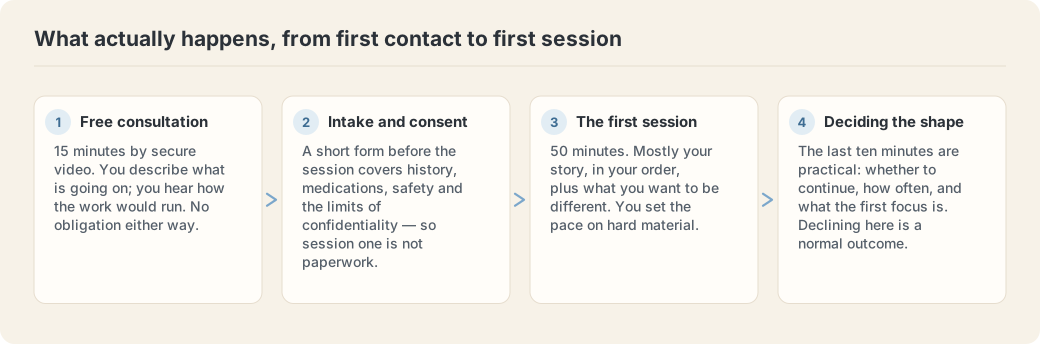
Individual sessions are $140 for 50 minutes, after a free 15-minute consultation.
The most common reason South Asian clients give for having avoided therapy is not stigma. It is the anticipated effort, the expectation of having to explain the entire cultural architecture before anything useful can happen, and of eventually being told that the obvious answer is to set a boundary, move out, or care less what your family thinks.
That advice is not wrong exactly. It is built for a model of adulthood in which independence is the goal and family obligation is a problem to be solved. In a collectivist frame it lands as a suggestion that you become a worse person.
This is counselling that starts further along. Family expectation, duty, izzat, log kya kahenge. These do not need translating, and they are not treated as pathology to be corrected. They are the context the work happens inside. Sessions run in English or Punjabi, and there is a full page in Punjabi (ਪੰਜਾਬੀ) if that is easier to read or to pass on to a parent.
What comes up
The things people actually say
Being the first in the family to do this
No template, nobody to ask, and often a private worry that seeking help proves something bad about you. Frequently combined with not telling anyone you are going.
Guilt that arrives with any independent choice
Career, partner, city, religion, how you spend money. Choosing for yourself feeling like a small betrayal rather than a normal adult act.
Two selves that do not overlap
One version at home, another at work or with friends, and the exhaustion of maintaining both, plus the question of which one is real.
"Log kya kahenge"
Decisions shaped by community perception rather than by what you want. Not vanity, a real social currency with real consequences for your parents as well as you.
Silence around mental health at home
A household where distress was met with practicality, prayer, or nothing at all. Not cruelty; usually a generation that had no capacity for it and no language.
Carrying what was never named
Migration, financial precarity, partition histories, racism absorbed in silence. Nobody discussed it, and it shaped the house you grew up in anyway, see intergenerational trauma.
If the idea of not having to explain the background is what appeals, that is exactly what the consultation is for. Book a free consultation.
What language actually changes
People who are fluent in English often assume the option of therapy in Punjabi is not for them. In practice, first language and emotional language are frequently not the same thing.
You may be entirely comfortable presenting in English at work and still find that the words for grief, shame, obligation, or the particular texture of a family argument only exist properly in Punjabi. Some things get flattened in translation (the most common Punjabi word for counselling is the English one, written in Gurmukhi), and if you spend a session translating, you spend it at one remove from what you are actually feeling.
Sessions here can be in Punjabi, English, or moving between them mid-sentence, which is how many people actually think. Punjabi-speaking counselling covers the practical detail. Availability of Punjabi-speaking counsellors varies from place to place; BCACC’s Find a Counsellor directory filters by language, and video works anywhere in BC.
This is not about choosing between your family and yourself
The fear that keeps a lot of people out of the room is that therapy will conclude with an instruction to cut people off. It is a reasonable fear, because plenty of Western therapeutic writing does treat enmeshment as the diagnosis and distance as the cure.
Most people arriving here want something more difficult: to stay in relationship with their family and stop carrying the parts that are not theirs. That is a legitimate goal and it is workable. What usually shifts is not the amount of contact but what you are willing to be responsible for, the difference between declining to manage someone else's disappointment and abandoning them.
Sometimes the work does lead to more distance, and that is your call, not a target set in advance. And sometimes it leads the other way, people report better relationships with parents once they stop needing them to become different people first.
The specific weight of being the one it worked out for
For many second-generation adults there is a particular and rarely-voiced burden: your parents' migration is understood to have been worth it because of how you turned out. That makes ordinary adult difficulty. A job you hate, a marriage that is failing, a diagnosis, a business that folded, carry an additional charge. It is not just your problem; it is evidence about whether the sacrifice paid off.
That is a heavy thing to carry silently, and it is one of the most common threads in this work. Naming it out loud, often for the first time, tends to be the point where something starts to move.
Who you would see
Taking new clients and seeing people across BC by secure video. Each is a Registered Clinical Counsellor; the registration is on the profile and can be checked on the BCACC register.

Savneet Singh, RCC
English and Punjabi · Anxiety, Depression, Trauma and attachment
In her words: “Comforting, safe and supportive, is what I aim for.”
Where to start
Deciding what to keep
A great deal of writing aimed at first- and second-generation adults treats the goal as separation: individuating, setting boundaries, becoming less enmeshed. For plenty of people that framing is not only unhelpful; it is describing a life they do not want.
The more useful work is discrimination rather than separation: sorting what you actually endorse from what you are carrying by default. Those are different categories and they get bundled together because nobody has ever asked.
Some obligations, examined, turn out to be things you genuinely choose. Caring for a parent, staying close, contributing financially, being present at things that matter to your family. Carried deliberately, these are load-bearing and sustaining rather than corrosive.
Others turn out to be inherited rules that nobody has revisited in a generation, frequently formed under conditions that no longer apply: about what can be discussed, what a career must look like, who gets consulted about your decisions. These are the ones that quietly cost the most, precisely because they were never chosen.
The third category is the hardest: obligations you do endorse that are nonetheless too heavy in their current form. Those do not need abandoning; they need renegotiating, which is slower and considerably more delicate than a boundary script implies.
None of this requires a confrontation or a declaration. Most of it is internal work that changes how you hold something, and the external conversations, where they happen at all, go much better afterwards. Setting boundaries with family covers those.
Marriage, partners, and the conversation nobody wants
One of the most frequently raised areas, and one where general advice is close to useless because it is written for a context where the decision belongs solely to the individual.
The recurring situations are specific. A partner the family will not accept. Pressure to marry on a timeline that is not yours. A marriage that is not working in a family where separation is close to unspeakable. Being the sibling whose choice will determine what is possible for the others. And navigating a partner's family alongside your own, with two sets of expectations that do not align.
What makes these hard is not that the answer is unclear. It is that every available option costs something real, and advice premised on "your life is yours" ignores that the cost is genuine rather than imagined.
What counselling can do here is narrower and more useful than a verdict. Working out what you actually want, separately from what you are prepared to bear. Understanding what the resistance is protecting, which is frequently fear rather than disapproval. Deciding what you would do with each outcome before the conversation, so it is not being decided in the room. And handling the aftermath, which is usually longer than the conversation.
What it will not do is tell you which is correct. Anyone who does is substituting their values for yours, which is the opposite of the job.
Services that tend to fit
Punjabi-speaking counselling
Sessions in Punjabi, English, or both, without translating your context first.
South Asian mental health
Family expectation, identity, and intergenerational patterns as the main work.
Anxiety counselling
For the vigilance and performance pressure that often come with this territory.
Individual therapy
For identity, direction, and working out what you want separately from what you owe.
Couples therapy
For relationships navigating two families' expectations alongside their own.
Common questions
Will my family find out I am in therapy?
No. Counselling is confidential, and whether you tell anyone is entirely your decision. Sessions are virtual, so there is no waiting room and no clinic to be seen entering. The limits on confidentiality are risk of serious harm and court orders, nothing else.
Can I have sessions in Punjabi?
Yes: in Punjabi, in English, or moving between them within a session, which is how a lot of people actually think. You do not have to choose in advance.
Will I be told to cut off my family?
No. That framing misreads the situation for most people. The work is usually about staying in relationship while stopping carrying what is not yours, and any decision about distance is yours, not a goal set for you.
My parents think therapy is for people with serious problems. Are they wrong?
They are describing a generation's understanding of it, formed when the only visible mental-health care was for crisis. Most therapy is not that. It is ordinary people working on ordinary difficulty before it becomes serious.
Sources and further support
- HereToHelp BC, mental health information for British Columbians
- CMHA BC, mental health resources
- BC Association of Clinical Counsellors, find a counsellor
General information, not clinical advice, and not a diagnosis. If you are in crisis, call or text 9-8-8 (Canada, 24/7) or BC Mental Health Support at 310-6789. In immediate danger, call 911.
Where you are
Online counselling across British Columbia
Every session is by secure video, so the counsellor you see does not depend on where you live. Each city page covers coverage, local public services and who is taking new clients there.
One conversation, no commitment.
A free 15-minute consultation over secure video, including an honest answer if something other than counselling would serve you better.
Book Free ConsultationNot ready to book? Send a line about what is going on. A reply comes within one business day, or read the guides first and come back when you want to.
Looking on behalf of someone else? What to send them, and what not to, including the funded routes most people do not know they qualify for.