Guide · Connection
Loneliness in adulthood, and why it is so hard to say
Adult loneliness is widespread, is not a character defect, and is largely structural: the conditions that produced friendship earlier in life, repeated unplanned contact with the same people, mostly disappear after education and early work. Rebuilding it requires deliberately reconstructing those conditions, which is unromantic and considerably more effective than being told to put yourself out there.
It is one of the most common things people bring to counselling and one of the last things they name.
7 min read · Updated
Why it gets harder, structurally
Friendships form reliably under three conditions: repeated unplanned contact with the same people, over time, in a setting with enough unstructured space for conversation. School, university and early jobs supply all three by default, which is why friendship in those periods feels effortless and unchosen.
Adult life systematically removes them. Work becomes remote, or busy, or transactional. People move for jobs and housing. Partnering and children reorganise time around a household. Remaining friendships require deliberate scheduling, and scheduling is exactly what a full life has least of.
The consequence is that adult friendship stops being something that happens and becomes something that must be built, using skills nobody was taught, at an age when initiating feels exposing. Most people interpret that difficulty as a personal failing rather than as the predictable result of the conditions disappearing.
This is worth stating clearly because the self-blame is the part that does the damage. Concluding that you are the problem makes initiating harder, which makes the isolation deeper, which confirms the conclusion.
Why it is so difficult to admit
Loneliness carries a particular stigma that other difficulties do not. Saying you are anxious describes a condition; saying you are lonely feels like reporting a verdict. That nobody chose you.
That makes it one of the last things disclosed in counselling, frequently arriving months in and often framed as something else. People will describe low mood, purposelessness, drinking more, or a relationship carrying more weight than it can hold, long before they will say the word.
There is also a specific bind in it. The state itself makes connection harder: loneliness increases sensitivity to social threat, which means ambiguous signals get read negatively, which produces withdrawal, which deepens the isolation. This is well documented and it means the experience is not an absence of people. It actively shapes how the people who are there get perceived.
Knowing that changes what to do about it, because it means the first move is often not meeting more people. It is noticing the negative reading of the contact you already have.
If this has been true for a while and you have never said it to anyone, that alone is a reasonable use of a free consultation.
What actually rebuilds it
- Repetition beats novelty, The single most useful principle. One activity attended weekly for six months does far more than six different events. Friendship comes from familiarity, and familiarity requires the same faces.
- Choose things with a task attached, A class, a team, a volunteer shift, a choir. Shared activity removes the burden of making conversation from nothing, which is the part that makes pure social events exhausting.
- Initiate more than feels natural, Research on this is consistent and slightly startling: people systematically underestimate how much others enjoy hearing from them. The reluctance to reach out is based on a prediction that is usually wrong.
- Escalate slowly and specifically, Acquaintance to friend happens through small increments. A specific invitation rather than "we should hang out sometime", which is a pleasantry rather than a plan.
- Reanimate dormant ties, Substantially easier than making new ones and consistently underused. People who have not been in touch for years are usually pleased to be, not resentful.
- Address the reading, not just the diary, If contact already exists but feels hollow, adding more will not fix it. That is the perception side, and it is what counselling works on directly.
When it is depression rather than circumstance
The two overlap heavily and pull in opposite directions for treatment, so the distinction matters.
Circumstantial loneliness responds to changing the circumstances: more repeated contact, deliberately built. Someone in this position generally wants connection and finds the logistics hard.
Where depression is driving it, the desire itself has gone. Invitations are declined not because of logistics but because nothing appeals, and the withdrawal is a symptom rather than a cause. Advice to socialise more lands as another failure. In that case the loop has to be entered elsewhere, see depression counselling and the reasoning on why activity precedes motivation.
The two frequently coexist, with circumstance producing the isolation and low mood then removing the capacity to reverse it. Where that is the picture, working on both simultaneously is usually necessary, a scheduled minimum of contact regardless of desire, alongside treatment for the mood.
And in a province where a great many people have moved from somewhere else, this is more common than it is discussed. It is a legitimate reason to book something, not a complaint too small to bring.
Loneliness inside a relationship
A large share of the loneliness people bring to counselling is not the absence of other people. It is loneliness inside a marriage, a family or a full social calendar, and it is considerably harder to name than the ordinary kind.
The reason is that it appears ungrateful and inexplicable. There is somebody there. The relationship may be affectionate, functional, long. Saying you feel alone inside it sounds like a complaint about a person rather than a description of an experience.
What is usually happening is a gap between contact and being known. Two people can share a household, logistics and years of history while the actual content of their inner lives has not been exchanged for a long time. It is drift rather than rupture, and drift produces no incident to point at.
It also has a specific pattern: the more times a subject has not been raised, the harder it becomes to raise, because raising it now requires explaining why it was not raised for four years. That accumulating cost is why it so often surfaces only in a crisis.
The workable move is rarely a summit conversation about the state of the relationship. It is smaller and more repeatable, restoring a regular window in which something other than logistics is discussed, and saying one true thing in it. Counselling for couples covers the joint version, and individual work is a legitimate route when only one of you is ready.
Common questions
Is loneliness a mental health problem?
It is not a diagnosis. It is a common human experience with well-documented effects on mood and physical health, and it is a legitimate thing to work on.
Is it not strange to see a counsellor about not having friends?
It is one of the more common underlying themes in adult counselling, and it is usually disclosed late because of exactly that worry.
Does a counsellor substitute for friendship?
No, and a good one will say so. Counselling can address what makes connection hard; it is not itself the connection, and any practice implying otherwise is misrepresenting what it offers.
I have people around me and still feel alone. Is that different?
Yes, and it is common. Loneliness is about the quality and depth of connection rather than the count, which is why more contact alone frequently does not resolve it.
Sources
- Canadian Mental Health Association, BC Division
- HealthLink BC, mental health and substance use
- BC government, mental health and substance use support
This guide is general information, not clinical advice, and it cannot diagnose anything or replace an assessment. If you are in crisis, call or text 9-8-8 (Canada, 24/7) or BC Mental Health Support at 310-6789.
Who you would talk to
Taking new clients and seeing people across BC by secure video. Each is a Registered Clinical Counsellor; the registration is on the profile and can be checked on the BCACC register.

Camille Granda, RCC, CCC
English and Tagalog · Trauma, Anxiety and chronic stress, Grief, loss and life transitions
In her words: “I want sitting with me to feel like the biggest belly breath you have ever taken.”

Savneet Singh, RCC
English and Punjabi · Anxiety, Depression, Trauma and attachment
In her words: “Comforting, safe and supportive, is what I aim for.”
Individual sessions are $140 for 50 minutes, after a free 15-minute consultation; card at booking.
Many extended health plans reimburse a Registered Clinical Counsellor, depending on the plan, so check yours; MSP does not cover private counselling. All fees.
Still deciding?
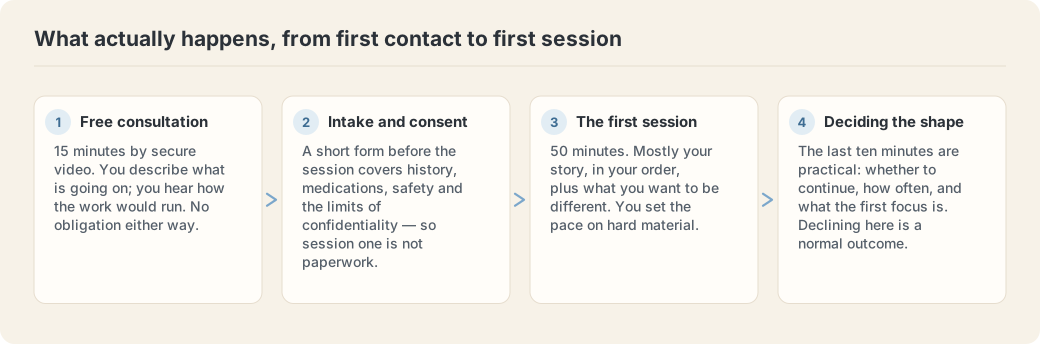
A free 15-minute consultation is the least committal way to find out whether this is a fit. No pressure, and no obligation to book a session afterward.
Book Free ConsultationNot ready to book? Send a line about what is going on. A reply comes within one business day.
Or a smaller step: What sessions cost · What the free 15 minutes is like
Looking on behalf of someone else? What to send them, and what not to, including the funded routes most people do not know they qualify for.
Where this leads
Online depression counselling and therapy across BC
The practice is virtual, so the same counsellors see people in every one of these cities. Each page says what the service involves there and who is taking new clients.
If this is close to your own situation, there is a page written for it: Counselling for international students in BC, Counselling for rotational and camp workers, Counselling for truck drivers in BC and Counselling for men in BC.
Where you are
Online counselling across British Columbia
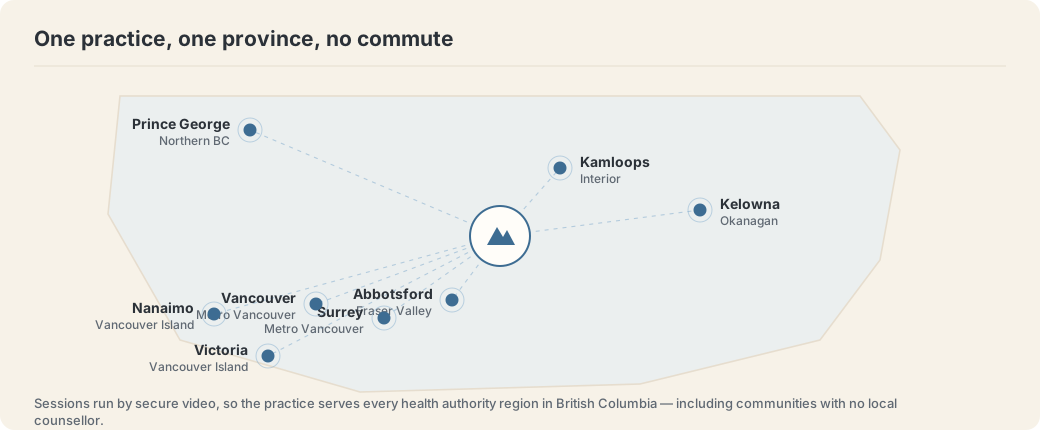
Every session is by secure video, so the counsellor you see does not depend on where you live. Each city page covers coverage, local public services and who is taking new clients there.