Guide · Anxiety
High-functioning anxiety: when everything looks fine from outside
"High-functioning anxiety" is not a clinical diagnosis. It is a widely used description of anxiety in someone whose performance has not visibly slipped, often because the anxiety is what is driving the performance. The distress is real, the cost is real, and it tends to go unaddressed for years precisely because nothing has fallen over yet.
The version of anxiety that gets promoted, hits deadlines, remembers birthdays, and cannot sleep.
6 min read · Updated
Why it goes unnoticed
Most descriptions of anxiety centre on impairment. The person who cannot go to work, cannot leave the house, cannot cope. If your anxiety has produced the opposite, that description does not fit, so you conclude you do not qualify. If you want to put words to it first, the reflection tool asks six questions and gives no score.
The pattern that gets called high-functioning anxiety runs the other way. The worry becomes fuel. You are early, over-prepared, and reliable. You reply immediately. You reread the message before sending. You are the person others describe as having it together, and none of it feels like competence from inside. It feels like staying just ahead of something. Where the dread centres on being judged in company rather than on falling behind, social anxiety in adults is the closer description.
The reason to take it seriously is not that it stops you functioning. It is what the functioning costs. Rest that is not restful, achievement that produces relief rather than satisfaction, and a nervous system that has not been off in years.
What it tends to look like
- Achievement powered by dread, You meet the deadline because missing it is unthinkable, not because the work pulls you. Finishing brings relief, then the next thing.
- Rest feels unsafe, Sitting down produces restlessness or guilt. Downtime gets filled. Holidays take days to settle into, if they ever do.
- Mental rehearsal, Conversations run in advance and again afterwards. You scan for what you might have said wrong.
- Difficulty saying no, Agreeing is faster than tolerating the discomfort of disappointing someone, so the load keeps growing.
- Body keeping score, Jaw tension, shoulders, stomach trouble, headaches, waking at 3am with the day already running.
- Nobody knows, The people closest to you would be surprised. That gap between the outside and the inside is its own specific loneliness.
Why it is hard to give up
The genuine difficulty is that it works. The anxiety produced results. The grades, the job, the reputation for reliability. So any suggestion of turning it down sounds like a proposal to become worse at your life.
That fear deserves a straight answer rather than reassurance. In practice, what changes in therapy is usually the fuel rather than the output. People who were driven by dread and become driven by something steadier tend not to collapse; they usually report that the same work costs less. But it is a real fear, it should be named early, and it is a reasonable thing to be cautious about.
For a lot of people this pattern is also inherited rather than personal. If the household you grew up in ran on vigilance, or on the sense that security depended on performance, the strategy was rational when you formed it. Intergenerational patterns sit underneath a great deal of what gets labelled high-functioning anxiety.
What actually helps
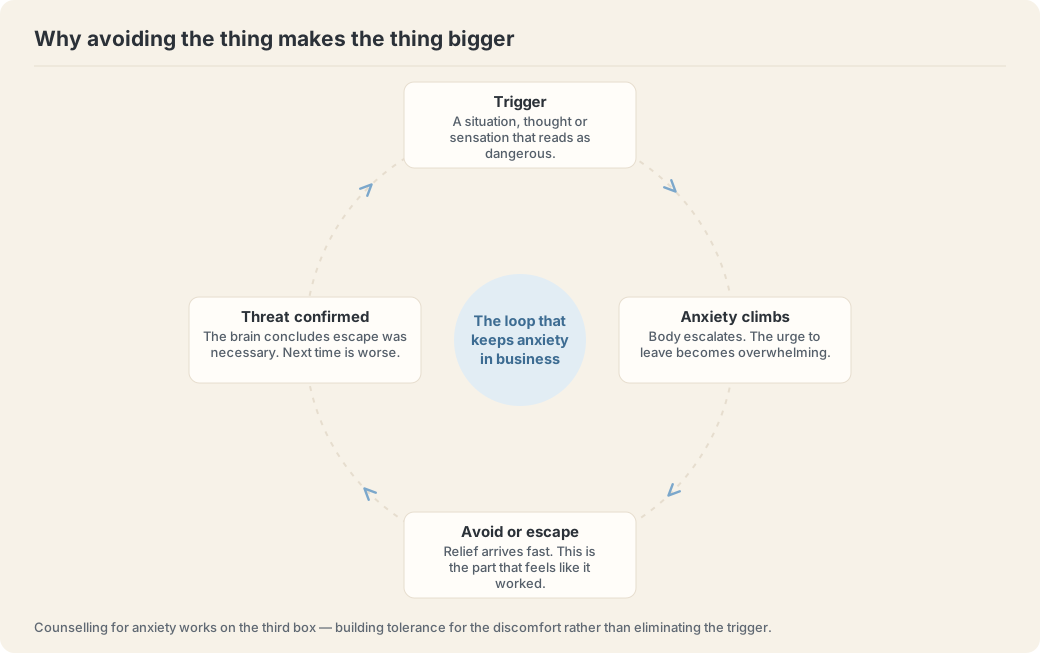
CBT-based work is effective here, though the target differs from panic-focused work. Rather than the catastrophic interpretation of body sensations, the targets are the rules: if I stop, it falls apart, good enough is not safe, other people's disappointment is intolerable, and the behaviours that keep them untested.
The behavioural side is usually the uncomfortable part: deliberately sending the email without the fourth reread, leaving something at good-enough, saying no once and sitting with it. These are small and they are not easy, because each one is an experiment your anxiety has spent years preventing you from running.
If this is where you are, the work is described in more detail on the anxiety counselling page. If it has already tipped into exhaustion and detachment rather than drive, burnout and depression may be the closer fit.
If "nothing is actually wrong, I am just tired all the time" is a sentence you have said, it is worth fifteen minutes. Book a free consultation.
The specific problem of being good at it
The reason this presentation goes untreated for years is not that it is mild. It is that the strategy works. Over-preparation genuinely produces better work. Arriving early genuinely prevents problems. Anticipating what could go wrong genuinely catches things other people miss. The anxiety is not producing failure; it is producing output, and the output is being rewarded.
That creates a real bind. Giving up the anxiety feels like giving up the competence, and nobody wants to trade away the thing that built their career. It is also why encouragement to relax lands so badly. It sounds like advice to become worse at your job from someone who has not considered what it would cost.
The way through is separating the two, which is harder than it sounds and is most of the work. The preparation is not the anxiety. The 3 a.m. rehearsal of a conversation is not preparation; it is the same circuit running with no output. Learning to tell those apart, in the moment, is what allows the standard to stay while the cost comes down.
It is also worth naming the collapse risk. Anxiety that presents as capability is load-bearing for other people as well as for you, and it tends to continue until something forces a stop. An illness, a breakdown, a relationship ending. Coming in before that point is considerably easier than coming in after it.
What other people see, and what they miss
- They see reliability, You do not miss things. What they miss is the checking that produced it, and the hour of anticipatory dread before an ordinary meeting.
- They see calm, The external presentation is frequently flat rather than agitated, which is why people are surprised. Internally the volume is high.
- They see someone who does not need help, Which is a self-reinforcing loop: appearing fine means nobody asks, and nobody asking means the practice of not saying anything gets stronger.
- They do not see the recovery cost, The evening after a demanding day, the weekend spent flattened, the holiday that takes four days before anything relaxes. This is where the bill is paid and none of it is visible.
- They do not see the body, Jaw tension, stomach trouble, headaches, waking at four. Frequently investigated medically for years before anyone connects it to anxiety.
- They do not see the self-talk, The commentary is often savage in a way that would be shocking said aloud, and is treated internally as ordinary motivation.
What changes, realistically, when this is worked on
People with this presentation want to know what they are trading before they start, which is reasonable. The honest answer is more specific than "you will feel better".
The recovery time shortens first. Before anything else changes, the flattened evening after a demanding day becomes a flattened hour. That is usually the earliest measurable shift and it is easy to miss because the demanding days do not stop.
The anticipatory phase shrinks. The dread before an ordinary meeting is frequently longer and worse than the meeting. That gap tends to close before the meeting itself feels different.
The 3 a.m. rehearsal reduces. Not the preparation. The pointless repetition of preparation already completed. Learning to tell those apart is most of the work and it is where the returned hours come from.
The commentary softens before it stops. Self-criticism is the last thing to change and it usually changes in volume rather than content. The same sentence arriving less loudly and being believed less automatically.
What does not change: the standard, the conscientiousness, or the noticing. Nobody in this work is asked to become less careful. What frequently improves is output, because the anticipatory dread and the over-rehearsal were themselves consuming capacity.
And one honest caveat: for people whose anxiety has been load-bearing for a decade, the early phase can feel destabilising rather than relieving. Removing the pressure that was organising your week leaves a gap, and knowing that is coming makes it much easier to sit through.
What therapy for high-functioning anxiety actually looks like
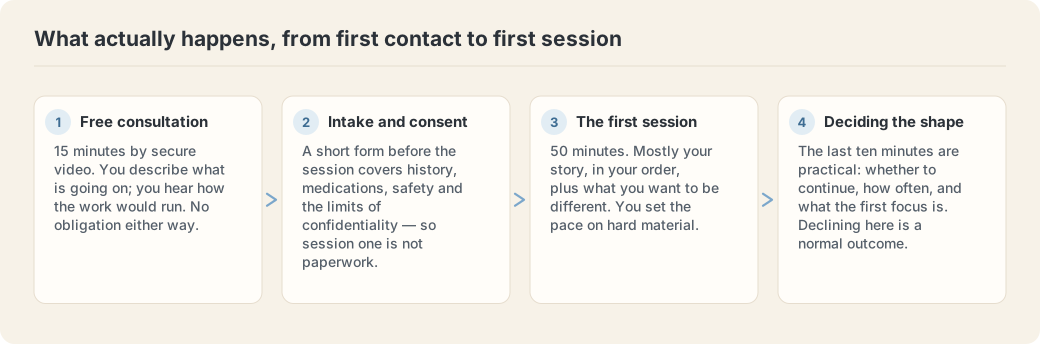
The searched phrase is "high functioning anxiety therapy", and it deserves a concrete answer rather than reassurance. The work usually starts somewhere counterintuitive: not with relaxing, but with mapping what the anxiety is currently doing for you. The deadlines it meets, the standards it enforces, the disasters it believes it is preventing. High-functioning anxiety persists precisely because it pays; therapy that ignores the payment gets politely outperformed by the symptom.
From there the work is specific: separating standards from threats (you can keep the excellence and retire the dread that powers it), practising sub-maximal effort on purpose in low-stakes places, letting the body’s alarm complete instead of overriding it, and, often the deepest layer. The history of where performing became the price of safety. Approaches drawn on here include CBT and, where the roots are older than the job, EMDR. None of it requires your performance to collapse first; arriving while everything still looks fine from outside is the standard entry, not the exception.
Common questions
Is high-functioning anxiety a real diagnosis?
No. It is a descriptive phrase, not a clinical category, what a clinician might identify is generalized anxiety or another anxiety presentation. The label is useful because it names a pattern people recognise; it is not something that appears on a chart.
Do I need therapy if I am coping?
Coping is not the threshold. If it costs you sleep, rest, and presence with people you care about, that is a legitimate reason to address it, and addressing it earlier is easier than addressing it after something gives way.
Will therapy make me less driven?
The common outcome is that the same work costs less, rather than that ambition disappears. Worth raising directly in a first session, because it is the fear that keeps most people out of the room.
How is this different from just being conscientious?
Conscientiousness feels like caring about doing things well. This feels like staying ahead of a threat. The reliable tell is what happens when you stop, genuine conscientiousness can rest, this pattern cannot.
Sources
- Anxiety Canada, generalized anxiety disorder
- CAMH, anxiety disorders
- HereToHelp BC, anxiety information
This guide is general information, not clinical advice, and it cannot diagnose anything or replace an assessment. If you are in crisis, call or text 9-8-8 (Canada, 24/7) or BC Mental Health Support at 310-6789.
Who you would talk to
Taking new clients and seeing people across BC by secure video. Each is a Registered Clinical Counsellor; the registration is on the profile and can be checked on the BCACC register.

Camille Granda, RCC, CCC
English and Tagalog · Trauma, Anxiety and chronic stress, Grief, loss and life transitions
In her words: “I want sitting with me to feel like the biggest belly breath you have ever taken.”

Savneet Singh, RCC
English and Punjabi · Anxiety, Depression, Trauma and attachment
In her words: “Comforting, safe and supportive, is what I aim for.”
Individual sessions are $140 for 50 minutes, after a free 15-minute consultation; card at booking.
Many extended health plans reimburse a Registered Clinical Counsellor, depending on the plan, so check yours; MSP does not cover private counselling. All fees.
Still deciding?
A free 15-minute consultation is the least committal way to find out whether this is a fit. No pressure, and no obligation to book a session afterward.
Book Free ConsultationNot ready to book? Send a line about what is going on. A reply comes within one business day.
Or a smaller step: A reflection on how things have been · What sessions cost · What the free 15 minutes is like
Looking on behalf of someone else? What to send them, and what not to, including the funded routes most people do not know they qualify for.
Where this leads
Online anxiety counselling and therapy across BC
The practice is virtual, so the same counsellors see people in every one of these cities. Each page says what the service involves there and who is taking new clients.
Where you are
Online counselling across British Columbia
Every session is by secure video, so the counsellor you see does not depend on where you live. Each city page covers coverage, local public services and who is taking new clients there.