Guide · Getting started
How long does therapy actually take?
For a single, clearly defined difficulty, structured therapies are often designed around roughly 8 to 20 sessions. For long-standing patterns, complex trauma, or several things tangled together, it usually takes longer. What no counsellor can honestly do is quote you a number in the first ten minutes, but they should be able to tell you by session three or four what they are aiming at and roughly how long that tends to take.
Nobody wants an open-ended commitment to something expensive. The honest answer has a range in it, and the range is explainable.
7 min read · Updated
Why the honest answer is a range
Therapy is not a procedure with a fixed duration. Two people can arrive with the same words, "I have been anxious for a year", and need different amounts of work, because the anxiety in one case is attached to a specific situation that is about to change, and in the other it is the surface of something twenty years old.
The structured therapies give the clearest signal, because they were built and tested with a defined length. Trials of cognitive behavioural therapy for anxiety and depression have typically run somewhere in the range of 8 to 20 sessions. Trauma-focused protocols are often similar. That is where the commonly quoted numbers come from. They are the shape of the research, not a promise about you.
What actually determines length is less mysterious than it sounds: how long the pattern has been running, how many areas of your life it touches, whether your circumstances are stable enough to practise anything, and how much support exists outside the room. None of that is a measure of how difficult a person is. It is a description of the job.
What tends to be shorter
- One clear, bounded problem, A specific phobia, a decision you are stuck on, a single recent event that knocked you sideways. The target is obvious, which means progress is measurable.
- A recent onset, Something that started three months ago has usually not yet reorganised your whole life around it. Patterns that are still forming are easier to interrupt.
- A stable situation to practise in, Between-session practice is where structured therapy does much of its work. If your housing, income and relationships are steady enough to try something different, the work moves faster.
- A specific outcome you can name, "I want to drive on the highway again" is a target. "I want to feel better" is a direction. Both are legitimate; the first one finishes sooner.
What tends to take longer
- Patterns that formed early, Ways of relating learned in childhood have decades of rehearsal behind them. They change, but not on the timeline of a skills course.
- Complex or repeated trauma, Where harm was prolonged and relational, a large part of the work is building capacity before anything is processed. Rushing that stage is the most common way trauma therapy goes wrong. See trauma therapy.
- Several things at once, Anxiety plus a difficult relationship plus a job that is making both worse. Each is workable; together they take more sessions, because they keep re-triggering each other.
- An ongoing situation that has not changed, Therapy cannot resolve a stressor that is still happening. Where the situation is fixed for now, the work shifts to surviving it well, which is slower and more open-ended.
How to tell whether it is working
The number of sessions matters far less than whether anything is moving. Progress in therapy is rarely a smooth upward line. A fortnight of feeling worse after opening something painful is normal and not, on its own, a sign of failure. Over a two-month horizon, though, you should be able to point at something.
Useful markers, roughly in the order they tend to appear: you understand the pattern better than you did; you notice it happening while it happens rather than afterwards; the recovery time after a bad episode gets shorter; you do one thing you had been avoiding; other people notice before you do.
If none of those has shifted after eight to ten sessions, that is worth raising directly. A good counsellor treats that as information about the plan, not a verdict on you, and changing approach, changing frequency, or referring you elsewhere are all legitimate answers. There is a whole guide on what to do when therapy is not working.
Weekly, biweekly, or something else
Frequency is a real variable, not an administrative detail. Weekly sessions build momentum and are usually recommended at the start and during any intensive piece of work, trauma reprocessing in particular is difficult to do well at a fortnightly pace, because too much of each session is spent re-establishing where you were.
Biweekly can work well once things are stable, when the work is largely about practising something between sessions, or when cost makes weekly unsustainable. Stretching to monthly is usually maintenance rather than treatment, and it is worth naming it as that rather than pretending it is the same thing more slowly. Weekly vs biweekly sessions sets the two side by side.
Cost is a legitimate input to this decision and there is no need to be coy about it. Fewer sessions you can actually afford, spaced deliberately, beats a weekly plan you abandon in week five. The fees page sets out what a session costs, and paying for counselling in BC covers the routes.
If you want a realistic estimate for your situation rather than a range from an article, ask in a free 15-minute consultation.
Ending on purpose
Most therapy does not end; it fades out. Someone cancels, reschedules, then stops replying. That is understandable and it costs you something. The review, the consolidation, and the plan for what to do if it comes back.
A deliberate ending takes one session. It covers what changed, what did not, what you now know about your own early warning signs, and what would justify coming back. It also makes returning much easier later, because you are resuming rather than starting over.
You are allowed to end therapy at any time, for any reason, including that you do not want to continue. You do not owe an explanation. Saying it out loud rather than disappearing is worth doing for your own sake more than anyone else's.
What a course of work usually looks like over time
Describing therapy as a number of sessions hides its shape, and the shape is more useful to know. Most courses of work move through four recognisable phases, and the phases are unequal in length.
Sessions one to three are orientation. History, current picture, what you want different, and, as much as anything, establishing whether the two of you can work together. Almost nobody feels significantly better in this stretch, and people who expected to frequently conclude prematurely that it is not working.
Sessions three to eight are usually where the first movement appears, and it is rarely the movement people expected. Understanding a pattern comes before changing it, and the first real marker is normally noticing something as it happens rather than three days later. That sounds modest and it is the hinge the rest depends on.
The middle stretch is the actual work, and it is the least linear part. Progress here is a sawtooth: a good fortnight, then something knocks it back, then a slightly higher floor than last time. Judging the work on any single week during this phase will mislead you in both directions.
The last phase is consolidation, which people routinely skip by stopping. It covers what changed, what your own early warning signs are, and what you would do if it returned. It is one or two sessions and it is disproportionately valuable, because it is what makes the gains durable rather than dependent on the appointment continuing.
Coming back later, which is normal
A significant proportion of people who complete a course of counselling return at some point, and the framing that treats this as relapse is both inaccurate and unhelpful.
Life produces new problems. A course of work that resolved a specific difficulty three years ago did not inoculate you against a bereavement, a separation or a change in circumstances, and expecting it to is like expecting one course of physiotherapy to cover every future injury.
Returning is also usually much faster the second time. The relationship exists, the history is known, and you are considerably better at the work than you were. You can identify a pattern in one session that previously took six to surface. Episodes of returning are frequently short and targeted for exactly that reason.
This is one of the practical arguments for ending deliberately rather than fading out. An ending that reviewed what changed, named your own early warning signs, and stated what would justify coming back makes the return a resumption rather than a restart. It also removes the awkwardness people feel about getting back in touch, because the door was explicitly left open.
And it is worth saying plainly that returning is not a sign the first course failed. The most common reason people come back is not that the original difficulty recurred. It is that the work gave them a way of dealing with things, and something new has arrived that is worth using it on.
Common questions
Can I do just one session?
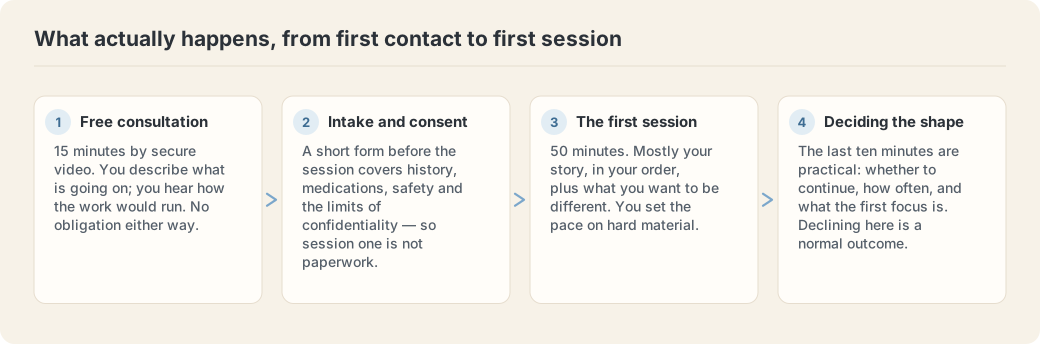
Yes. Some people come for a single consultation to get oriented, get a referral, or ask one specific question. A single session cannot do the work of a course of therapy, but it is a legitimate use of a session and nobody will pressure you into a package.
Is it a bad sign if therapy takes a long time?
No. Length reflects what you are working on, not how well you are doing it. Long-standing relational patterns take longer than a recent, bounded problem. That is a statement about the problem, not about you.
What if I run out of insurance coverage partway through?
Say so early rather than at the end. Knowing the budget changes how the work is planned: what gets prioritised, what frequency makes sense, and what you can carry on with independently. It is a normal conversation and not an awkward one.
Do I have to commit to a number of sessions upfront?
Not here. There is no package, no minimum, and no penalty for stopping. Sessions are booked as you go, and the plan is reviewed rather than assumed.
Sources
- HealthLink BC, mental health and substance use
- Canadian Mental Health Association, BC Division
- BC Association of Clinical Counsellors
This guide is general information, not clinical advice, and it cannot diagnose anything or replace an assessment. If you are in crisis, call or text 9-8-8 (Canada, 24/7) or BC Mental Health Support at 310-6789.
Who you would talk to
Taking new clients and seeing people across BC by secure video. Each is a Registered Clinical Counsellor; the registration is on the profile and can be checked on the BCACC register.

Camille Granda, RCC, CCC
English and Tagalog · Trauma, Anxiety and chronic stress, Grief, loss and life transitions
In her words: “I want sitting with me to feel like the biggest belly breath you have ever taken.”

Savneet Singh, RCC
English and Punjabi · Anxiety, Depression, Trauma and attachment
In her words: “Comforting, safe and supportive, is what I aim for.”
Individual sessions are $140 for 50 minutes, after a free 15-minute consultation; card at booking.
Many extended health plans reimburse a Registered Clinical Counsellor, depending on the plan, so check yours; MSP does not cover private counselling. All fees.
Still deciding?
A free 15-minute consultation is the least committal way to find out whether this is a fit. No pressure, and no obligation to book a session afterward.
Book Free ConsultationNot ready to book? Send a line about what is going on. A reply comes within one business day.
Or a smaller step: What sessions cost · What the free 15 minutes is like
Looking on behalf of someone else? What to send them, and what not to, including the funded routes most people do not know they qualify for.
Where you are
Online counselling across British Columbia
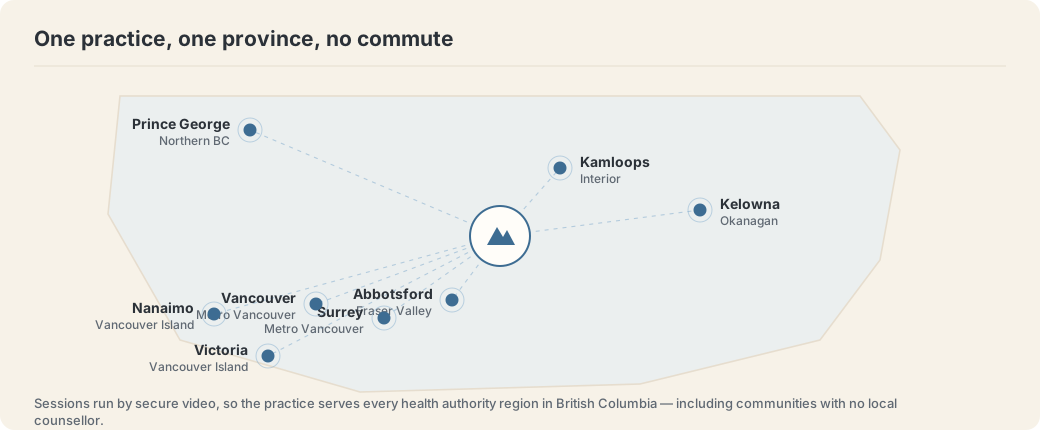
Every session is by secure video, so the counsellor you see does not depend on where you live. Each city page covers coverage, local public services and who is taking new clients there.