Guide · Getting started
How to actually find a therapist in BC
Start by deciding whether you need free, low-cost, or private care, because that determines where to look. Verify anyone you shortlist against their college or association register. Then use free consultations to test fit. The working relationship predicts outcomes more reliably than the specific modality does.
The search itself is a barrier, dozens of directory profiles that all sound the same, and no obvious way to compare them.
7 min read · Updated
First: free and low-cost options
Private therapy is not the only route, and it is not always the right first one. Before paying out of pocket, it is worth knowing what exists:
Health authority services. Each BC health authority runs mental-health and substance-use services, free at point of use, accessed by self-referral or through a GP. Wait times vary considerably by region and by urgency.
Foundry for anyone aged 12–24, offering free counselling both in centres and virtually across BC. CMHA BC branches run free and low-cost programs that differ by community. Post-secondary counselling is included in student fees if you are enrolled. Employee assistance programs through work typically cover a set number of free sessions, and a surprising number of people do not know they have one.
Training clinics at universities offer sessions with supervised student clinicians at substantially reduced rates. HealthLink BC at 8-1-1 is free and staffed 24/7, and can point you toward what exists in your area. A fuller list is on the low-cost and free counselling page.
Where to look for private therapists
- Directories, Psychology Today, Counselling BC, and the BCACC register are where most BC practitioners list. Filter by what matters to you: language, modality, virtual availability, fee, rather than reading everything.
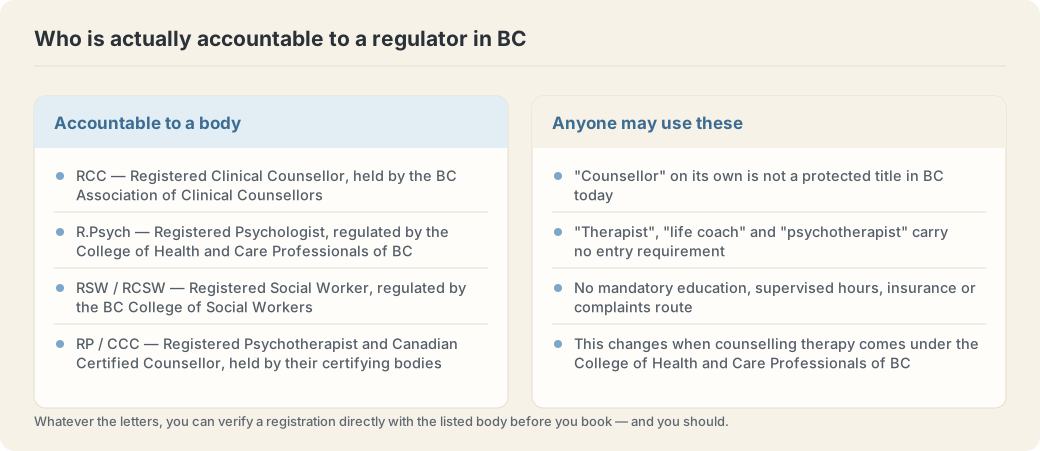
- The relevant register, The BCACC register for RCCs, the College of Health and Care Professionals of BC for psychologists, the BC College of Social Workers for social workers. This is also how you verify someone is who they say they are.
- Your GP, Can refer into public services and often knows local private practitioners.
- Word of mouth, Genuinely useful, with one caveat: a therapist who was transformative for a friend may be a poor fit for you. Fit is not transferable.
How to check someone is legitimate
This matters more in BC than most people realise. Counselling therapy is not currently a government-regulated profession here, "counsellor" and "therapist" are not protected titles, so anyone may use them. That changes when psychotherapy regulation begins on 29 November 2027, but until then verification is on you. The detail is in the comparison of BC therapist types.
Practically: look for a designation with a body behind it: RCC, CCC, R.Psych, RSW/RCSW, and then check the register directly rather than trusting the website. It takes two minutes. What you are confirming is that there is verifiable training, professional liability insurance, continuing education, and somewhere to complain if something goes wrong.
One thing you will not find is client reviews, and their absence is not a red flag. Soliciting testimonials from counselling clients is prohibited under BCACC advertising standards, so a therapist with glowing client quotes is more concerning than one with none. What a practice can honestly publish instead: registration, training, supervision, the complaints route, is the thing worth reading.
What to ask on a consultation call
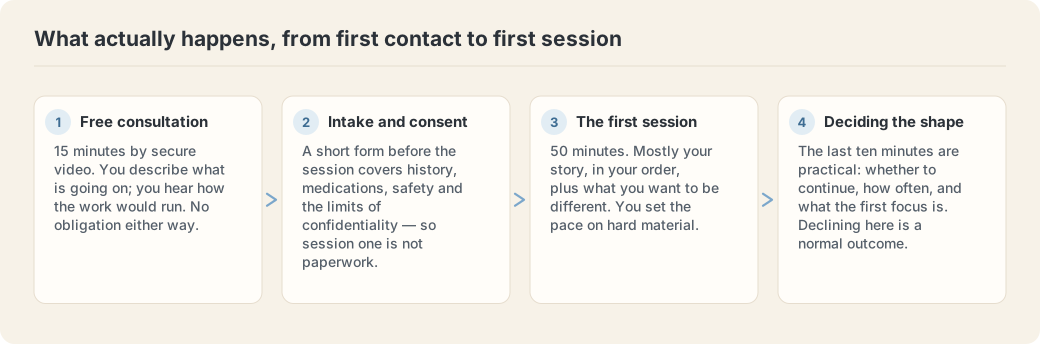
Nearly every private practitioner in BC offers a free 15-minute consultation, and it exists so you can assess them. Worth asking:
- Have you worked with this before?, Specific experience with what you are actually bringing, not general competence.
- How do you work?, If the answer is jargon you cannot follow, and they do not translate it when asked, that is information.
- What would the first few sessions look like?, A practitioner should be able to describe a rough shape without promising outcomes.
- Fees, cancellation, and receipts, What they charge, what their cancellation policy is, and what their receipt shows for insurance purposes.
- Availability, Whether they have a spot in the timeslot you can actually attend, and whether they have a waitlist.
If you are shortlisting, a free 15-minute call is how you test this one, no obligation either way. Book a free consultation.
How to judge fit
The strongest predictor of whether therapy helps is not the modality. It is the working relationship. Which means your instinct after a first conversation is real evidence, not squeamishness.
Reasonable signals: you felt heard rather than assessed; they were direct without being prescriptive; they were comfortable saying what they do not do. Reasonable warning signs: guarantees of outcomes, pressure to commit to a long package immediately, defensiveness when questioned, or a diagnosis offered by someone who is not qualified to give one.
And it is entirely acceptable to consult with two or three people before choosing. It feels awkward. It is standard, and a good practitioner would far rather you found the right fit than stayed out of politeness. If you want to know what the first real session involves, that is set out here.
Where to actually look
- The BCACC directory, The BC Association of Clinical Counsellors maintains a searchable public register of Registered Clinical Counsellors, filterable by area, specialisation and language. It doubles as the place to verify anyone's registration.
- The provincial psychologists' register, If you need diagnosis or formal assessment, this is the designation to search rather than a counsellor directory. See psychiatry and assessment in BC.
- The BC College of Social Workers, Clinical social workers provide counselling and are frequently covered by plans that also cover counsellors.
- Your insurer's provider list, Backwards but efficient: if reimbursement is essential, start from who your plan actually pays for rather than falling in love with a practice that is not eligible.
- Your EFAP, If you have one, it is free and fast. Cap the expectations along with the sessions, see EFAP vs private counselling.
- A specific referral from someone you trust, Still the highest-yield route, with one caveat: fit is personal, and a counsellor who transformed your friend's life may be wrong for you.
Reading a therapist's website properly
A profile is a marketing document and can still be read for signal. The things worth weighting are specific: which designation, held by which body; what training in which methods, and at what level; what they say they do not work with; and whether the fee is stated at all.
Vagueness is the main warning sign. A page that lists twenty specialisms is telling you about positioning rather than expertise. Language that promises transformation, breakthroughs or results is either untrained or ignoring the advertising standards counsellors work under. And a site carrying client testimonials is displaying something prohibited by the BCACC code, which is worth noticing.
What should be easy to find: the fee, the cancellation policy, the format, and how to get in touch. A practice that makes you request the price is optimising for a sales conversation.
Then stop reading and book two consultations. Websites are a filter, not a decision. Nobody has ever determined fit from a photograph and three paragraphs. Questions worth asking a therapist covers what to establish once you are actually talking to someone.
Booking two consultations rather than one
The most useful thing you can do, and almost nobody does it: book two free consultations in the same week, with different counsellors, before committing to either.
The reason is that fit is comparative and almost impossible to judge in isolation. A single consultation gives you one data point and no scale. You have no idea whether what you experienced was unusually good, unusually poor, or ordinary. Two gives you a contrast, and the contrast is where the information is.
What people notice when they do this is rarely what they expected. Not who was warmer, but where they spoke more freely. Where they edited themselves less. Which conversation left them thinking about something afterwards. Those are far better predictors of a working alliance than likeability.
It costs nothing but an extra thirty minutes, and no competent counsellor is offended by it, consultations are free precisely so that fit can be assessed without cost being the barrier. You do not need to disclose that you are speaking to anyone else, and you may say so if you prefer.
One caveat: do not extend this indefinitely. Beyond three or four, consulting becomes its own form of avoidance, and the decision gets harder rather than clearer. Two, occasionally three, and then choose, knowing that changing counsellor later is entirely possible and considerably less costly than most people assume.
Common questions
How much does therapy cost in BC?
Private counselling with an RCC typically runs roughly $120–$180 per session; psychologists are usually considerably more. MSP does not cover private counselling, so the cost is met by an extended health plan or out of pocket. Free and low-cost options do exist across BC and are worth checking first.
Will my extended health cover it?
Many BC plans cover Registered Clinical Counsellors, but not all, some list only psychologists and social workers. Check the actual wording of your plan before booking, since this is the most common source of unpleasant surprises.
How long are the waitlists?
Public services vary widely by health authority and urgency. Private practitioners are often able to start within a week or two, which is a large part of why people pay privately.
What if the first therapist is not right?
Change. It is common, it is not a failure, and most practitioners will help you find someone better suited. Staying with a poor fit out of politeness wastes both money and time.
Sources
- BC Association of Clinical Counsellors, find an RCC
- Foundry BC, free services for ages 12–24
- HealthLink BC, 8-1-1 health information
- CMHA BC, programs and services
This guide is general information, not clinical advice, and it cannot diagnose anything or replace an assessment. If you are in crisis, call or text 9-8-8 (Canada, 24/7) or BC Mental Health Support at 310-6789.
Who you would talk to
Taking new clients and seeing people across BC by secure video. Each is a Registered Clinical Counsellor; the registration is on the profile and can be checked on the BCACC register.

Camille Granda, RCC, CCC
English and Tagalog · Trauma, Anxiety and chronic stress, Grief, loss and life transitions
In her words: “I want sitting with me to feel like the biggest belly breath you have ever taken.”

Savneet Singh, RCC
English and Punjabi · Anxiety, Depression, Trauma and attachment
In her words: “Comforting, safe and supportive, is what I aim for.”
Individual sessions are $140 for 50 minutes, after a free 15-minute consultation; card at booking.
Many extended health plans reimburse a Registered Clinical Counsellor, depending on the plan, so check yours; MSP does not cover private counselling. All fees.
Still deciding?
A free 15-minute consultation is the least committal way to find out whether this is a fit. No pressure, and no obligation to book a session afterward.
Book Free ConsultationNot ready to book? Send a line about what is going on. A reply comes within one business day.
Or a smaller step: What sessions cost · What the free 15 minutes is like
Looking on behalf of someone else? What to send them, and what not to, including the funded routes most people do not know they qualify for.
Where you are
Online counselling across British Columbia
Every session is by secure video, so the counsellor you see does not depend on where you live. Each city page covers coverage, local public services and who is taking new clients there.