Guide · Trauma
What does "trauma" actually mean?
Trauma is the lasting effect of an event, a series of events or a set of circumstances that a person experienced as physically or emotionally harmful or life-threatening, which is close to how SAMHSA, the US mental health agency, defines it; in general medicine the same word also means a physical injury. Clinically, trauma refers less to an event than to what the event did, specifically, to a memory that did not get filed properly and so keeps behaving as though it is still happening. That is why two people can go through the same thing and only one is still carrying it, and why "it was not that bad" is not evidence of anything.
A word that describes both a car crash and a rude email has stopped doing useful work. It is worth reclaiming the distinction.
8 min read · Updated
The event is not the measure
The most persistent misunderstanding about trauma is that it is a property of events. That some experiences are traumatic and others are not, and you can rank them. It is an intuitive model and it does not match what clinicians see.
Two people in the same collision: one is shaken for a fortnight and then it recedes into an unpleasant memory; the other cannot drive eighteen months later. Same event, different outcome. The difference is not resilience as a character trait. It is what happened to the memory afterwards, whether it got processed into ordinary autobiographical storage, or stayed live.
That is why the most useless question you can ask yourself is whether what happened to you was bad enough. People routinely disqualify themselves on those grounds, comparing their experience to something worse and concluding they have no claim on the word. Meanwhile they cannot sleep. The presence of the symptoms is the information; the ranking of the event is not.
What does a trauma memory do differently?
An ordinary difficult memory has a past tense. You can bring it to mind, feel something about it, and put it down. It has a beginning and an end, it sits in a timeline, and recalling it does not recruit your whole body.
A traumatic memory often does not behave that way. It arrives uninvited, triggered by something apparently unrelated. A smell, a tone of voice, a particular quality of light. It comes in fragments rather than narrative, more often sensory than verbal. And it arrives without a past tense: the body responds as though the threat is present, because as far as the nervous system is concerned, it is.
This is the reason insight alone frequently fails to shift trauma. You can know with complete certainty that you are safe and still have a body that has not received the update. Approaches like EMDR exist precisely because the problem is one of storage rather than understanding.
"Big T" and "little t", a useful distinction, misused
The informal shorthand distinguishes "Big T" trauma. The events everyone would recognise: assault, serious accident, disaster, combat, sudden bereavement, from "little t" trauma, the accumulated smaller experiences that were not individually catastrophic but were relentless: chronic criticism, emotional neglect, growing up around unpredictability, being the only person in the room who looked like you.
The distinction is useful for describing shape. It is frequently misused as a hierarchy, as if "little t" meant "less real". It does not, and the accumulated variety is often harder to work with, not despite being smaller, but because it has no single event to point at and because it usually shaped a person during development rather than interrupting an already-formed one.
Where the harm was prolonged, relational and early, clinicians tend to speak of complex trauma, which typically shows up in identity, emotional regulation and expectations of other people rather than in flashbacks to a specific scene. Intergenerational trauma sits in this territory too, where what is transmitted is not the event but the adaptation to it. Where the family language is Punjabi, that adaptation is often easier to describe in it than in English. There is a full page in Punjabi (ਪੰਜਾਬੀ) covering how sessions work.
What it tends to look like from the outside, and inside
- Hypervigilance, A threat-detection system that never fully powers down. Sitting facing the door, tracking exits, reading small changes in tone. Exhausting precisely because it is skilled.
- Numbness and distance, The less-discussed half. Flat, far away, watching yourself from outside, hypoarousal rather than hyperarousal, and frequently mistaken for coping well.
- Reactions out of proportion to their trigger, A response that is enormous relative to the event that set it off. From inside it does not feel disproportionate at all, because the response belongs to something else.
- Avoidance that has quietly reorganised a life, Routes not taken, subjects not raised, relationships kept at a manageable depth. Rarely experienced as avoidance; usually experienced as preference.
- Sleep that will not repair, Difficulty falling asleep because the day finally goes quiet, or waking at the same hour, or dreams that are not narratively about the event but carry its feeling.
- A body with symptoms and no findings, Chronic tension, gut trouble, headaches, unexplained pain. Worth investigating medically, and worth knowing that a clear scan does not mean nothing is happening.
If something you thought you had dealt with is still shaping how you live, a free 15-minute consultation is a low-stakes place to start.
Why "just talk about it" can make things worse
There is a persistent folk belief that trauma is resolved by describing it in enough detail. Sometimes that helps. Sometimes it re-floods a nervous system that had no capacity to tolerate the flooding, and the person leaves the session worse than they arrived, having learned that opening the subject is dangerous.
This is why competent trauma therapy is sequenced, and why the sequence is not optional. The first phase builds capacity: regulation skills, grounding, resources you can actually reach for under load. Only then is the memory approached, and even then in controlled amounts with a deliberate close so you leave settled rather than raw.
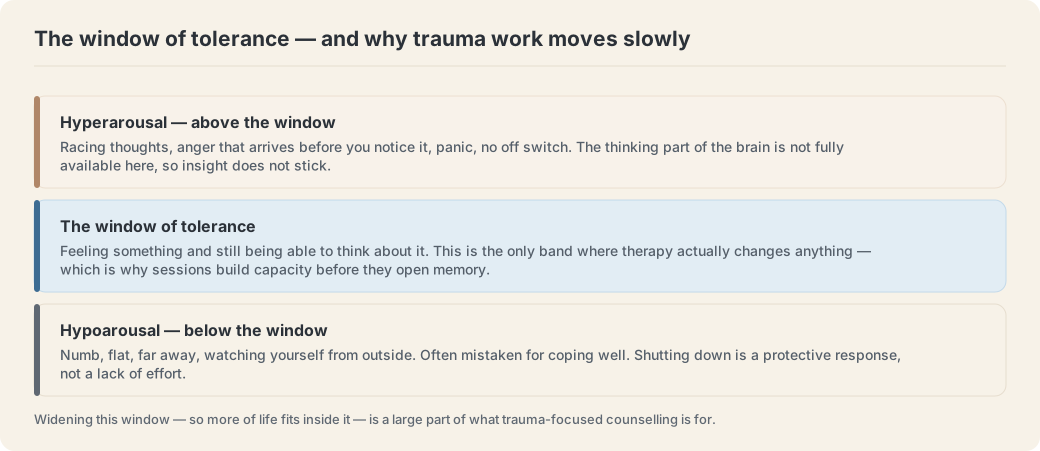
The window of tolerance is the working concept here: the band of arousal in which you can feel something and still think about it. Outside that band, the thinking part of the brain is not fully online, and nothing therapeutic is happening no matter how much is being said. Widening the window is a large part of the treatment.
Sequencing is also why the length of a session sometimes becomes the constraint rather than the material. Approaching a memory, working with it, and closing properly is a lot to fit into fifty minutes once twenty of them have gone into settling, which is the arithmetic the 90-minute EMDR intensive exists for, and only once the capacity phase is genuinely in place. It is a format decision, not a shortcut past the sequence.
What recovery does and does not mean
Trauma treatment does not delete memories, and any approach promising that is misrepresenting itself. What changes is the memory's grip: it stops arriving uninvited, it stops recruiting the whole body, and it acquires a past tense. You can think about it on purpose and stop thinking about it on purpose.
Most people describe the change less as forgetting and more as demotion. The thing that used to run the day becomes a thing that happened. Some meaning often gets rewritten along the way, particularly the beliefs formed in the aftermath about fault, safety and what kind of person you are.
It is also worth saying plainly that not everyone who has been through something terrible develops post-traumatic difficulties, and needing no treatment is not a failure to take it seriously. The point of a page like this is not to persuade anyone they are damaged. It is to make sure that someone who is still carrying something does not talk themselves out of help on the grounds that it was not bad enough.
Why some people are affected and others are not
The same event, two people, two different outcomes. It is the question that produces the most self-blame, because the unspoken conclusion is usually that one of them was weaker.
That is not what the research points to. Several factors influence whether a traumatic memory gets processed normally or stays live, and almost none of them are about character. What happened immediately afterwards matters a great deal: whether there was someone to be with, whether you were believed, whether you were able to rest or had to keep functioning. Support in the days after an event is among the more consistent protective factors identified.
Whether you could act matters. Events in which someone was able to do something: protect a person, escape, fight, help, are processed differently from events in which they were pinned in place. Entrapment is a significant risk factor, which is part of why harm within a relationship or a household tends to leave deeper marks than a discrete external event.
Prior load matters. A nervous system already running near the ceiling from earlier experience, ongoing stress or sleep debt has less capacity to absorb another impact.
Meaning matters. Events that violate a core assumption. That a particular person was safe, that effort protects you, that the institution would act, tend to require more rebuilding than events that are terrible but do not overturn anything.
None of these is a moral quality. They describe circumstances, which is why "why did it not affect them the same way" has an answer that has nothing to do with your resilience.
Post-traumatic growth, and how it gets misused
There is a real body of research on positive psychological change following adversity: shifts in priorities, in relationships, in sense of what matters. It is a genuine finding and it is one of the most commonly misapplied ideas in the field.
What the research describes is something people sometimes report afterwards, alongside distress rather than instead of it. What it gets converted into is an expectation: that suffering ought to produce wisdom, that you should be finding the meaning in it, and that struggling without visible growth is a second failure on top of the first.
That conversion does real harm. It arrives most often from people who are uncomfortable witnessing distress, and it functions to close the subject. "Everything happens for a reason" is the domestic version and it is one of the most reliably unhelpful things anyone can say to a person in the middle of something.
Two things are worth holding at once. Growth after adversity is real and it is not owed, not universal, and not on a schedule. And it is never a justification for what happened. Someone finding meaning afterwards does not retrospectively make the event acceptable or necessary.
Clinically, growth is not something to aim at directly. It sometimes emerges once the memory has stopped firing in the present and there is capacity for something other than survival. Chasing it before that point mostly produces people performing recovery while still carrying everything.
Common questions
Do I have to describe what happened in detail?
No. Effective trauma work does not require a full narrative account, and several approaches deliberately require little verbal detail. You control what is said and when.
Can something be trauma if I do not remember it clearly?
Yes. Fragmented, patchy or largely absent memory is common rather than disqualifying. It is one of the things a nervous system does under extreme load.
Is trauma therapy going to make me feel worse?
Approaching difficult material can be temporarily hard, which is exactly why sequencing and pacing are clinical decisions rather than preferences. Well-conducted trauma therapy builds capacity before it opens anything, and closes each session deliberately.
What is the medical definition of trauma?
The word has two medical senses. In general medicine and emergency care, trauma is a physical injury: a wound, a fracture, a head injury. In mental health it means the psychological effect of an event or circumstances experienced as harmful or life-threatening. The diagnosis of post-traumatic stress disorder sets a narrower bar for the event itself, exposure to actual or threatened death, serious injury or sexual violence, but trauma responses are not limited to people who meet it.
What is the difference between trauma and PTSD?
Post-traumatic stress disorder is a formal diagnosis with defined criteria, made by a qualified professional. Trauma is the broader phenomenon. Many people carry trauma responses without meeting the criteria for the diagnosis, and they are still treatable.
Sources
- HealthLink BC, mental health and substance use
- Canadian Mental Health Association, BC Division
- World Health Organization, ICD-11 browser
- SAMHSA, Concept of Trauma and Guidance for a Trauma-Informed Approach (2014)
This guide is general information, not clinical advice, and it cannot diagnose anything or replace an assessment. If you are in crisis, call or text 9-8-8 (Canada, 24/7) or BC Mental Health Support at 310-6789.
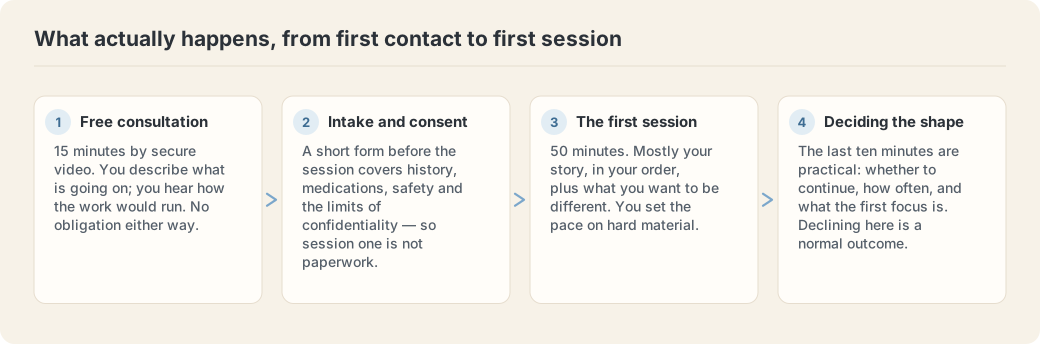
Individual sessions are $140 for 50 minutes, after a free 15-minute consultation; card at booking.
Many extended health plans reimburse a Registered Clinical Counsellor, depending on the plan, so check yours; MSP does not cover private counselling. All fees.
There is no wrong way to start.
A free 15-minute consultation over secure video, whenever you are ready for one. Nothing is committed by having it, and no card is needed to book it.
Book Free ConsultationNot ready to book? Send a line about what is going on. A reply comes within one business day.
Or a smaller step: What sessions cost · What the free 15 minutes is like
Looking on behalf of someone else? What to send them, and what not to, including the funded routes most people do not know they qualify for.
Where this leads
Online trauma therapy and counselling across BC
The practice is virtual, so the same counsellors see people in every one of these cities. Each page says what the service involves there and who is taking new clients.
If this is close to your own situation, there is a page written for it: Counselling for first responders in BC.
Where you are
Online counselling across British Columbia
Every session is by secure video, so the counsellor you see does not depend on where you live. Each city page covers coverage, local public services and who is taking new clients there.