Comparison · Choosing a therapist
RCC, psychologist, or social worker: who should you see in BC?
If you want talk therapy, an RCC, a clinical social worker, and a psychologist can all provide it, and all three hold master's-level training or higher. The practical differences are diagnosis (psychologists and some clinical social workers can formally diagnose; RCCs cannot), formal assessments (psychologists only), cost (psychologists are typically the most expensive), and what your extended health plan happens to list.
Three different letters after three different names, all offering something that looks like therapy. Here is what actually separates them in British Columbia.
7 min read · Updated
| Registered Clinical Counsellor (RCC) | Registered Psychologist (R.Psych) | Registered Clinical Social Worker (RCSW/RSW) | |
|---|---|---|---|
| Minimum training | Master's in counselling or equivalent, plus supervised clinical hours | Doctorate (PhD/PsyD/EdD) plus supervised practice and examination | Master of Social Work, plus supervised hours for clinical registration |
| Oversight in BC | BCACC, a voluntary professional association, not a statutory college | College of Health and Care Professionals of BC, statutory; "psychologist" is a protected title | BC College of Social Workers, statutory; "social worker" is a protected title |
| Can formally diagnose | No | Yes | Clinical registration permits assessment and diagnosis of mental disorders |
| Psychoeducational / cognitive assessments | No | Yes. The main thing only psychologists do | No |
| Published BC fee guidance | $140 to $175 per 50-minute individual session (BCACC 2026 fee guide, read 1 October 2026); $140 at this practice | $245 an hour (BC Psychological Association recommended rate, effective 12 May 2025, read 1 October 2026) | Set by each practitioner; ask for the fee before booking |
| Covered by MSP | No | No (outside public settings) | No (outside public settings) |
| Listed by extended health plans | Many plans, depending on the plan; check the wording | Almost always | Commonly |
Before comparing: what the three sets of letters certify
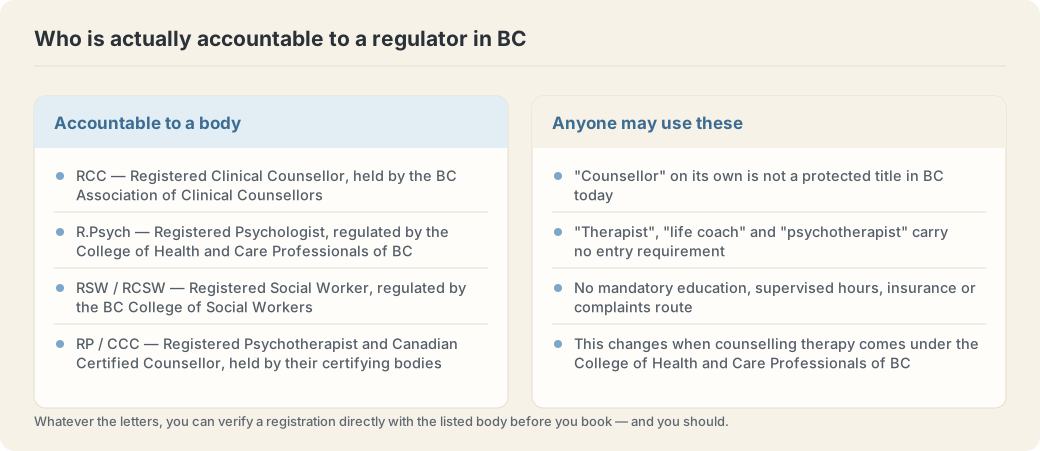
RCC is a designation awarded by the BC Association of Clinical Counsellors, a professional association, against a master’s degree in counselling or a closely related field, supervised clinical practice, continuing education, liability insurance and a code of ethics with a complaints process. It is not a government licence, and the words "counsellor" and "therapist" are not protected in BC: anyone may use them. What a Registered Clinical Counsellor is, and how to check one covers the designation in full, with the four-minute register check.
"Licensed counsellor" is not a British Columbian term. It is the American phrasing, and there is no BC licence that matches it. What exists here is registration: RCC through BCACC, R.Psych through the College of Health and Care Professionals of BC (formerly the College of Psychologists of BC), or RSW/RCSW through the BC College of Social Workers.
So when the three are compared below, the comparison is between three different routes to the same broad work, with genuinely different training, scope and cost, not between a licensed professional and an unlicensed one.
The regulation question, and what changes in 2027
This is the part most comparisons get wrong or leave out, so it is worth being precise.
In British Columbia today, counselling therapy is not a government-regulated profession. "Counsellor" and "therapist" are not protected titles: legally, anyone may use them. "Psychologist" and "social worker" are protected, under their respective statutory colleges.
The RCC designation is how counsellors have addressed that gap voluntarily. It is granted by the BC Association of Clinical Counsellors, which is a professional association rather than a statutory college. To hold it, a counsellor must meet education and supervised-practice requirements, carry insurance, complete continuing education, and be bound by a code of ethics with a complaints process (how to become a Registered Clinical Counsellor in BC sets out each step). It is real accountability. It just is not government accountability.
That is changing. The Health Professions and Occupations Act replaced the old Health Professions Act on 1 April 2026, and psychotherapy is being brought in as a regulated profession under the College of Health and Care Professionals of BC, with regulation of the profession beginning 29 November 2027. It is a protected-title model, following the approach taken in New Brunswick, Nova Scotia, and PEI.
What this means for you right now: until late 2027, the letters after someone's name are the main signal you have. An RCC, a CCC, or a clinical social worker has verifiable training, insurance, and somewhere to complain. Someone calling themselves a "therapist" with nothing after their name may be excellent, but there is no body you can check them against, and no process if something goes wrong. That is the distinction worth caring about, far more than which of the three registered designations you pick.
When the difference genuinely matters
- You need a formal diagnosis on paper, For disability benefits, academic accommodation, a workplace process, or a legal matter, you likely need a psychologist. An RCC cannot diagnose, and should tell you so rather than working around it.
- You need psychoeducational or cognitive testing, ADHD assessments, learning-disability assessments, IQ testing. This is the one area only psychologists do, and it is usually a separate piece of work from ongoing therapy.
- Cost is a real constraint, The BC Psychological Association recommends $245 an hour; an individual session here is $140. If your benefit cap is $800 a year, that is about 3 sessions at the psychologists' recommended rate or 5 here. For ongoing weekly therapy, that difference compounds fast.
- Your plan only lists certain professions, Some plans reimburse psychologists and social workers but not RCCs. Read the actual wording before you book. This is the single most common source of unpleasant surprises.
- You want a specific modality, EMDR, the Gottman Method, and most other approaches are training-based, not profession-based. Practitioners of any of the three designations may hold them. Ask about the training directly rather than inferring it from the letters.
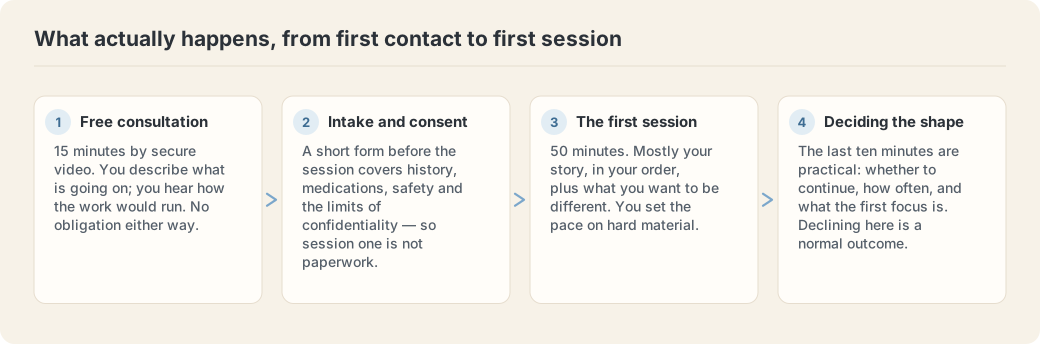
Not sure which of the three you need? That is a reasonable thing to work out on a free 15-minute call, including if the answer is someone else. Book a free consultation.
Looking for a registered psychologist in BC?
Psychologists in British Columbia are licensed by the College of Health and Care Professionals of BC, which absorbed the formerly separate College of Psychologists of BC when the colleges amalgamated. Its public registry is free to search by name, and shows whether a licence is current and any restrictions on it. Licensee numbers were reissued in June 2026, so search by name rather than by an older number.
A psychologist is the right door when what you need is an assessment or a diagnosis: an ADHD, learning or cognitive assessment, or a diagnosis letter for a benefits claim, an employer, a school or a legal process. A counsellor cannot provide those, and should say so on the first call.
If what you need is counselling itself, a Registered Clinical Counsellor is a second door. Individual counselling here is $140 for 50 minutes, after a free 15-minute consultation, and whether your extended health plan reimburses an RCC depends on the plan, so check that it names the designation. Fees and coverage has the full table, including the association figures for each kind of practitioner.
What matters more than the designation
Across decades of psychotherapy research, one of the better predictors of whether therapy helps is the working relationship between client and therapist: how well you two fit, whether you feel understood, whether you can be honest. That is not determined by which of these three registers someone sits on.
Which is why nearly every private practitioner in BC offers a free consultation. It exists precisely so you can test fit before spending money. Use it, and use it more than once if you need to, talking to two or three people before choosing is normal and slightly awkward and entirely reasonable.
Three situations where the designation decides it
- You need documentation for an employer or insurer, Almost all of these processes require a diagnosis, and only a physician, psychiatrist or registered psychologist can provide one. A counsellor cannot, however long you have been working together, which is worth knowing before a deadline rather than after.
- You want an ADHD, autism or psychoeducational assessment, Registered psychologist. Not a counsellor, not a social worker. Costs are substantial and largely uncovered by MSP in private practice; psychiatry and assessment in BC sets out the lower-cost routes.
- Your benefits plan reimburses only one designation, The most common practical constraint, and the one people discover after their first invoice. Plans vary considerably: some cover an RCC, some only a psychologist, some both at different rates. Confirm the designation with your insurer before booking anyone.
What the transition to college regulation will change
Psychotherapy in British Columbia becomes a regulated profession on 29 November 2027, under the Health Professions and Occupations Act (in force since 1 April 2026), licensed by the College of Health and Care Professionals of BC, which already regulates psychologists among other professions. That is a real change rather than a rebranding, and it is worth understanding what it does and does not do.
What it changes: a protected title, "psychotherapist", which only those licensed by the College may use (the word "counsellor" stays unprotected); a statutory complaints and discipline process backed by legislation rather than by association membership; and mandated entry requirements that apply to everyone who uses that title, not only to those who chose to join a body.
What it does not change: the existing designations remain meaningful in the meantime, and an RCC today is already held to educational requirements, supervised hours, insurance and a published code of ethics with a complaints process behind it. The transition raises the floor for everyone else rather than creating standards where none existed for registrants.
The practical implication for you is unchanged either way. Ask which designation someone holds and which body holds it, then verify it on that body's public register, see how to verify a counsellor in BC. That advice works before, during and after the transition.
Cost differences, and what actually drives them
Fees vary by designation in BC, and the drivers are worth understanding because the cheapest option is not always the best value and the most expensive is not always the most qualified.
Registered psychologists typically charge the most, reflecting doctoral-level training and the assessment work only they can perform. Registered clinical counsellors and clinical social workers generally sit lower. Within each designation the range is wide, and it tracks experience, specialisation and location more than anything else.
What matters more than the headline rate is what your plan reimburses. A higher fee with 80% coverage costs less than a lower fee with none, and this is the calculation people most often skip. Check the designation with your insurer before comparing rates, see extended health coverage in BC.
It is also worth being clear that fee does not track effectiveness. For talk therapy specifically, the evidence does not support the idea that a more expensive designation produces better outcomes for common presentations. Where the designation genuinely matters is where the task requires it: diagnosis, formal assessment, prescribing.
Which produces a straightforward rule. If you need something only a particular designation can do, pay for that designation. If you need counselling, choose on fit and on what your plan covers, not on the letters.
Where Westpeak Wellness fits
Westpeak Wellness is a Registered Clinical Counsellor practice, which places it in the first column: master's-level training, BCACC-bound, able to provide therapy but not formal diagnosis or psychoeducational assessment.
So if what you need is an ADHD assessment or a diagnosis for a benefits claim, this is not the right door, and saying so on a consultation call takes about a minute. If what you need is ongoing therapy for anxiety, depression, trauma, or a relationship under strain, particularly in Punjabi, where the options in BC are genuinely limited, then it may be.
Common questions
What does CCC stand for, and how is it different from RCC?
CCC is Canadian Certified Counsellor, a national certification from the Canadian Counselling and Psychotherapy Association. RCC is Registered Clinical Counsellor, the British Columbia designation from the BC Association of Clinical Counsellors. They have similar entry requirements, a master's degree and supervised hours, and some counsellors hold both. For extended health in BC, RCC is the designation most plans name; a CCC alone is covered by some plans and not others.
What does "MA, RCC" after a counsellor's name mean?
MA is the master's degree, usually in counselling psychology; RCC is the registration with the BC Association of Clinical Counsellors that the degree, supervised hours and an ethics exam make possible. MC or MEd in the same position are also master's degrees. The letters after the comma are the ones an insurer looks for.
RSW vs RCC: which should I choose?
Both can provide counselling, but they are overseen differently. A Registered Social Worker is regulated by a statutory college, the BC College of Social Workers; an RCC is registered with the BC Association of Clinical Counsellors, a professional association, until the regulation of psychotherapy in BC begins on 29 November 2027. A Registered Social Worker with an MSW has clinical training plus a systems view, and often works with families, housing and benefits alongside therapy; an RCC is trained specifically in counselling and psychotherapy. Many BC extended health plans cover both, depending on the plan. Choose on fit and approach, and check your own plan names the designation.
Is a Registered Therapeutic Counsellor (RTC) the same as an RCC?
No. RTC is a designation from a different association with different entry requirements, and whether a plan lists it depends on the plan. Neither RTC nor RCC is a government licence, since counselling is not a regulated profession in BC; the practical difference is that RCC requires a master's degree and is the designation many plans that list counsellors name, depending on the plan.
What does RCC stand for?
Registered Clinical Counsellor. A designation held through the BC Association of Clinical Counsellors. It signals a master's-level counselling qualification, supervised clinical hours, continuing education, insurance and a code of ethics with a complaints process. It is not a government licence, because counselling is not yet a regulated profession in British Columbia.
Is a "licensed counsellor" the same thing in BC?
No, and strictly there is no such thing here. "Licensed counsellor" is American phrasing and there is no British Columbian licence that corresponds to it. What exists in BC is registration: with the BC Association of Clinical Counsellors, the College of Health and Care Professionals of BC for psychologists, or the BC College of Social Workers. Somebody advertising as a "licensed counsellor" in BC may be perfectly well qualified, but the word is not carrying the meaning it appears to.
What does BCACC require to become an RCC?
A master's degree in counselling psychology or a closely related field, a period of supervised clinical practice, evidence of continuing education, professional liability insurance, and agreement to a code of ethics that includes a public complaints process. Requirements are set by the association and do change, so the current version is on the BCACC site rather than reproduced here.
How do I find a registered psychologist in BC?
Two free searches. The BC Psychological Association’s Find a Psychologist service filters by location, area of concern, language, new-client availability and virtual or in-person sessions; it is the association’s referral list rather than the whole profession, so confirm the licence on the College of Health and Care Professionals of BC’s public registry, searching by name. In BC the title “psychologist” is reserved for people that college licenses. BCPA recommends $245 an hour (effective 12 May 2025); an individual session with a Registered Clinical Counsellor here is $140 for 50 minutes, so when what you need is counselling rather than an assessment or a diagnosis, an RCC is often the more practical route. Psychiatry and assessment in BC covers the assessment side.
How do I check that someone is actually registered?
Search the public register directly rather than trusting a website. BCACC, the College of Health and Care Professionals of BC (for psychologists) and the BC College of Social Workers each publish a free searchable register, and each will confirm whether a registration is current and in good standing. It takes about two minutes and is worth doing before booking with anybody, including this practice.
Is an RCC a "real" therapist?
Yes. An RCC holds a master's degree in counselling or an equivalent field, has completed supervised clinical hours, carries professional liability insurance, completes ongoing continuing education, and is bound by the BCACC code of ethics with a formal complaints process. The distinction is that BCACC is a professional association rather than a government college, and that is changing, with psychotherapy regulation beginning in BC on 29 November 2027.
Can an RCC diagnose anxiety or depression?
No. Formal diagnosis in BC sits with psychologists, physicians, psychiatrists, and clinical social workers with the relevant registration. An RCC can absolutely work with anxiety or depression. They cannot put a diagnostic label on your file or produce documentation that depends on one.
Why is a psychologist more expensive?
Longer training. A doctorate rather than a master's, and a scope that includes formal assessment. It reflects the cost of the credential and the breadth of the scope, not a difference in how much someone cares about your outcome.
Does MSP cover any of them?
Not for private practice. BC's Medical Services Plan does not cover private counselling regardless of designation. Publicly funded mental-health services do exist through health authorities and are free at point of use, though wait times vary considerably by region.
Sources
- College of Health and Care Professionals of BC, the incoming regulator
- Province of BC, health profession regulation
- BC Laws, Psychologists Regulation (Health Professions Act)
- Kelty Mental Health, psychologists and registered clinical counsellors
- BC Association of Clinical Counsellors, Fee Guide 2026 (read 1 October 2026)
- BC Psychological Association, recommended rate 2025–2026 (read 1 October 2026)
- BC Psychological Association, Find a Psychologist (read 3 Oct 2026)
- College of Health and Care Professionals of BC, psychology (read 3 Oct 2026)
General information, not clinical or legal advice. Fee ranges are typical BC private-practice ranges and vary by practitioner. Confirm any practitioner’s registration directly with the relevant college or association.
Individual sessions are $140 for 50 minutes, after a free 15-minute consultation; card at booking.
Many extended health plans reimburse a Registered Clinical Counsellor, depending on the plan, so check yours; MSP does not cover private counselling. All fees.
Talk it through before you commit.
A free 15-minute consultation, including an honest answer if what you need is someone other than an RCC.
Book Free ConsultationNot ready to book? Send a line about what is going on. A reply comes within one business day.
Or a smaller step: Burnout, or depression? A reflection · What sessions cost · What the free 15 minutes is like
Looking on behalf of someone else? What to send them, and what not to, including the funded routes most people do not know they qualify for.
Keep reading
Related pages
Where you are
Online counselling across British Columbia
Every session is by secure video, so the counsellor you see does not depend on where you live. Each city page covers coverage, local public services and who is taking new clients there.