Guide · Getting started
How do you know when it is time for therapy?
There is no threshold you have to cross. The practical test is not "is this bad enough" but "has this been going on longer than it should, and is it costing me things I care about?" If a difficulty has outlasted the situation that caused it, is shrinking your life, or is being managed by avoiding things, that is already sufficient reason, no crisis required.
Almost nobody arrives at counselling too early. The far more common story is a year or two of waiting for things to get bad enough to count.
7 min read · Updated
The wrong test, and why so many people use it
The question people actually ask themselves is comparative: is this bad enough compared to what other people go through? It is a decent instinct about resources and a terrible instinct about health. Nobody applies it to a knee that has hurt for eight months.
The comparison is also rigged, because you are comparing your inside to everyone else's outside. The colleague who seems fine is not a control group. And the people whose difficulties are most visible are not the ones who most need help, often they are the ones with the least energy left for concealment.
A better test has three parts: duration, cost, and direction. How long has this been going on? What is it taking from you: sleep, work, patience with people you love, things you used to do? And is it getting better on its own, or has it settled in? A difficulty that is persistent, costly and static does not need to be severe to be worth addressing.
Which signals tend to matter?
- The problem has outlasted its cause, The job ended, the relationship ended, the deadline passed, and the state it produced did not lift with it. Stress that persists past its situation has usually stopped being about the situation.
- Your world is getting smaller, Fewer invitations accepted, fewer routes driven, fewer conversations started. Avoidance is quiet and cumulative, and it is usually noticed only in retrospect. This is the single most reliable signal in the list.
- Sleep has changed and stayed changed, Weeks of lying awake rehearsing, or sleeping heavily and waking unrestored. Sleep is one of the first systems to register that something is wrong and one of the last to recover.
- The same argument, on repeat, A conflict that resets rather than resolves: with a partner, a parent, an adult child, usually means the actual subject is not the stated one.
- People close to you have said something, Not one offhand remark. A pattern of the people who know you best independently noticing the same change is worth more than your own read, because your own read has adjusted gradually.
- Coping has acquired a cost of its own, Drinking more, working later, scrolling until 2 a.m., eating in ways that are about regulation rather than hunger. Coping mechanisms are not moral failures; they are information about load.
- You have already tried the obvious things, Exercise, sleep hygiene, a holiday, cutting back caffeine, and it helped for a fortnight. When the reasonable interventions keep not sticking, the problem is probably not the one you have been solving.
- You keep researching it, Reading a guide like this one is itself a data point. People who are genuinely fine do not spend an evening looking up whether they need therapy.
What is not required
A surprising number of people rule themselves out on grounds that are not grounds at all:
- A diagnosis, You do not need one to begin, and a Registered Clinical Counsellor does not provide one. Most people arriving at counselling have no diagnosis and never acquire one.
- A referral, Private counselling in BC requires no doctor's referral. You can book directly.
- A specific trauma, Plenty of people arrive with no single event to point at, only a long accumulation. That is a legitimate reason to come, not a weaker one.
- A crisis, Counselling is not only for emergencies, and using it before an emergency is the cheaper, easier version. If you are in crisis right now, that needs a crisis service, call or text 9-8-8, or 310-6789 in BC.
- Knowing what you want to work on, "I do not know why I am here, I just know something is off" is a completely ordinary opening. Working out the question is part of the job.
- Having tried everything else first, Therapy is not a last resort, and treating it as one mostly guarantees you arrive with more to untangle than you would have had a year earlier.
The things that need more than counselling
Being honest about the ceiling matters as much as encouraging people through the door. Some situations need something other than, or in addition to, a weekly counselling session.
If you are having thoughts of ending your life, that is a reason to reach out now rather than to book something for next Tuesday: 9-8-8 by call or text, anywhere in Canada, twenty-four hours a day, or 310-6789 for BC Mental Health Support. Immediate danger is 9-1-1.
Symptoms with a possible physical cause: profound fatigue, significant unexplained weight change, a sudden change in cognition, belong with a physician first, because several medical conditions present convincingly as depression or anxiety. Substance dependence needing withdrawal management, an eating disorder needing medical monitoring, and psychosis all need specialised services rather than general counselling. Saying so is part of a counsellor's stated scope, and a good consultation will say it rather than take the booking.
If most of that list sounded familiar, the next step is smaller than it feels: book a free 15-minute consultation.
What the first step actually costs you
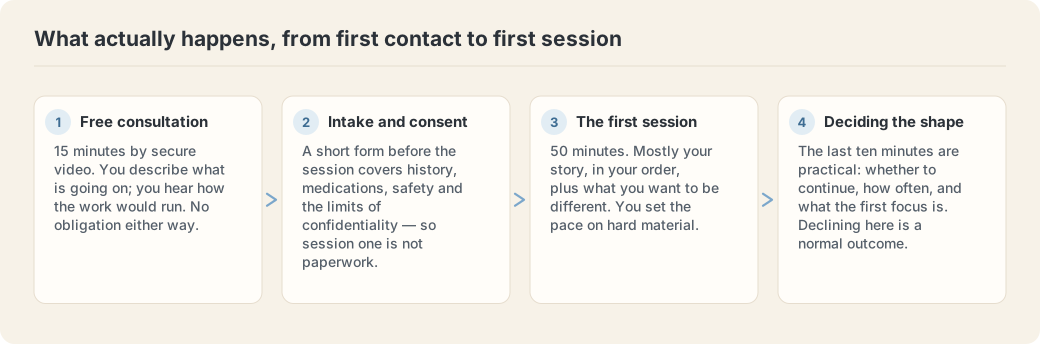
The gap between deciding to do something and doing it is where most of the delay lives. It helps to know exactly how small the first step is: a free fifteen-minute consultation over secure video, in which you say roughly what is going on and hear how the work would run.
You are not committing to a course of therapy, you are not required to tell the whole story, and deciding afterwards that it is not for you is an entirely normal outcome, including deciding that a different counsellor would suit you better. What happens in a first session covers the stage after that in detail.
The thing most people say afterwards is some version of I should have done this ages ago. That is not a sales line; it is what happens when a decision that has been carrying eighteen months of weight turns out to take fifteen minutes.
The two-week record that answers the question better than any list
If you have read the signals and still cannot decide, there is a cheap way to get an actual answer rather than a feeling: keep a brief record for two weeks. Three lines a day, at roughly the same time. How the day was out of ten. What the hardest part was. What you avoided.
It works because self-assessment across a long stretch is unreliable in a specific direction, people average over the good days and discount the bad ones, and a difficulty that has developed gradually has no comparison point left. Two weeks of contemporaneous notes removes the averaging.
What people typically find surprises them in one of two ways. Either the picture is considerably worse on paper than it felt: nine of fourteen days rated four or below, three social invitations declined, the same avoidance recurring, which settles the question. Or it is genuinely more variable than the current low mood suggested, which is also useful, because it points at what makes the good days good.
The third finding is the most useful of all: the trigger you had not identified. Patterns that are invisible from inside a week become obvious on a page. That it is always worse after contact with a particular person, or on Sundays, or after poor sleep rather than after hard work.
And whatever it shows, the record itself makes a first session considerably more efficient. Arriving with two weeks of data rather than a general impression can save the better part of a session, which at private rates is not a trivial saving.
The cost of waiting, stated plainly
Most of the reasons people give for waiting are reasonable: cost, time, uncertainty about whether it is warranted. What is usually missing from the calculation is the other side of it.
Patterns get more established. A difficulty running for six months has less rehearsal behind it than one running for four years. This is not a moral point; it is a practical one about how long the work takes, and the arithmetic favours starting earlier.
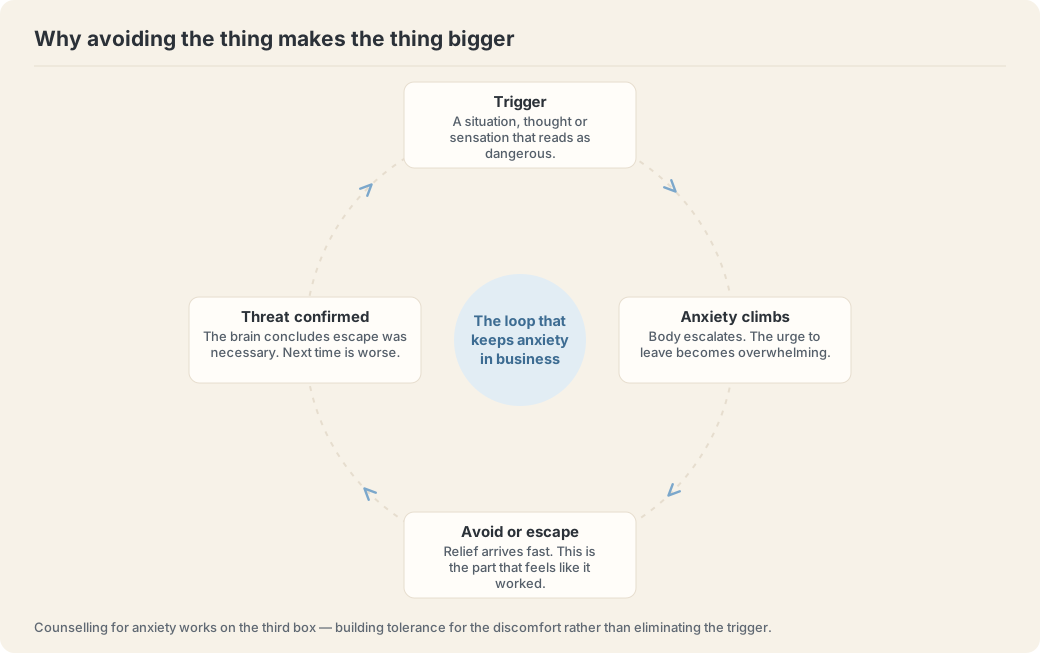
Avoidance accumulates. The single most reliable feature of untreated anxiety is that the list of avoided situations grows. Each addition is small and defensible and the total quietly reorganises a life. Reversing it is straightforward and takes proportionally longer the longer the list.
Other things get built on top. Sleep deteriorates, drinking increases, a relationship absorbs the strain, work performance slips. Each of those becomes its own problem requiring its own attention, and they interact.
Relationships pay the interest. The people around you are usually absorbing something, and the resentment that accumulates on both sides while nothing is named is frequently harder to repair afterwards than the original difficulty.
None of this is an argument that you must book something today. It is the missing half of a decision that people usually make by weighing only the cost of acting. Waiting is also a choice with a price, and it is worth counting it before choosing.
Common questions
What if I start and realise I did not need it?
That is a fine outcome and it happens. A consultation or a first session that concludes "you are handling this, and here is what to watch for" is a useful result, not a wasted one.
Do I need to be in crisis to justify booking?
No, and waiting for a crisis makes the work harder rather than more deserved. Counselling is considerably more effective as prevention than as rescue.
I am functioning fine at work. Does that mean I am okay?
Not necessarily. Functioning is a poor measure, because it is often the last thing to break and the first thing people protect at the cost of everything else. See high-functioning anxiety.
Is it too late if this has been going on for years?
No. Long-standing patterns take longer to shift than recent ones, but duration does not make them untreatable. Plenty of people begin after a decade of managing.
Sources
- Canadian Mental Health Association, BC Division
- HealthLink BC, mental health and substance use
- 9-8-8 Suicide Crisis Helpline (Canada)
This guide is general information, not clinical advice, and it cannot diagnose anything or replace an assessment. If you are in crisis, call or text 9-8-8 (Canada, 24/7) or BC Mental Health Support at 310-6789.
Individual sessions are $140 for 50 minutes, after a free 15-minute consultation; card at booking.
Many extended health plans reimburse a Registered Clinical Counsellor, depending on the plan, so check yours; MSP does not cover private counselling. All fees.
There is no wrong way to start.
A free 15-minute consultation over secure video, whenever you are ready for one. Nothing is committed by having it, and no card is needed to book it.
Book Free ConsultationNot ready to book? Send a line about what is going on. A reply comes within one business day.
Or a smaller step: What sessions cost · What the free 15 minutes is like
Looking on behalf of someone else? What to send them, and what not to, including the funded routes most people do not know they qualify for.
Where this leads
If this is close to your own situation, there is a page written for it: Counselling for men in BC.
Where you are
Online counselling across British Columbia
Every session is by secure video, so the counsellor you see does not depend on where you live. Each city page covers coverage, local public services and who is taking new clients there.