Free tool · about 2 minutes
Which kind of counselling fits?
Five questions about what has been going on, and a suggested place to start. Some answers point to a service here; some point to a guide, to a crisis line, or to something that is not counselling at all. Nothing is stored and there is no sign-up.
Updated
Rather ask a person? Book a free 15-minute consultation, and a counsellor will check the starting point with you.
Question 1 of 5
Nothing here is stored or sent anywhere. Closing the page erases it. Privacy
How this works, and what it cannot do
Five questions, weighted so urgency wins. If an answer indicates you are not safe, the result says so and points at crisis services rather than a service page. A website should not be triaging that, and counselling is the wrong speed for it.
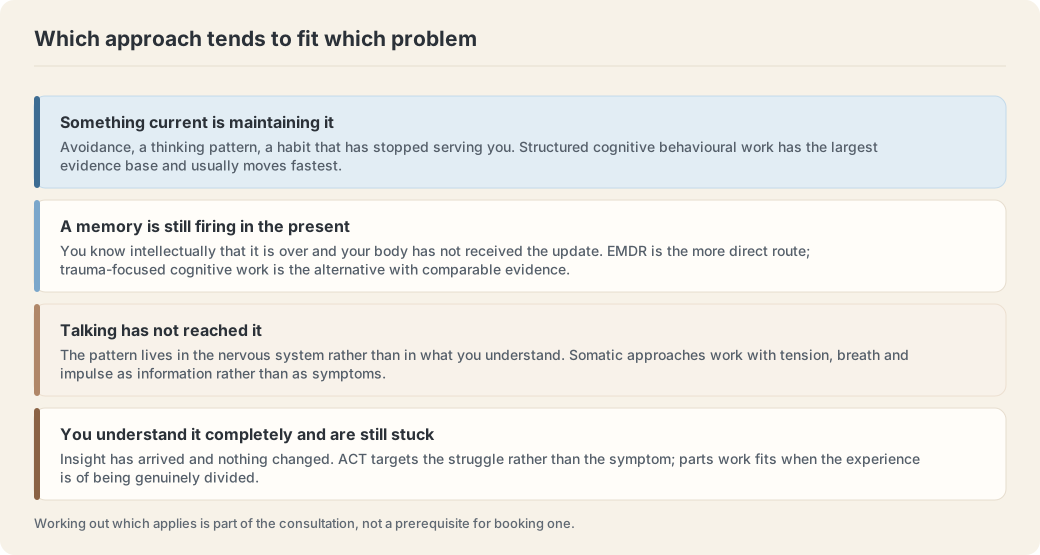
Otherwise it looks for the pattern people most often arrive with. Something older that is still active points toward trauma-informed work and possibly EMDR. Conflict or distance points to couples counselling, and if only one of you wants to come, individual vs couples therapy is the decision to read first. Exhaustion from work points at burnout vs depression, because those two look alike and need different responses.
What it cannot do is assess anything. It has no validation behind it, it does not know your history, and five questions cannot outperform a conversation. Treat it as a signpost, a free 15-minute consultation costs nothing and will get you a better answer. If you would rather read first, signs it might be time for therapy covers the same ground at length.
Common questions
Is this an assessment?
No. It sorts your answers towards a starting point, which is a different job from assessing anything. A Registered Clinical Counsellor does not diagnose in any case, where a formal diagnosis is what you need, that is a physician, psychiatrist or registered psychologist. What this can do is stop you spending a first session working out which door you should have walked through.
What if the result is not what I expected?
That is worth paying attention to rather than overriding. It usually means one answer carried more weight than you thought it would, often the question about whether the difficulty sits inside one person or between two. You can run it again and change that answer to see how much it was driving. If the result still feels wrong, it is wrong: five questions cannot know what you know.
Can it tell me counselling is not the answer?
Yes, and some of its outcomes do exactly that. A tool that can only ever conclude "book with us" is an advertisement wearing a quiz's clothes. Where what you describe points to a physician, to an EFAP you already have, or to something practical rather than therapeutic, it says so and links there instead.
Do you see my answers?
No. Everything runs in your browser. Nothing is sent anywhere, nothing is stored, and there is no account, no email field and no analytics attached to what you choose. Closing the tab ends it.
Does the suggestion commit me to anything?
Not in the slightest. It is a starting point for a conversation, and the free 15-minute consultation exists precisely so that the starting point can be checked before anybody books a session. Changing direction after that conversation is normal and costs nothing.
This is one of six free counselling tools, from which kind of counselling fits to what it costs after extended health and what a stress leave pays. Each runs in your browser and none asks for an email address.
Who you would talk to
Taking new clients and seeing people across BC by secure video. Each is a Registered Clinical Counsellor; the registration is on the profile and can be checked on the BCACC register.

Camille Granda, RCC, CCC
English and Tagalog · Trauma, Anxiety and chronic stress, Grief, loss and life transitions
In her words: “I want sitting with me to feel like the biggest belly breath you have ever taken.”

Savneet Singh, RCC
English and Punjabi · Anxiety, Depression, Trauma and attachment
In her words: “Comforting, safe and supportive, is what I aim for.”
Individual sessions are $140 for 50 minutes, after a free 15-minute consultation; card at booking. All fees · How to check a counsellor’s registration
Keep reading
If you want the longer version
Therapy starts with one conversation.
Book a free 15-minute consultation over secure video. No pressure, just a chance to see if we’re a good fit.
Book Free ConsultationNot ready to book? Send a line about what is going on. A reply comes within one business day, or read the guides first and come back when you want to.
Looking on behalf of someone else? What to send them, and what not to, including the funded routes most people do not know they qualify for.