Guide · Choosing a counsellor
Questions worth asking a therapist before you book
Ask what approach they would use for your situation and why, how they would know it was not working, what their limits are, and what the money looks like. The quality of the answers matters more than the content: a counsellor who can explain their reasoning plainly, name what they do not do, and tolerate being questioned is showing you how the work will go.
Most people treat a first consultation as an audition they are attending. It is closer to an interview they are conducting.
7 min read · Updated
Why this feels awkward, and why it should not
Asking a health professional to justify their approach feels presumptuous to many people, particularly anyone raised to treat professionals as authorities. It is worth getting past, for a practical reason: the working relationship between you and a counsellor is one of the more consistent predictors of whether therapy helps at all, across every method that has been studied.
That relationship starts in the consultation. How a counsellor handles being asked a direct question: whether they answer it, deflect it, or subtly make you feel difficult for asking, is a preview of how they will handle you saying "this is not working" in session nine.
You are also, straightforwardly, buying something. Nobody thinks twice about asking a contractor what they would do and why.
Questions about the work itself
- "What approach would you use for something like this, and why that one?", The best answer names something specific and explains the fit. A vague "I am integrative and I tailor to the client" is not wrong, but on its own it tells you nothing, ask what tailoring would look like for your situation.
- "How would we know if it was working?", You are listening for something checkable. A counsellor who has thought about this will describe markers you would both be able to see, not just "you will feel better".
- "How would we know if it was not working, and what would you do then?", The more revealing version. A good answer includes changing approach and referring you elsewhere. Anyone who cannot imagine their approach failing is a risk.
- "What do you not work with?", Everyone has limits. A counsellor who claims none is either inexperienced or not being straight with you. Real answers here build more confidence than a long list of specialisms.
- "How much of this happens between sessions?", Structured therapies rely heavily on between-session practice. Knowing that upfront prevents the mismatch where you expected to talk and are being handed a worksheet.
- "What is your experience with people in my situation?", Reasonable, and reasonable to expect an honest answer including "less than you might want". Honesty here is more valuable than confidence.
Questions about the practical shape
- "What does a session cost, and is that the whole cost?", Session fee, cancellation policy, whether letters or forms are charged separately, whether the rate changes. No surprises later.
- "Do you direct-bill, or do I pay and submit?", A material difference to cash flow. Where a practice does not direct-bill, you pay the practice directly and claim reimbursement yourself, see extended health coverage in BC.
- "Will my insurer cover your designation specifically?", The critical detail people miss. Plenty of plans cover a psychologist and not a Registered Clinical Counsellor, or vice versa. Confirm the designation with your insurer, not just the dollar amount.
- "How often would we meet, and for how long is that likely to run?", Expect a range with reasoning rather than a number. Be wary of anyone quoting a precise session count before they know you.
- "What is your availability, and what happens if I need to reschedule?", Evening availability, waitlists, and cancellation terms are all easier to establish now than to discover in month two.
- "What happens between sessions if things get bad?", Almost no private practice offers 24-hour crisis cover, and it is important to know that clearly rather than to assume otherwise. A good answer names the crisis services instead.
Questions about credentials, and how to check the answers
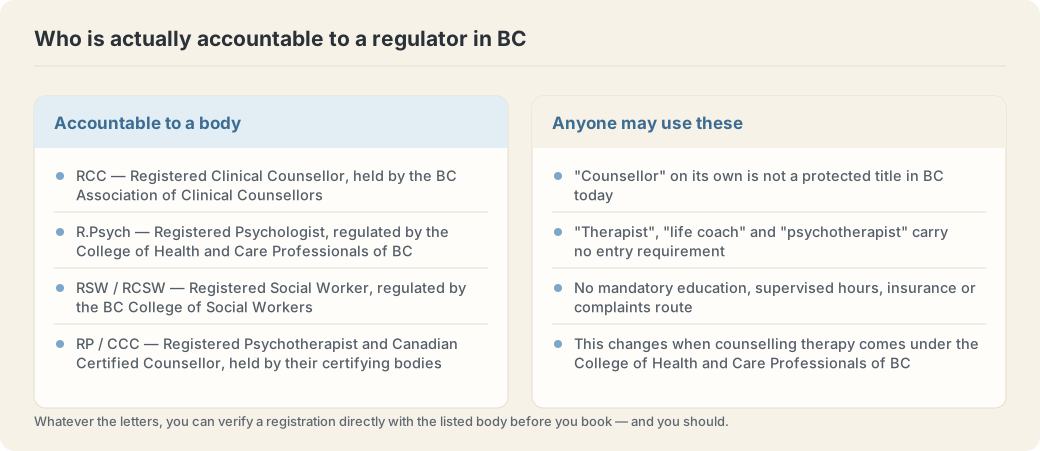
In British Columbia today, "counsellor" and "therapist" are not protected titles, so the letters after a name carry more information than the job title does. Ask what designation someone holds and which body holds it, then verify it independently. Every regulator and association maintains a public register, and you do not need anyone's permission to look.
A Registered Clinical Counsellor (RCC) is registered through the BC Association of Clinical Counsellors. A Registered Psychologist is regulated by the College of Health and Care Professionals of BC. A Registered Social Worker is regulated by the BC College of Social Workers. The practical significance of any of them is that there is somewhere to complain.
It is also fair to ask about training in a specific method. "EMDR-trained" covers a wide range, and asking what level of training someone completed is a normal question that a properly trained clinician will answer without defensiveness.
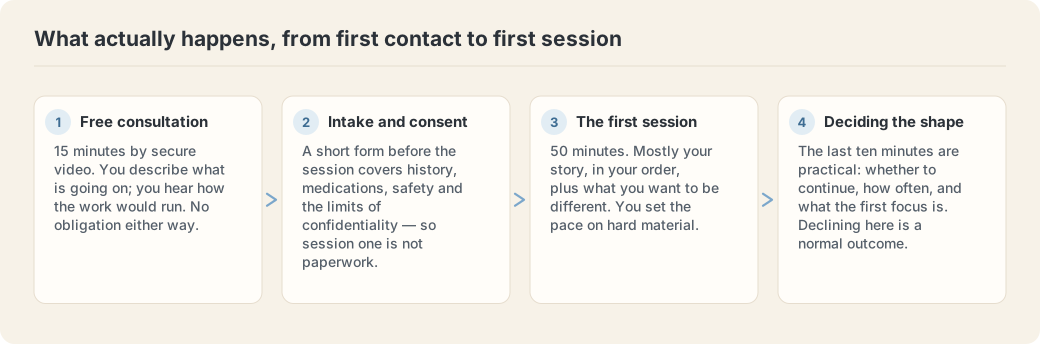
Every question on this page is fair game in a consultation here: book a free 15 minutes and ask them.
Answers worth being wary of
- A guarantee of any kind, Nobody can promise an outcome, and offering one breaches the advertising standards counsellors work under. See standards and accountability.
- Pressure to commit to a package, Pre-paid blocks of sessions serve the practice's cash flow. Being able to stop at any point without penalty serves you.
- Dismissing your question, "Do not worry about the details, just trust the process" during a consultation is a preview, and not a good one.
- Claiming to treat everything, A list of twenty specialisms usually means none. Depth is more useful than breadth.
- Discomfort with being asked about fit, A counsellor who is fine saying "I might not be the right person for this" is demonstrating exactly the judgement you want.
- Anything that sounds like a testimonial, Client testimonials are prohibited under BCACC advertising standards, because consent given inside a therapeutic relationship is not freely given. A practice showcasing them is telling you something about how it handles rules.
What you never have to explain
You do not have to justify choosing not to continue. You do not have to give a reason for preferring a counsellor of a particular gender, language or background. Those are legitimate clinical preferences, not fussiness. You do not have to disclose your whole history in a consultation to establish that your reason for calling is valid.
And you are allowed to consult more than one counsellor before choosing. It is normal, it is sensible, and nobody competent will be offended by it. Fit is not something either of you can determine from a website.
If it helps to see how the other side of this conversation runs, what happens in a first session and how to find a therapist in BC cover the process end to end.
What a good counsellor is assessing while you ask
A consultation runs in both directions, and it is worth knowing what is being weighed on the other side, not because you are being graded, but because understanding it makes the conversation less like an audition.
The first question is fit for this difficulty. A counsellor should be forming a view about whether what you are describing sits inside their competence, and a good one will say so when it does not. That is why questions about scope get straightforward answers from experienced clinicians and defensive ones from inexperienced clinicians.
The second is safety and level of care. Any competent counsellor is quietly assessing whether private weekly counselling is the right container at all, or whether medical assessment, a specialised programme or urgent support should come first. A consultation that ends with a referral elsewhere is that assessment working.
The third is workability, not whether you are motivated, but whether the circumstances allow anything to change right now. Someone in an ongoing crisis, without stable housing, or in an active situation that has not resolved may be better served by stabilisation than by insight-oriented work.
The fourth is the relationship, and it is mutual. A counsellor is noticing whether they can be useful to you specifically, and occasionally the honest answer is no, not because of anything about you, but because fit is not universal. Hearing that is disappointing and it is a mark of someone doing the job properly rather than filling a slot.
Questions to ask yourself before the call
- What would be different if this worked?, Not "I would feel better": something observable. You would drive on the highway, or sleep through, or have the conversation you have been avoiding. A concrete answer gives the work a target and gives you a way to judge it later.
- What am I hoping they will not ask about?, Usually the most useful question on this list. Whatever it is, it is probably relevant, and noticing it in advance means you can decide when rather than being caught by it.
- What have I already tried?, Including previous therapy, and what went wrong with it. This is useful information for a counsellor and it saves weeks.
- What can I realistically commit?, Money and hours, honestly. A plan built without these ends abruptly at exactly the wrong moment.
- Am I looking for change or for confirmation?, Both are human. Only one of them is therapy, and knowing which you are bringing this week is worth the thirty seconds.
- What would make me leave?, Deciding in advance what would count as this not working means you are less likely to drift for six months or bolt after one difficult session.
Common questions
Is it rude to ask a therapist about their qualifications?
No. It is a reasonable question about a professional service, and a registered clinician will answer it directly. Anyone who bristles has told you something useful.
Can I talk to more than one counsellor before deciding?
Yes, and many people do. Consultations are usually free specifically so that fit can be assessed without cost being a barrier.
What if I do not know what to ask?
Describe what is going on and let the counsellor explain what they would do about it. The explanation itself will tell you most of what you need to know.
How do I check that someone is actually registered?
Every regulator and association in BC maintains a public register you can search directly. Ask which body holds the designation, then look it up yourself rather than taking the website's word for it.
Sources
- BC Association of Clinical Counsellors
- College of Health and Care Professionals of BC
- BC College of Social Workers
This guide is general information, not clinical advice, and it cannot diagnose anything or replace an assessment. If you are in crisis, call or text 9-8-8 (Canada, 24/7) or BC Mental Health Support at 310-6789.
Who you would talk to
Taking new clients and seeing people across BC by secure video. Each is a Registered Clinical Counsellor; the registration is on the profile and can be checked on the BCACC register.

Camille Granda, RCC, CCC
English and Tagalog · Trauma, Anxiety and chronic stress, Grief, loss and life transitions
In her words: “I want sitting with me to feel like the biggest belly breath you have ever taken.”

Savneet Singh, RCC
English and Punjabi · Anxiety, Depression, Trauma and attachment
In her words: “Comforting, safe and supportive, is what I aim for.”
Individual sessions are $140 for 50 minutes, after a free 15-minute consultation; card at booking.
Many extended health plans reimburse a Registered Clinical Counsellor, depending on the plan, so check yours; MSP does not cover private counselling. All fees.
Still deciding?
A free 15-minute consultation is the least committal way to find out whether this is a fit. No pressure, and no obligation to book a session afterward.
Book Free ConsultationNot ready to book? Send a line about what is going on. A reply comes within one business day.
Or a smaller step: What sessions cost · What the free 15 minutes is like
Looking on behalf of someone else? What to send them, and what not to, including the funded routes most people do not know they qualify for.
Where you are
Online counselling across British Columbia
Every session is by secure video, so the counsellor you see does not depend on where you live. Each city page covers coverage, local public services and who is taking new clients there.