Guide · Getting started
What actually happens in a first therapy session
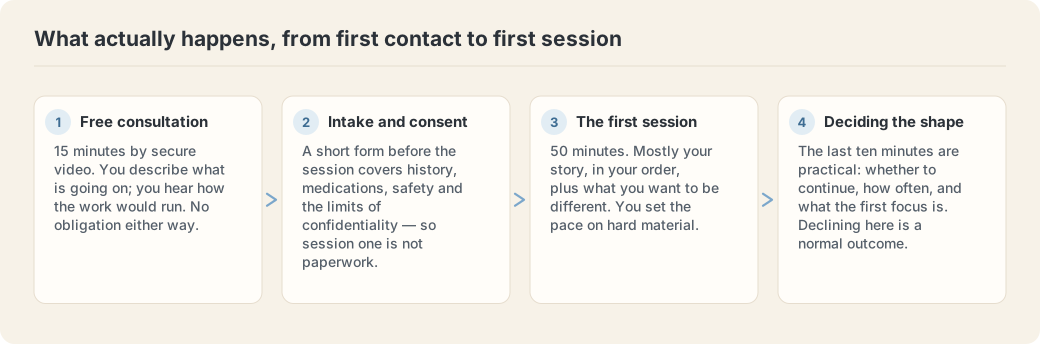
A first session is mostly orientation: paperwork and confidentiality limits, what brought you, some history, and what you want to be different. You will not be asked to relive your worst experience, you are allowed to say "I would rather not go into that yet," and the most useful thing you can do is notice whether you felt reasonably comfortable. That is the actual test.
The unknown is doing a lot of the work in keeping people out of the room. Here is the whole thing, start to finish.
6 min read · Updated
Before the session
Most practices send intake paperwork in advance: contact details, emergency contact, a consent form, and often a brief questionnaire about what you are bringing. Filling it in honestly saves session time, but if a question feels like too much to answer in a form, leaving it blank and raising it in person is entirely acceptable.
For a virtual session, do the boring preparation. Test the link beforehand rather than at the appointment time. Find a room with a door, or a parked car. Headphones improve both audio and privacy. Have water and tissues within reach. You may not need them, and it is better not to go looking mid-sentence.
The first ten minutes: the unglamorous part
Sessions open with housekeeping, and a counsellor who skips it is cutting a corner. Expect confidentiality and its limits spelled out plainly: what you say stays private, except for risk of serious harm to you or someone else, a child or vulnerable adult at risk of abuse or neglect, or a court order. In BC this is set out in the BCACC code of ethics and provincial privacy law.
Fees, cancellation policy, and how receipts work for extended health reimbursement usually get covered here too. It is administrative and it is worth listening to, most later friction between client and counsellor traces back to something in this five minutes that nobody read out loud.
The main part: what you get asked
Then the actual conversation, which is more ordinary than people expect. The questions are usually some version of:
- What brings you here now?, Not just what is wrong, why now rather than six months ago. The answer often points straight at what matters.
- How long has this been going on?, Whether it is recent, recurring, or lifelong changes what kind of work makes sense.
- What does it affect?, Sleep, work, relationships, appetite, the things you have stopped doing.
- What have you already tried?, Including previous therapy: what helped, what did not, and what you did not like. This is useful information, not a test.
- Some background, Family, health, major events. Broad strokes in a first session; nobody is expecting a full history.
- What would "better" look like?, The hardest question, and often the most important. "I don't know" is a completely acceptable answer and is sometimes the starting point.
What will not happen
You will not be made to describe trauma in detail. A competent counsellor works at your pace, and in trauma-informed practice that pacing is the point, going too fast is a clinical error, not thoroughness. "I don't want to go into that yet" is a complete sentence and a reasonable one.
You will not be diagnosed. Counsellors in BC do not diagnose. That sits with psychologists, physicians and psychiatrists, as set out in the comparison of BC therapist types. You will also not be told what to do; if you get advice-giving in session one, that is worth noticing.
And you will not be fixed. One session is orientation. Some people leave the first one lighter for having said things out loud; others leave stirred up, which is normal and usually settles within a day.
The 15-minute consultation is a lower-stakes version of all of this, and it costs nothing. Book a free consultation.
How to tell whether it is a fit
The research on what predicts good outcomes keeps pointing at the working relationship, which means your reaction to this person is data rather than politeness. Worth asking yourself afterwards: did I feel listened to rather than processed? Could I imagine saying the harder thing to them? Did they explain their approach in language I understood?
You do not owe anyone a second session. Trying two or three counsellors before choosing is normal, and any decent practitioner would rather you found the right fit elsewhere than stayed out of politeness. The free consultation exists for exactly this reason.
Things people worry about that turn out not to be issues
- "I will not know what to say", You are not expected to arrive with a structured account. Most first sessions begin with a version of "start wherever you want" and the counsellor does the work of shaping it. Silence is normal and not something you are failing at.
- "I will cry", Many people do. It is an entirely unremarkable event in a counselling room, and nobody is evaluating you for it. There will be tissues and no comment.
- "I will be judged", Counsellors hear the full range of human experience and calibrate accordingly. The thing you are most dreading saying is almost certainly not the most difficult thing said in that room this month.
- "My problem is too small", Duration and cost are better tests than severity. Nobody is triaging you against other people's difficulties.
- "I will have to talk about my childhood", Only if it is relevant to what you want to change. Plenty of effective work stays firmly in the present.
- "They will tell me to leave my partner / quit my job", A counsellor who directs your life decisions is doing something other than counselling. The work is on helping you think, not on issuing instructions.
What to do in the twenty-four hours afterwards
First sessions have an afterwards, and nobody warns people about it. Having said several things out loud for the first time frequently produces a delayed reaction: feeling raw, unexpectedly tired, or oddly elated, sometimes several hours later. All of that is ordinary and it settles.
Two practical things help. Do not schedule anything demanding immediately afterwards; an hour with nothing in it is worth protecting. And write down anything that surfaced on the way home, because the useful material frequently arrives after the session rather than during it and is largely gone by the next week.
It is also worth deliberately noticing your reaction to the counsellor, separately from your reaction to the material. Did you feel able to disagree? Did you edit yourself, and if so, about what? Those questions matter more for the next decision than whether the session was comfortable, because a session can be uncomfortable and still be a good fit, and can be pleasant and go nowhere.
And if you leave certain it is not the right person, that is a useful outcome to have reached in fifty minutes rather than five sessions. Saying so, or not booking again, requires no justification.
The paperwork, and why it says what it says
Intake documents are usually skimmed, and two parts of them are worth actually reading because they determine things people later assume were never explained.
The limits of confidentiality. These are set out in writing before a first session for a reason: they are the only circumstances in which what you say leaves the room. Risk of serious harm to you or an identifiable other, suspected abuse or neglect of a child or vulnerable adult, and a court order. Everything else stays. Reading this before session one means you know the boundaries while deciding what to say, rather than discovering them afterwards.
The cancellation policy. Twenty-four hours is standard and it is enforced, because a missed slot cannot be refilled. It is not a penalty for being unwell; it is how a practice with fixed hours remains viable. Knowing the terms prevents an avoidable resentment later.
The rest is ordinary: contact details, emergency contact, medications, history, and consent to treatment. The medication question matters more than people assume, interactions and side effects shape what is realistic, and a counsellor is not assessing your character by asking.
Two things worth doing rather than skimming. Ask about anything you do not want on a file, because you can discuss what is recorded and how. And ask how long records are kept and how they are stored. You are entitled to a straight answer, and the privacy page sets out the standing position.
Common questions
What if I cry?
Extremely common, entirely expected, and not something you need to apologise for. Tissues are standard equipment for a reason.
What if I have nothing to say?
Also common. Your counsellor will ask questions. The session is not a performance you have to carry. "I don't know where to start" is a legitimate place to start.
How long is a session?
Fifty minutes is the standard individual session across most of BC. Couples sessions are often 50 or a longer extended format. Fees are on the fees page.
Can I ask my counsellor questions?
Yes, and it is worth doing. Their training, how they work, their experience with what you are bringing, what they think a realistic timeframe looks like. A good practitioner welcomes it.
Sources
- BC Association of Clinical Counsellors, code of ethics and standards
- HereToHelp BC, getting help for mental health
- CMHA BC, finding help
This guide is general information, not clinical advice, and it cannot diagnose anything or replace an assessment. If you are in crisis, call or text 9-8-8 (Canada, 24/7) or BC Mental Health Support at 310-6789.
Who you would talk to
Taking new clients and seeing people across BC by secure video. Each is a Registered Clinical Counsellor; the registration is on the profile and can be checked on the BCACC register.

Camille Granda, RCC, CCC
English and Tagalog · Trauma, Anxiety and chronic stress, Grief, loss and life transitions
In her words: “I want sitting with me to feel like the biggest belly breath you have ever taken.”

Savneet Singh, RCC
English and Punjabi · Anxiety, Depression, Trauma and attachment
In her words: “Comforting, safe and supportive, is what I aim for.”
Individual sessions are $140 for 50 minutes, after a free 15-minute consultation; card at booking.
Many extended health plans reimburse a Registered Clinical Counsellor, depending on the plan, so check yours; MSP does not cover private counselling. All fees.
Still deciding?
A free 15-minute consultation is the least committal way to find out whether this is a fit. No pressure, and no obligation to book a session afterward.
Book Free ConsultationNot ready to book? Send a line about what is going on. A reply comes within one business day.
Or a smaller step: What sessions cost · What the free 15 minutes is like
Looking on behalf of someone else? What to send them, and what not to, including the funded routes most people do not know they qualify for.
Where you are
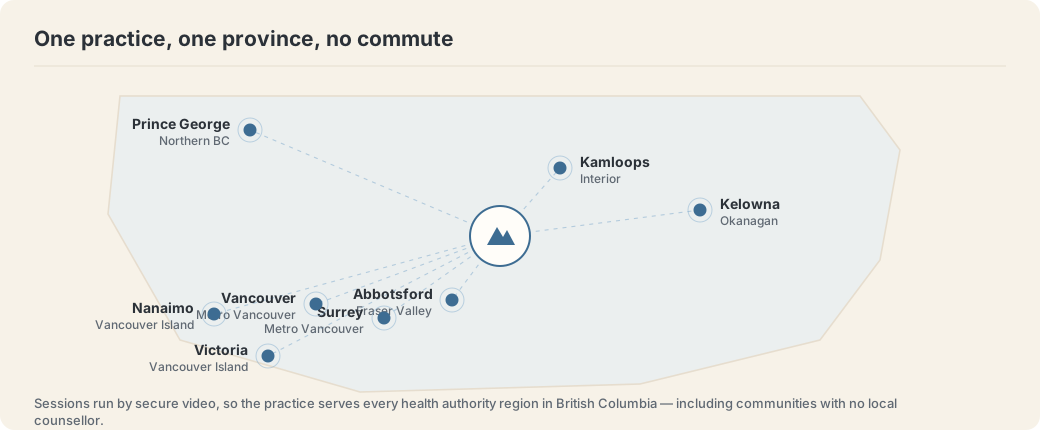
Online counselling across British Columbia
Every session is by secure video, so the counsellor you see does not depend on where you live. Each city page covers coverage, local public services and who is taking new clients there.