Guide · Couples
Does couples therapy actually work?
The research on structured couples therapy is reasonably encouraging: a majority of couples report meaningful improvement, with the strongest evidence behind approaches built on relationship research rather than general advice. The most consistent predictor of a poor outcome is not the severity of the problems. It is how long the couple waited, and whether both people arrive willing to look at their own part.
Most couples arrive years later than they meant to, and the delay does more damage than the arguments did.
8 min read · Updated
What the evidence actually supports
Couples therapy has been studied far less than individual therapy, but the structured approaches, the ones with a defined method and a treatment manual rather than general conversation, have a genuine evidence base. Emotionally focused therapy and the Gottman Method are the two most researched, and both show meaningful improvement for a substantial majority of couples who complete a course of treatment.
What the research does not show is that couples therapy saves every relationship, or that improvement means the couple stays together. Some of the better outcomes in couples work are separations conducted with far less damage than they would otherwise have involved, particularly where children are in the picture. A therapy that only counts staying together as success is measuring the wrong thing.
It is also worth being precise about what "works" means here. Improvement in couples research is usually measured as a reduction in relationship distress and an increase in satisfaction. That is real and it matters. It is not the same as a guarantee, and no counsellor can honestly offer one.
The waiting problem
The single most repeated observation in couples work is that people come late. By the time a couple books, the pattern has usually been running for years, and a good deal of the damage is not the original disagreement but the accumulated evidence each partner has been collecting about the other.
This matters because contempt. The sense that your partner is beneath you, expressed in eye-rolls, sarcasm and mockery, is corrosive in a way that anger is not. Anger is engagement. Contempt is a verdict already reached. Once a relationship is largely running on it, the work is considerably harder, because both people are now defending a conclusion rather than describing a problem.
The practical implication is unglamorous: coming earlier makes a large difference, and "we are not bad enough for therapy yet" is the same reasoning error that keeps individuals waiting. If the same argument has reset rather than resolved four or five times, the pattern is established.
What makes a better outcome more likely
- Both partners actually want to be there, Not equally enthusiastic. That is rare, but both present voluntarily. Where one person has been brought as the problem to be fixed, the work usually has to start by dismantling that framing before anything else can happen.
- Willingness to look at your own part, The single most useful disposition either partner can bring. Couples work does not adjudicate. A counsellor who agrees with you about who is right has stopped being useful to the relationship.
- Coming before contempt sets in, Repair is possible after contempt, and it is slower and less certain. Coming while the arguments are still hot but not yet dismissive is a substantially better position.
- A defined focus, Structured approaches begin with assessment precisely so that the work targets something specific. The fight about the dishes is rarely about the dishes, and identifying what it is about is most of the job.
- Doing something differently between sessions, Skills practised only in the room do not transfer. The couples who improve fastest are the ones who try something new during the week and report back on how badly it went.
When couples therapy is not the right container
Being clear about this matters more than filling appointments:
- Where there is intimate partner violence, Conjoint couples therapy is generally contraindicated where there is ongoing violence or coercive control, because a session that requires honest disclosure can put someone at risk afterwards. Individual support and specialised services come first. In immediate danger, call 9-1-1; VictimLinkBC is available at 1-800-563-0808, twenty-four hours a day.
- Where an affair is ongoing, Work on the relationship cannot proceed meaningfully while an outside relationship is still live. That is a boundary condition, not a moral judgement.
- Where one partner has already decided, If the decision to leave is made and the sessions are a way of softening the announcement, saying so is kinder and the work becomes something else, often separation support, which is legitimate and different.
- Where an untreated individual problem is driving everything, Active addiction, untreated severe depression, or unprocessed trauma in one partner will keep overwhelming the couples work. Sequencing individual work first is often faster than doing both badly at once. See individual vs couples therapy.
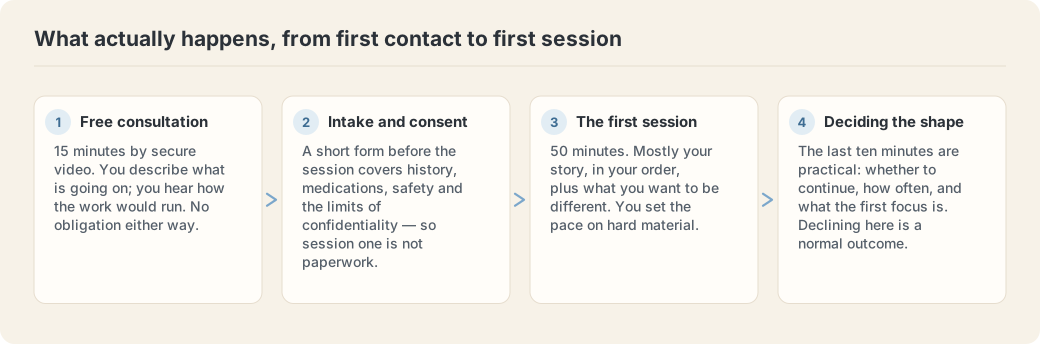
If you have been meaning to do this for a year or two, a free 15-minute consultation is a low-stakes way to start.
What sessions actually look like
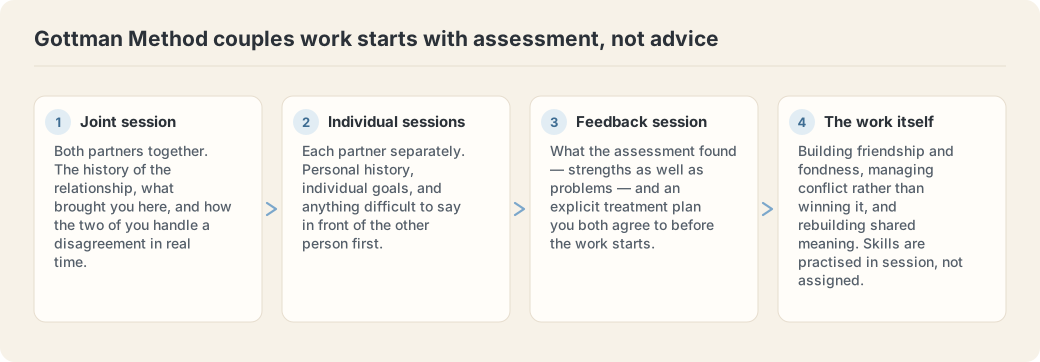
In a structured approach, the first phase is assessment rather than advice. That typically means a joint session covering the history of the relationship and how the two of you handle disagreement, then an individual session with each partner, then a feedback session where the counsellor sets out what they found, strengths as well as problems, and you agree a plan together.
People are frequently surprised that the assessment includes what is working. It is not a courtesy; it is the material the repair gets built from. A relationship with no remaining friendship is a different job from one where the affection is intact and the conflict management has collapsed.
After that, sessions tend to be more active than people expect. Rather than each partner reporting the week to the counsellor, you are asked to have the difficult conversation in the room, slowly, with interruptions, because the point is to change how you do it, not to describe how you did it. How the Gottman Method works covers the structure in detail.
Doing it online
Couples work by video has one practical complication and one underrated advantage. The complication is logistics: two people, one camera, and the need for genuine privacy from children and housemates, which is harder than it sounds and worth solving before the first session rather than during it.
The advantage is that it removes the commute for two people rather than one, which is often the difference between a couple sustaining weekly sessions and quietly stopping after four. For couples on different shift patterns, or where one partner works away, virtual sessions are frequently the only format that survives contact with real life. That is how online couples and marriage counselling runs at this practice, by secure video anywhere in BC.
Sitting side by side on one device works better than two devices in two rooms, which tends to reproduce the distance the therapy is trying to close. Where partners genuinely cannot be in the same place, it can still work. It is worth naming as a constraint rather than pretending it is neutral.
What each partner can do before the first session
Couples work starts faster when both people arrive having done a small amount of thinking separately. None of this requires agreement, and none of it should be shared before the session.
Write down the fight. Not the topic. The sequence. Who says what, what happens next, where it turns, how it ends. Most couples have one argument with many subjects, and the sequence is remarkably stable. Seeing your own moves written down is frequently the first useful shift.
Identify what you are actually afraid of. Underneath most recurring conflict is a fear that has never been stated plainly: that you do not matter, that you will be left, that you are being slowly erased, that nothing you do will ever be enough. The stated subject is usually a poor guide to this.
Name what you want to keep. Repair is built out of what remains: humour, a shared history, a particular kind of loyalty. Couples who can list these have considerably more material to work with than couples who arrive with only a charge sheet.
Decide what you are willing to look at in yourself. This is the single strongest predictor available before the work starts. Not who is more at fault, what portion of the pattern is yours, and whether you are prepared to examine it in front of the other person.
And be honest with yourself about the goal. Repair, decide, or separate well are three different pieces of work. Arriving intending one while presenting another wastes everybody's time, including yours.
What the first three months usually change
Couples arrive wanting the fighting to stop, and that is rarely the first thing that moves. Knowing the actual order prevents a lot of premature conclusions.
What changes first is the recovery time. The argument still happens; it ends sooner and the aftermath is shorter. A row that used to consume a weekend takes an evening. That is unglamorous and it is the earliest reliable marker.
Second is the ability to name the pattern while it is happening. One of you says "we are doing the thing" mid-conflict. It sounds trivial and it is the point at which a couple stops being inside the pattern and starts operating on it.
Third is repair getting received. Not more repair attempts. Every couple makes those. The other person accepting one. That single shift changes the shape of conflict more than any technique.
Fourth, and much later, is the underlying issue. The actual subject. The imbalance, the breach, the difference in what each of you needs, usually becomes workable only once the conflict has stopped consuming the sessions.
What frequently does not change is the frequency of disagreement, and couples who measure success by that metric conclude too early that it is not working. Much of the recurring conflict in a long relationship is perpetual by nature. The goal is holding it without damage, not eliminating it.
Common questions
What if my partner will not come?
Individual therapy focused on the relationship is a legitimate and often effective option. Changing your own half of a pattern changes the pattern, and a number of couples end up in joint work after one partner started alone.
Will the counsellor take sides?
No. A counsellor who agrees with one partner about who is right has stopped being useful to the relationship. The work is on the pattern between you, which neither of you controls alone.
Do we have to talk about our sex life?
Only if it is relevant to what you want to change, and only at a pace you set. Nothing is compulsory, and you can decline any topic without justifying it.
Can couples therapy help us separate well?
Yes, and that is a legitimate goal rather than a failure. Separating with less damage, particularly where children are involved, is a real outcome that couples work can support.
Sources
This guide is general information, not clinical advice, and it cannot diagnose anything or replace an assessment. If you are in crisis, call or text 9-8-8 (Canada, 24/7) or BC Mental Health Support at 310-6789.
Who you would talk to
Taking new clients and seeing people across BC by secure video. Each is a Registered Clinical Counsellor; the registration is on the profile and can be checked on the BCACC register.

Camille Granda, RCC, CCC
English and Tagalog · Couples counselling, Trauma, Anxiety and chronic stress
In her words: “I want sitting with me to feel like the biggest belly breath you have ever taken.”
Couples sessions are $175 for 50 minutes; a 110-minute extended session is $340, after a free 15-minute consultation; card at booking.
Many extended health plans reimburse a Registered Clinical Counsellor, depending on the plan, so check yours; MSP does not cover private counselling. All fees.
Still deciding?
A free 15-minute consultation is the least committal way to find out whether this is a fit. No pressure, and no obligation to book a session afterward.
Book Free ConsultationNot ready to book? Send a line about what is going on. A reply comes within one business day.
Or a smaller step: Which kind of counselling fits? · What sessions cost · What the free 15 minutes is like
Looking on behalf of someone else? What to send them, and what not to, including the funded routes most people do not know they qualify for.
Where this leads
Online couples and marriage counselling across BC
The practice is virtual, so the same counsellors see people in every one of these cities. Each page says what the service involves there and who is taking new clients.
If this is close to your own situation, there is a page written for it: Punjabi-speaking couples counselling in BC.
Where you are
Online counselling across British Columbia
Every session is by secure video, so the counsellor you see does not depend on where you live. Each city page covers coverage, local public services and who is taking new clients there.