Who we work with
Counselling for couples at a decision point
Couples counselling in BC by secure video, 50 minutes at $175 or 110 minutes at $340. Gottman-informed and structured, for couples who keep having the same argument, including partners joining from separate locations, which shift work and travel often require.
Most couples do not arrive after a catastrophe. They arrive after two years of the same conversation going nowhere.
8 min read · Updated
Many extended health plans reimburse a Registered Clinical Counsellor, depending on the plan, so check yours; MSP does not. Receipts are issued for every session, and the fees are published in full. On a calendar-year plan, sessions held by 31 December count against this year: using benefits before the plan year ends.
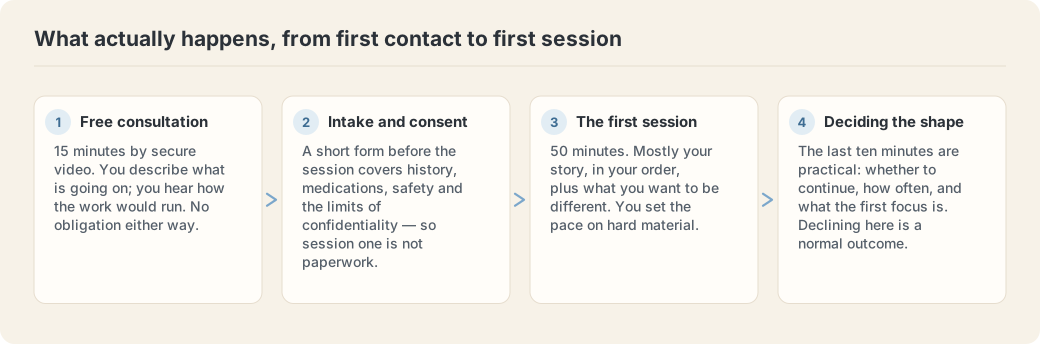
Couples sessions are $175 for 50 minutes; a 110-minute extended session is $340, after a free 15-minute consultation; card at booking.
There is usually a moment that prompts the call, and it is rarely the worst thing that has happened. More often it is small and clarifying. A fight that followed exactly the script of the last four, a realisation that you have started editing what you say, an evening in complete silence that neither of you mentioned.
By that point the pattern is well established, and the accumulated evidence each person has collected about the other has become part of the problem. The original disagreement is often almost incidental.
This page is about the situations couples actually arrive in, rather than the method used once they do. If you want the method, couples therapy and how the Gottman Method works cover it; if you want to know whether any of it helps, does couples therapy work is the more direct answer.
What comes up
The things people actually say
The same fight, on repeat
Different subjects, identical structure. One person pursues, the other withdraws, and both of you can predict the next five moves. The topic is almost never what it is about.
Drifting rather than fighting
No conflict to point at, just two people running parallel logistics operations who have not had a real conversation in a year. Frequently harder to raise than open conflict, because nothing is technically wrong.
One person carrying the relationship
One partner tracking the state of things, initiating repair, booking the counselling. That asymmetry is usually longstanding and rarely gets named directly until it is in the room.
After a breach of trust
An affair, a significant lie, a financial secret. The question is not only whether it can be repaired but whether both people actually want to attempt it, which is a different question and often unasked.
Mismatched load at home
The division of domestic and cognitive work, which is one of the more reliable sources of long-run resentment because it accumulates invisibly and is easy to dispute.
Parenting differences that have hardened
Two people who agreed in principle and diverged in practice, now each convinced the other is undermining them in front of the children.
Family and in-law pressure
Where the couple is not the only unit with a stake in the decisions. A common and often unacknowledged dynamic in families where obligation runs across generations.
Deciding whether to continue
Some couples arrive not to repair but to work out whether to. That is a legitimate reason to book, and it deserves better than being decided by attrition.
If the same conversation has been going nowhere for a while, a free 15-minute consultation is a low-stakes place to start.
What "we tried counselling once" usually means
A large share of couples arriving here have tried before, and the account of what went wrong tends to be one of three things. It became a forum where each partner presented evidence and the counsellor was expected to adjudicate. It stayed pleasant and changed nothing. Or one partner felt outnumbered and stopped coming.
All three are avoidable, and avoiding them is largely a matter of structure. Work that begins with a proper assessment: how the relationship functions, what is still intact, what each person is actually afraid of, has something to aim at. Work that begins with the presenting argument tends to keep having the presenting argument.
It also matters that a counsellor does not take sides, and says so explicitly and early. Not out of neutrality for its own sake, but because agreeing with one partner about who is right converts a therapy into a tribunal, and a tribunal cannot help a relationship.
What the first few sessions look like
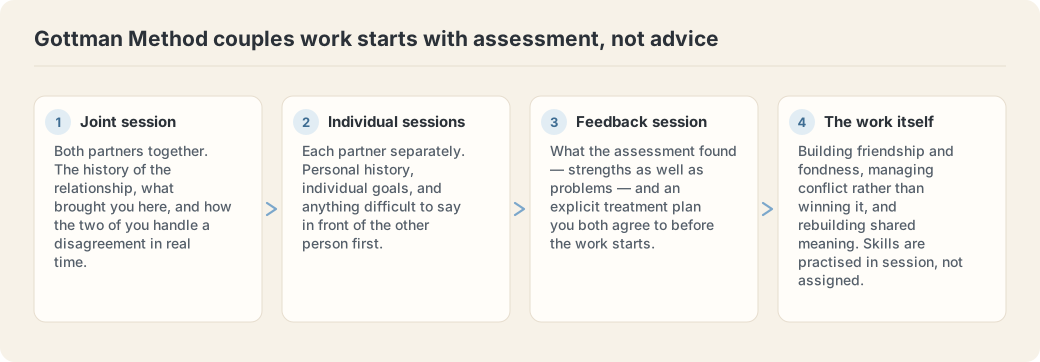
The structured approaches begin with assessment rather than intervention: a joint session covering the history and how the two of you handle disagreement, an individual session with each partner, and then a session where the findings and a plan are set out and agreed. Nothing is worked on until both people know what is being worked on.
People are often surprised that the assessment gives as much attention to what is working as to what is not. That is deliberate. The remaining friendship, humour and goodwill are the material any repair is built from, and a relationship where those are intact is a different job from one where they are not.
After that, sessions are more active than most people expect. You are asked to have the difficult conversation in the room, slowly, with interruptions, because the aim is to change how the two of you do it rather than to describe how you did it last Tuesday.
When one partner is reluctant
It is common for one person to book and the other to agree without enthusiasm. Reluctance is not the same as refusal, and it is workable, provided the reluctant partner is there voluntarily rather than as the identified problem.
Where somebody has been brought to be fixed, that framing has to be dismantled before anything useful can happen, and doing so is usually the first real piece of work. A counsellor who accepts the framing has already lost the session.
If one partner genuinely will not attend, individual therapy focused on the relationship is a real option rather than a consolation. Changing your own half of a pattern changes the pattern, and a number of couples end up in joint work after one person started alone. Individual vs couples therapy sets out how to choose.
Where couples work is not the right container
Being clear about this matters more than filling appointments. Conjoint couples therapy is generally not appropriate where there is ongoing intimate partner violence or coercive control, because a session that requires honest disclosure can create risk afterwards; individual and specialised support comes first. In immediate danger, call 9-1-1; VictimLinkBC is available at 1-800-563-0808, twenty-four hours a day.
It is also unlikely to work while an affair is still ongoing, or where one partner has already decided to leave and the sessions are a way of softening the announcement. Saying that plainly is kinder than six weeks of ambiguity, and separation support is a legitimate and different piece of work.
Where an untreated individual difficulty is driving most of the conflict: active addiction, severe untreated depression, unprocessed trauma, sequencing individual work first is frequently faster than doing both badly at once.
Doing it online, as two people
Virtual sessions solve the logistics problem that ends most couples therapy: two schedules, one appointment, and a commute that has to work for both. Removing the travel is often the difference between sustaining weekly sessions and quietly stopping in week four.
It introduces one requirement worth solving before the first session rather than during it: genuine privacy. Children, housemates and thin walls all shape what can be said, and a session where one of you is guarding the door is not a session.
Sitting together at one device works better than two devices in two rooms, which tends to reproduce exactly the distance the work is trying to close. Where partners are genuinely in different places: shift patterns, rotational work, one of you away. It can still work well, and it is worth naming as a constraint rather than pretending it is neutral.
Who you would see
Taking new clients and seeing people across BC by secure video. Each is a Registered Clinical Counsellor; the registration is on the profile and can be checked on the BCACC register.

Camille Granda, RCC, CCC
English and Tagalog · Couples counselling, Trauma, Anxiety and chronic stress
In her words: “I want sitting with me to feel like the biggest belly breath you have ever taken.”
Where to start
The between-sessions agreement
The most common way couples work is undone is not what happens in the room. It is the conversation on the drive home, where the session gets re-litigated and whatever was said becomes ammunition.
A short agreement, made in the first session, prevents most of it. No debriefing the session for twenty-four hours. Not silence, just not analysing who said what and whether the counsellor agreed with them. Anything important survives a day and comes back into the room, which is where it can be handled.
Nothing said in session gets quoted in an argument. The moment a disclosure becomes evidence, both of you stop disclosing, and the work becomes a performance.
Practise the specific thing rather than the general lesson. Couples work usually produces one concrete thing to try in the week. A repair phrase, a break signal, a particular conversation. One thing, tried badly, is worth more than a resolution to communicate better.
Report failures rather than successes. The most useful material a couple brings back is the attempt that went wrong. Bringing only the good week wastes the session, and it is a strong pull for anyone who wants to be doing well at therapy.
None of this requires either of you to feel warmly toward the other in a given week. It requires both of you to keep the container intact, which is a much lower bar and the one that actually determines whether the work holds.
Rebuilding after a breach of trust
Repair after an affair, a significant lie or a hidden financial problem is possible and it is slower and more structured than most couples expect. Being clear about the shape helps both people decide whether they want to attempt it.
Disclosure comes first and it has to be complete. Repair cannot proceed on an instalment plan; each new revelation resets the clock, and drip-fed truth is the single most common reason attempted repair fails.
Then a period of transparency that would be intolerable in an ordinary relationship. Access, accounting, answering the same question repeatedly without irritation. This is temporary, it is not a permanent arrangement, and the partner who breached trust does not get to set the end date.
Then the harder part: understanding how it happened. Not to distribute blame, but because "it meant nothing" explains nothing, and a couple who cannot account for it has no basis for believing it will not recur.
Then, much later, the relationship itself: what was not working, what was not being said, and what both people want now.
Two honest points. The injured partner will need to ask the same questions many times, and that repetition is part of the process rather than a failure to move on. And the timeline is longer than either person wants, measured in many months rather than weeks. Couples who are told this in advance do considerably better than couples who conclude at week six that it should be finished by now.
Services that tend to fit
Couples therapy
The main container: assessment first, then structured work on conflict, friendship and shared meaning.
Individual therapy
Where one partner is not attending, or where an individual difficulty needs its own space first.
Trauma therapy
When something one partner is carrying keeps overwhelming the couple work.
Counselling in Punjabi
For couples whose family conversations happen in Punjabi and lose something in translation.
Anxiety counselling
Where anxiety in one partner is driving the pursuing-and-withdrawing pattern.
Common questions
Do both of us have to be on the call for the consultation?
It helps, and it is not required. Some couples do the consultation together; sometimes one person calls first to work out whether to raise it at all. Either is fine.
Will we be told who is right?
No. A counsellor who adjudicates has stopped being useful to the relationship. The work is on the pattern between you, which neither of you controls on your own.
What if we decide to separate?
That is a legitimate outcome rather than a failure, and couples work can support separating with considerably less damage, which matters a great deal where children are involved.
Can we do couples sessions in Punjabi?
Yes. Sessions run in English or Punjabi, including couples work, which matters when the family context being discussed happens in Punjabi.
Sources and further support
General information, not clinical advice, and not a diagnosis. If you are in crisis, call or text 9-8-8 (Canada, 24/7) or BC Mental Health Support at 310-6789. In immediate danger, call 911.
Where you are
Online counselling across British Columbia
Every session is by secure video, so the counsellor you see does not depend on where you live. Each city page covers coverage, local public services and who is taking new clients there.
One conversation, no commitment.
A free 15-minute consultation over secure video, including an honest answer if something other than counselling would serve you better.
Book Free ConsultationNot ready to book? Send a line about what is going on. A reply comes within one business day, or read the guides first and come back when you want to.
Looking on behalf of someone else? What to send them, and what not to, including the funded routes most people do not know they qualify for.