Guide · Anxiety
Health anxiety: when the checking never settles it
Health anxiety is maintained by the things that seem to relieve it: checking the body, searching symptoms, and seeking reassurance from doctors or family. Each produces short-lived relief and strengthens the underlying belief that vigilance is necessary. Treatment works by reducing those behaviours rather than by providing better reassurance, and it always runs alongside proper medical care rather than instead of it.
The tests come back clear, the relief lasts two days, and then it starts again. That loop is the condition, not a failure to be reassured.
7 min read · Updated
An important caveat first
Nothing on this page suggests that physical symptoms should be ignored or that medical concerns are imaginary. New, persistent or changing symptoms warrant medical assessment, and a counsellor is not qualified to determine what is or is not physically wrong.
People with health anxiety also get ill, and being labelled anxious can make it harder to be taken seriously, which is a real harm and a reasonable thing to be angry about. The distinction being drawn here is not between real and imagined symptoms; it is between a concern that is resolved by appropriate assessment and a pattern in which no amount of assessment resolves anything.
The clinical target is the loop, not the vigilance about your body per se. And the first step in treating it is almost always to establish appropriate medical care rather than to bypass it.
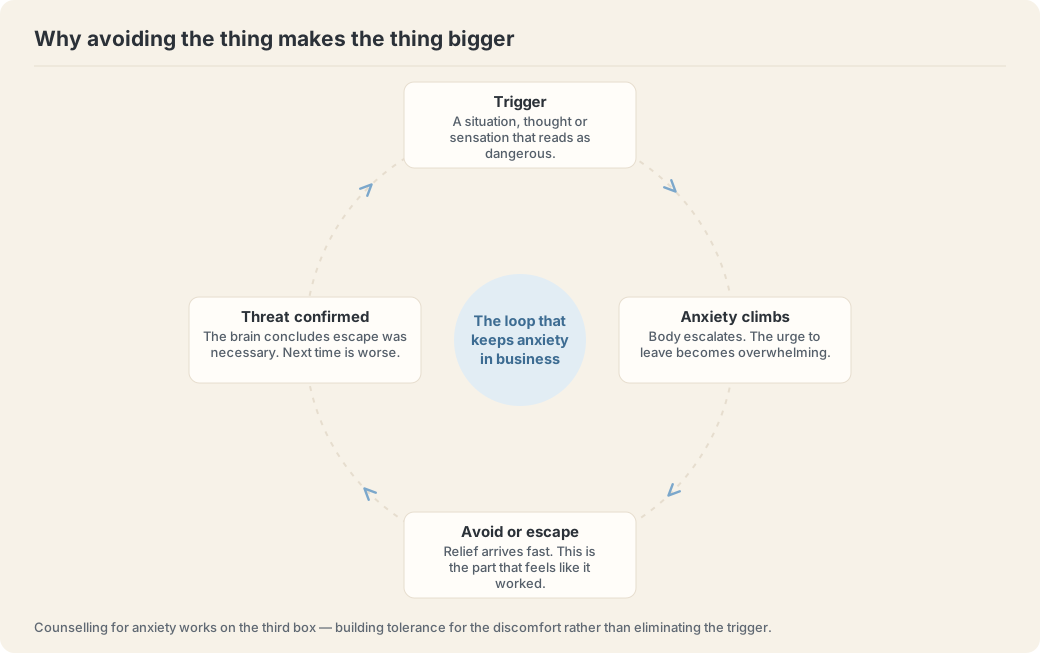
Why reassurance stops working
The defining experience is that reassurance has a half-life. A clear scan produces genuine relief for a day or two, then doubt re-enters. The test might have missed it, the doctor did not check the right thing, symptoms have changed since.
The mechanism is the same one that maintains any anxiety. Checking or seeking reassurance reduces distress quickly, which reinforces the behaviour, which makes the next episode arrive sooner and require more reassurance to settle. Over time, the interval shortens and the dose required increases.
Searching symptoms online is the modern accelerant. Any symptom set can be matched to something catastrophic, attention narrows onto the worst match, and the search itself becomes a compulsive behaviour delivering brief relief and lasting alarm.
Body-checking works the same way. Repeatedly palpating an area, monitoring a heartbeat, examining a mark, the checking irritates tissue, raises awareness of normal sensation, and produces exactly the changes it is looking for. The examination generates the evidence.
If the reassurance keeps wearing off within days, a free 15-minute consultation is a reasonable next step.
What treatment looks like
- Establish an agreed medical baseline, A single, thorough assessment with a physician, and an explicit agreement about what monitoring is appropriate going forward. This is the foundation, and it makes the rest possible.
- Reduce checking on a schedule, Not stopping abruptly: extending the interval deliberately, tolerating the discomfort, and observing that it falls without the check. Recording the prediction beforehand makes the disconfirmation stick.
- Stop searching symptoms, Usually the single highest-impact change, and the hardest. Some people need the specific sites blocked rather than relying on willpower.
- Agree a reassurance limit with family, Partners providing repeated reassurance are doing something kind that maintains the problem. An explicit agreement, answered once, then not again, removes the strain from the relationship as well as the loop.
- Work on the interpretation, not the sensation, Bodies produce constant sensation. The question the work addresses is what a twinge means, and how much certainty is actually available about it.
- Build tolerance for uncertainty, The underlying target. No test provides permanent certainty about future health for anyone. The goal is not confidence that nothing is wrong; it is the ability to live without that guarantee, which is the position everybody is in.
What it costs, and why people wait
Health anxiety is unusually expensive in time: appointments, tests, hours of searching, and the mental space consumed by monitoring. It is also unusually isolating, because the concern sounds unreasonable when described and people quickly learn not to raise it.
It frequently damages the relationship with medical care in both directions. People become reluctant to attend for fear of being dismissed as anxious, which occasionally means a genuine problem is presented late. And clinicians under time pressure may reassure quickly rather than address the pattern, which delivers exactly the short-term relief that keeps it running.
The pattern also tends to be triggered rather than continuous, an illness in the family, a death, a milestone birthday, a news story. Recognising the trigger is useful, because it reframes an episode as a response to something rather than as evidence.
Treatment for this is well established and generally measured in months rather than years. The main obstacle is that people usually seek help for the symptoms rather than the anxiety, and the loop can run for a decade before anyone names it.
How to talk to your doctor about it
The relationship with medical care is frequently the most damaged part of this, in both directions, and a small amount of directness repairs a surprising amount.
Name the pattern explicitly. "I think I have health anxiety, and I would like help distinguishing when I actually need to come in" changes the entire register of a consultation. It moves you from someone presenting symptoms to someone collaborating on a problem, and most clinicians respond well to it.
Ask for an agreed monitoring plan. What is worth coming in for, what is not, and how often. A written, agreed threshold is enormously useful, because it replaces an unanswerable question in the moment with a decision already made in a calmer one.
Ask for one thorough assessment rather than repeated partial ones. Serial reassurance-seeking is what maintains the loop; a single comprehensive baseline is what makes reducing it possible.
Say plainly that you are working on it. A clinician who knows this is happening is far less likely to reassure reflexively, which is kind, brief and counterproductive, and more likely to hold the agreed plan with you.
And the caveat that always belongs here: this does not mean stopping medical care or ignoring new symptoms. It means agreeing in advance what warrants attention, so that vigilance has a boundary rather than being either total or abandoned.
Common questions
What if something is wrong?
Then it needs medical assessment, and this work does not replace that. Treatment for health anxiety always runs alongside appropriate medical care, and establishing what appropriate looks like is part of it.
Is it wrong to want to check?
The urge is understandable. The issue is that checking provides relief that is short-lived and increases the frequency of the urge, so the pattern intensifies over time.
Can a counsellor tell me whether my symptoms are anxiety?
No. A counsellor does not diagnose and cannot assess a physical symptom. That is a physician's job, and a counsellor who offers an opinion on it is working outside their scope.
How long does treatment take?
It responds well to structured work and is typically measured in months. The main variable is how much checking and searching has become embedded.
Sources
This guide is general information, not clinical advice, and it cannot diagnose anything or replace an assessment. If you are in crisis, call or text 9-8-8 (Canada, 24/7) or BC Mental Health Support at 310-6789.
Who you would talk to
Taking new clients and seeing people across BC by secure video. Each is a Registered Clinical Counsellor; the registration is on the profile and can be checked on the BCACC register.

Camille Granda, RCC, CCC
English and Tagalog · Trauma, Anxiety and chronic stress, Grief, loss and life transitions
In her words: “I want sitting with me to feel like the biggest belly breath you have ever taken.”

Savneet Singh, RCC
English and Punjabi · Anxiety, Depression, Trauma and attachment
In her words: “Comforting, safe and supportive, is what I aim for.”
Individual sessions are $140 for 50 minutes, after a free 15-minute consultation; card at booking.
Many extended health plans reimburse a Registered Clinical Counsellor, depending on the plan, so check yours; MSP does not cover private counselling. All fees.
Still deciding?
A free 15-minute consultation is the least committal way to find out whether this is a fit. No pressure, and no obligation to book a session afterward.
Book Free ConsultationNot ready to book? Send a line about what is going on. A reply comes within one business day.
Or a smaller step: A reflection on how things have been · What sessions cost · What the free 15 minutes is like
Looking on behalf of someone else? What to send them, and what not to, including the funded routes most people do not know they qualify for.
Where this leads
Online anxiety counselling and therapy across BC
The practice is virtual, so the same counsellors see people in every one of these cities. Each page says what the service involves there and who is taking new clients.
Where you are
Online counselling across British Columbia
Every session is by secure video, so the counsellor you see does not depend on where you live. Each city page covers coverage, local public services and who is taking new clients there.