Guide · Practical pressures
Money stress and mental health in BC
Financial strain has a direct, well-documented effect on mental health: through chronic stress, through the cognitive load of constant calculation, and through shame. Counselling cannot change your income, and it can address the shame, the avoidance that makes the situation worse, and the decisions that are being deferred. Practical financial help is a separate and equally necessary route.
It is one of the most common sources of distress in this province and one of the least likely to be named in a session.
7 min read · Updated
Why it hits mental health so directly
Financial strain is not an unpleasant circumstance that makes people sad. It has specific mechanisms, and knowing them makes it easier to treat as a health issue rather than a personal failing.
It is chronic and inescapable. Unlike a discrete stressor, money pressure is present every day, in every decision, with no off switch. Chronic stress with no resolution is exactly the pattern most associated with anxiety and depressive presentations.
It consumes cognitive capacity. Constant calculation: what can be delayed, what can be covered, what happens if something breaks, occupies working memory continuously. That leaves measurably less capacity for everything else, including for the decisions that might improve the situation.
It removes options. The things that reliably help mood: activity, social contact, time off, sometimes treatment itself, frequently cost money. Financial strain restricts exactly the responses that would help.
And it is loaded with shame in a way that few other stressors are, because it is widely treated as a verdict on competence rather than as a circumstance. That shame is what keeps it out of the room.
The avoidance loop
Financial difficulty produces a specific and recognisable avoidance pattern, and the pattern reliably makes the situation worse.
Unopened envelopes. Not checking the balance. Not answering unknown numbers. Not opening the app. Each avoidance provides immediate relief from acute distress, and each one allows the underlying situation to deteriorate. A missed deadline, an escalated debt, a fee that could have been avoided.
The deterioration then makes the next look more frightening, which strengthens the avoidance. It is the same architecture as any anxiety loop and it is not a matter of irresponsibility; it is a predictable response to a stimulus that produces distress with no available action.
Interrupting it works the same way as any other exposure. Opening one envelope, with support, and observing that the distress falls. Then two. Getting an accurate picture is nearly always less frightening than the imagined one, and it is the prerequisite for any practical step.
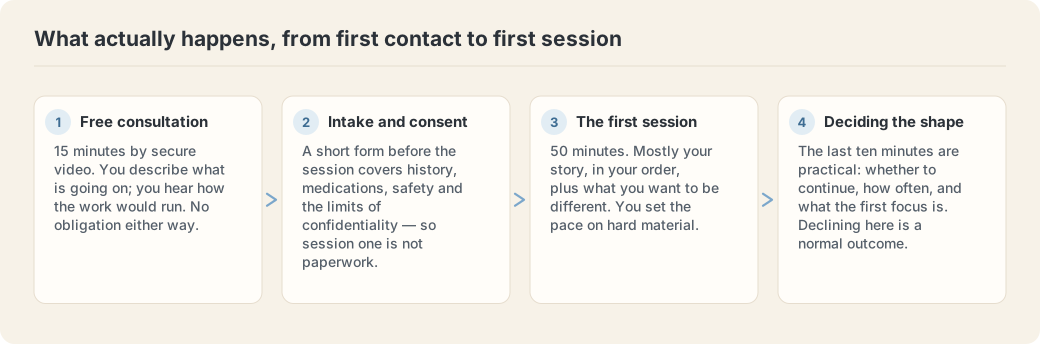
If the money is the thing and you have never said it out loud, a free 15-minute consultation costs nothing to start with.
What counselling can and cannot do
- Cannot change your income, Worth stating first. No amount of therapy addresses a structural shortfall, and any framing that treats financial strain as a mindset problem is both wrong and insulting.
- Can address the shame, Which is frequently the heaviest part and the part that prevents people from accessing the practical help that exists.
- Can interrupt the avoidance, Graded, supported re-engagement with the actual numbers. This has direct financial consequences as well as psychological ones.
- Can support a deferred decision, Leaving a job, moving, declaring insolvency, asking family. These are frequently deferred for years because the distress of considering them is intolerable, and having somewhere to think changes that.
- Can treat what strain has produced, Anxiety, low mood and sleep disruption caused by financial pressure are still treatable, even while the pressure continues.
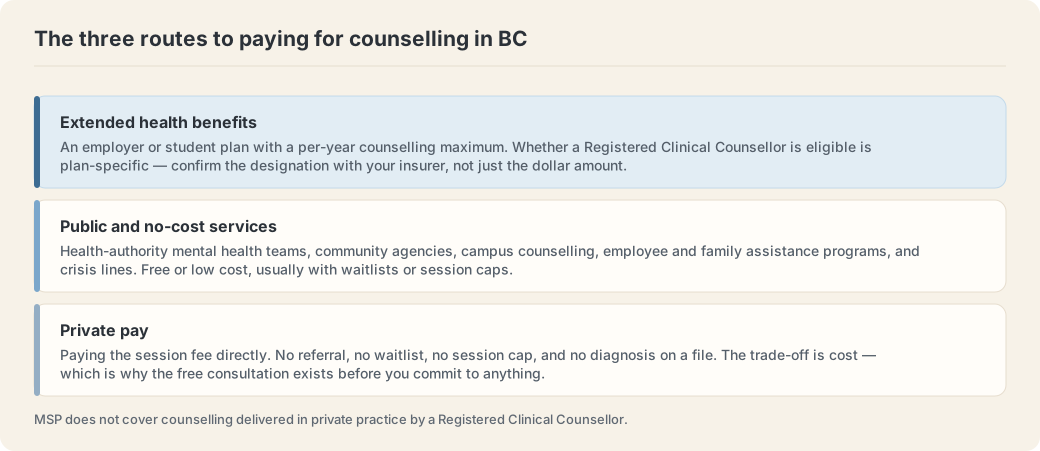
- Can be a bad use of money, If paying for counselling is itself creating strain, say so. Free routes exist and a counsellor should point you to them rather than take the booking, see low-cost counselling in BC.
The practical routes, which matter as much
Psychological support without practical support is half a response, and the practical side is frequently more available than people assume.
Non-profit credit counselling exists in BC and provides free or low-cost help with budgeting, creditor negotiation and debt management. It is distinct from commercial debt-settlement companies, which charge and are worth approaching with caution.
Licensed insolvency trustees provide a free initial consultation and are the only professionals who can administer a consumer proposal or bankruptcy. People wait far longer than they should before this conversation, usually out of shame, and frequently discover the options were less catastrophic than imagined.
Provincial and federal benefits are routinely unclaimed. Income assistance, disability assistance, rental supplements, and various credits all have take-up rates well below eligibility.
Creditors negotiate more often than people expect. Hardship arrangements exist at most institutions and are almost never volunteered.
And if financial pressure has reached the point of thoughts of ending your life, which it does, more often than is discussed. That needs support now: 9-8-8 by call or text, or 310-6789, both twenty-four hours a day.
Talking about money in a relationship
Financial strain rarely stays financial. It becomes an argument about values, about competence, and about who is responsible, and the actual numbers frequently never get discussed at all.
A few things reliably help. Separate the accounting from the argument. Establishing what is true. The balances, the obligations, the actual monthly shortfall, is a task, and it goes considerably better as a scheduled hour with a spreadsheet than as a fight at eleven at night.
Notice which of you is avoiding and which is monitoring. This is the most common configuration: one partner cannot look, the other cannot stop looking. Both are anxiety responses to the same situation, and each reads the other as the problem. Naming it as a shared response rather than a character difference removes a great deal of heat.
Distinguish the past from the plan. How the situation arose and what to do now are separate conversations, and merging them guarantees neither is completed. Most couples need to have the first one eventually; almost none need to have it first.
Agree what each of you actually fears. Frequently it is not the same thing. One fears destitution, the other fears being judged, a third fears the loss of independence. The fights make far more sense once those are on the table.
And where money pressure is genuinely structural rather than behavioural, the useful conversation is about how to survive it together rather than how to solve it, which is a different and more honest goal.
Common questions
Is it absurd to pay for counselling when money is the problem?
It is a fair question and worth raising directly. Where paying would worsen the strain, the free and low-cost routes are the right answer and a counsellor should say so.
Can a counsellor give financial advice?
No. That is outside scope. Credit counselling, an insolvency trustee or a financial planner are the right professionals, and counselling works on what surrounds the situation.
Why can I not make myself open the mail?
Because avoidance reliably reduces acute distress in the moment, which reinforces it. It is a predictable anxiety pattern rather than a failure of character, and it responds to graded, supported exposure.
Does financial stress cause depression?
The association between financial strain and both anxiety and depressive presentations is well established. Causation runs in both directions, which is part of what makes the loop hard to exit.
Sources
- Credit Counselling Society
- BC government, income assistance
- Canadian Mental Health Association, BC Division
This guide is general information, not clinical advice, and it cannot diagnose anything or replace an assessment. If you are in crisis, call or text 9-8-8 (Canada, 24/7) or BC Mental Health Support at 310-6789.
Who you would talk to
Taking new clients and seeing people across BC by secure video. Each is a Registered Clinical Counsellor; the registration is on the profile and can be checked on the BCACC register.

Camille Granda, RCC, CCC
English and Tagalog · Trauma, Anxiety and chronic stress, Grief, loss and life transitions
In her words: “I want sitting with me to feel like the biggest belly breath you have ever taken.”

Savneet Singh, RCC
English and Punjabi · Anxiety, Depression, Trauma and attachment
In her words: “Comforting, safe and supportive, is what I aim for.”
Individual sessions are $140 for 50 minutes, after a free 15-minute consultation; card at booking.
Many extended health plans reimburse a Registered Clinical Counsellor, depending on the plan, so check yours; MSP does not cover private counselling. All fees.
Still deciding?
A free 15-minute consultation is the least committal way to find out whether this is a fit. No pressure, and no obligation to book a session afterward.
Book Free ConsultationNot ready to book? Send a line about what is going on. A reply comes within one business day.
Or a smaller step: A reflection on how things have been · What sessions cost · What the free 15 minutes is like
Looking on behalf of someone else? What to send them, and what not to, including the funded routes most people do not know they qualify for.
Where you are
Online counselling across British Columbia
Every session is by secure video, so the counsellor you see does not depend on where you live. Each city page covers coverage, local public services and who is taking new clients there.