Comparison · Trauma treatment
CBT or EMDR for trauma: how they differ
Trauma-focused CBT works through language, examining thoughts and beliefs about what happened, often with structured written or spoken exposure. EMDR works through reprocessing, using bilateral stimulation while you hold the memory in mind, and requires far less verbal description. Both are recommended for PTSD in major guidelines. The choice is usually about fit rather than efficacy.
Both are recommended in clinical guidelines for PTSD. They get there by different routes.
6 min read · Updated
| Trauma-focused CBT | EMDR | |
|---|---|---|
| Core mechanism | Identifying and re-examining thoughts and beliefs; structured exposure | Reprocessing memories with bilateral stimulation while holding them in mind |
| How much you must describe | Substantial. The work happens largely through language | Considerably less; detailed narration is not required |
| Homework between sessions | Usually yes, thought records, structured practice | Usually minimal; some journalling between sessions |
| Session structure | Agenda-led, collaborative, skills-oriented | Eight-phase protocol with defined processing sets |
| Guideline status for PTSD | Recommended | Recommended |
| Often suits | People who find it useful to talk things through and like structure and practice | People who find describing it unbearable, or who understand it intellectually but still feel it |
| Typical course | Commonly 8–20 sessions for single-incident trauma | Varies widely; single-incident may resolve in a handful of processing sessions |
The genuine difference: how much you have to say
For most people choosing between these, this is the deciding factor.
Trauma-focused CBT is a talking treatment in the fullest sense. You examine what you believe about the event and about yourself because of it: I should have stopped it, it was my fault, I cannot trust my judgement, and test those beliefs against evidence. Structured exposure to the memory, written or spoken, is often part of it. It requires putting the experience into words, repeatedly.
EMDR requires far less of that. Your counsellor needs enough to identify the target, an image, a belief, a body sensation, a distress rating, but the processing itself happens largely internally. You are not obliged to narrate what is passing through your mind. For people who have avoided therapy specifically because they cannot face describing what happened, this is frequently the deciding factor.
The head-versus-body gap
A pattern that shows up constantly in trauma work: people who fully understand, intellectually, that it was not their fault, and who still feel the whole weight of it.
Where that gap is the main problem, EMDR is often the better-fitting tool, because it works on how the memory is stored rather than on what you consciously believe about it. Where the beliefs themselves are the live problem, persistent guilt, ongoing self-blame that has not been examined, CBT's direct engagement with those beliefs is well suited.
This is a tendency rather than a rule. Plenty of people do well with either, and many courses of therapy end up drawing on both.
Unsure which fits what you are carrying? That is a good use of a free 15-minute call, before committing to either. Book a free consultation.
What matters more than the choice
Two things outrank the modality decision, and both get less attention than they deserve.
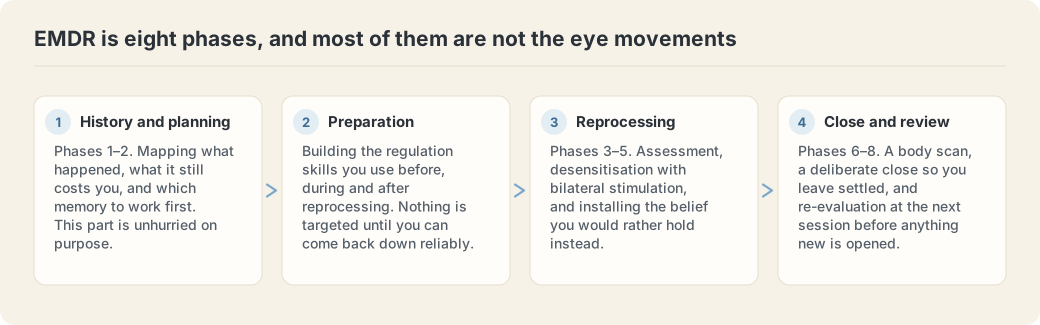
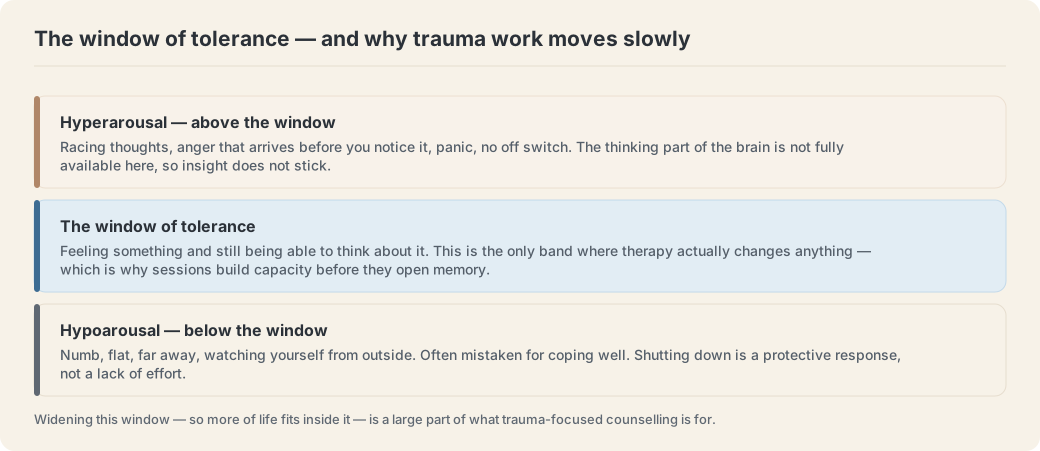
Stabilisation first. Neither approach should begin processing before you have enough capacity to tolerate distress between sessions. If you are in an unsafe situation, in early substance-use recovery, or currently without much ground under you, the honest answer is often "not yet" regardless of which method is on offer. A practitioner proposing either in a first session, without knowing your history, is moving too fast.
Pacing. Trauma work done too quickly can destabilise people, and that risk is identical across both approaches. Someone who checks in on how the last session landed, and slows down when the answer is bad, matters more than which protocol they were trained in.
How the choice is usually made in practice
Both have strong evidence for post-traumatic stress and neither is universally superior, which means the choice comes down to fit rather than ranking. A few considerations do most of the deciding.
How much you want to talk about it. Trauma-focused cognitive work involves recounting and examining the event in detail, repeatedly. EMDR requires substantially less verbal description. You hold the memory rather than narrate it. For people who cannot face telling the story, or who have told it many times to no effect, that difference is decisive.
Whether the problem is a belief or a memory. Where the lasting damage is in the conclusions drawn afterwards: about fault, safety, or what kind of person you are, cognitive processing approaches target that directly and well. Where the difficulty is a memory that fires in the present regardless of what you understand intellectually, EMDR is usually the more direct route.
Single incident or accumulated. Both handle single-incident trauma well. Where harm was prolonged and relational, either approach needs a longer stabilisation phase first, and the choice matters less than the pacing.
Your appetite for homework. Cognitive protocols typically involve structured between-session work. EMDR involves less. That is a real preference and a legitimate input.
A good counsellor should be able to explain which they would suggest and why, and should be willing to change if it is not working after a fair trial. If the answer is only "this is what I do", that is information about the practitioner rather than about the methods.
What do the guidelines actually recommend?
Clinical guidelines for post-traumatic stress across several countries converge on a fairly consistent position, and knowing it makes it easier to ask for the right thing.
The recommended first-line treatments are trauma-focused psychological therapies, the trauma-focused cognitive approaches and EMDR, rather than general counselling, general talking therapy, or medication as an opening move. That is a meaningful distinction: "I have been in therapy for two years and the flashbacks are unchanged" frequently means the therapy was not trauma-focused.
Both families are recommended, and guidelines generally do not rank one above the other for adults with post-traumatic stress. Where they differ is in the detail, some place slightly more weight on trauma-focused cognitive approaches on the strength of the larger evidence base, while treating EMDR as an established alternative.
What guidelines consistently do not recommend is single-session psychological debriefing immediately after a traumatic event, which was widely used for years and is now understood to be unhelpful and possibly harmful. If someone offers it, that is out of date.
The practical use of all this is simple. Ask a prospective counsellor whether the approach they are proposing is trauma-focused, and which one. A clinician who cannot answer that in a sentence is unlikely to be delivering either protocol as designed.
Where Westpeak Wellness fits
Westpeak Wellness offers EMDR therapy and draws on CBT within broader trauma therapy and anxiety counselling. In practice most courses of work here are not purely one or the other, stabilisation skills first, then whichever processing approach fits what you are bringing.
If what you actually need is a formal PTSD diagnosis for a benefits claim or a legal process, that requires a psychologist or physician rather than a counsellor, the comparison of BC therapist types sets out why.
Common questions
Can I do both?
Yes, and it is common. CBT-derived skills are often used to build stability before EMDR processing, and many practitioners move between them depending on what a given piece of the work needs.
Which one is faster?
EMDR has a reputation for being faster with single-incident trauma, and for some people it is. With complex or long-standing trauma both are slower, because most of the early work is stabilisation rather than processing.
Does EMDR work over video?
Yes, using an on-screen moving target, alternating audio, or self-administered tapping. The guide on what EMDR is covers the adaptations in detail.
What if I have tried one and it did not help?
Worth trying the other. It is also worth considering whether the issue was the modality, the pacing, or the fit with that particular practitioner. Those are three different problems with three different fixes.
Sources
- NICE, Post-traumatic stress disorder guideline (NG116)
- American Psychological Association, EMDR in the PTSD treatment guideline
- CAMH, trauma
General information, not clinical or legal advice. Fee ranges are typical BC private-practice ranges and vary by practitioner. Confirm any practitioner’s registration directly with the relevant college or association.
EMDR is offered as a 90-minute intensive at $190, or within 50-minute sessions at $140, after a free 15-minute consultation; card at booking.
Many extended health plans reimburse a Registered Clinical Counsellor, depending on the plan, so check yours; MSP does not cover private counselling. All fees.
Talk it through before you commit.
A free 15-minute consultation, including an honest answer if what you need is someone other than an RCC.
Book Free ConsultationNot ready to book? Send a line about what is going on. A reply comes within one business day.
Or a smaller step: Which kind of counselling fits? · What sessions cost · What the free 15 minutes is like
Looking on behalf of someone else? What to send them, and what not to, including the funded routes most people do not know they qualify for.
Where this leads
Online EMDR therapy across BC
The practice is virtual, so the same counsellors see people in every one of these cities. Each page says what the service involves there and who is taking new clients.
Where you are
Online counselling across British Columbia
Every session is by secure video, so the counsellor you see does not depend on where you live. Each city page covers coverage, local public services and who is taking new clients there.