Compare · How the work runs
Weekly or every two weeks?
Weekly sessions build and hold momentum, and they matter most at the start and during any intensive piece of work, trauma reprocessing in particular is difficult to do well fortnightly. Every two weeks suits stable periods, skills-based work with real practice between sessions, and situations where weekly is not financially sustainable. The wrong answer is a weekly plan you abandon in week five.
People usually treat frequency as a scheduling question. It changes what the therapy can do.
6 min read · Updated
| Weekly | Every two weeks | |
|---|---|---|
| Momentum | Builds and holds | Has to be rebuilt each time |
| Time spent catching up | Minimal | Often the first 10–15 minutes |
| Suits trauma reprocessing | Yes, usually the minimum | Generally not recommended |
| Suits skills practice | Yes | Yes, sometimes better, more practice time |
| Cost over three months | Roughly 12 sessions | Roughly 6 sessions |
| Risk of drift | Lower | Higher, cancellations become month-long gaps |
| Typical use | Start of work, intensive phases, crisis periods | Consolidation, maintenance, stable periods |
What does frequency actually change?
The obvious effect is dose, twice as many sessions in the same period. The less obvious and more important effect is continuity. In fortnightly work, a meaningful share of each session is spent re-establishing where you were, what happened in between, and what state you are both in. In weekly work that overhead largely disappears.
The other effect is on what can safely be opened. Difficult material has a half-life: it stays activated for some days after a session. Weekly sessions mean the next one arrives while it is still live and can be worked with. A fortnight can be long enough for someone to close the subject and arrive having decided not to reopen it.
This is why frequency is a clinical decision rather than a diary decision, and why a counsellor should have a view about it rather than asking what suits you.
When weekly genuinely matters
- The first four to six sessions, Assessment and the establishment of a working relationship both go considerably faster weekly. Starting fortnightly often means three months to reach where weekly would have been at six weeks.
- Trauma reprocessing, Approaches like EMDR involve opening and closing material deliberately within a session and reviewing at the next. A fortnight between is enough for someone to be carrying an incompletely processed target for two weeks. See EMDR therapy.
- Acute periods, A crisis, a separation, a bereavement, an imminent decision. When the situation is changing weekly, fortnightly sessions are always describing history.
- When avoidance is part of the pattern, For anyone whose difficulty involves avoiding difficult things, a fortnightly schedule offers considerably more room for the appointment itself to be avoided.
When every two weeks is a good choice
- The work is largely practice, Where the substance is trying something different between sessions, a fortnight gives more opportunity to actually do it and more material to bring back.
- Things have stabilised, After an intensive phase, spacing sessions out is often the correct next step rather than a compromise. It tests whether change holds without weekly support.
- Weekly is not sustainable, Entirely legitimate. Six sessions you can afford, spaced deliberately, beats twelve you abandon at five. Say so early so the plan is built around it rather than derailed by it.
- Life makes weekly unrealistic, Rotational work, shift patterns, caregiving. A fortnightly rhythm that is actually kept is better than a weekly one that is half cancelled.
What tends to go wrong
The most common failure is drift. A fortnightly schedule with one cancellation becomes a month, and a month becomes a check-in rather than a course of treatment. Monthly sessions are maintenance, and it is worth calling them that rather than pretending they are the same work more slowly.
The second failure is a frequency chosen once and never revisited. Frequency should change as the work changes: weekly through an intensive phase, fortnightly during consolidation, and a deliberate ending rather than a fade. If nobody has raised it in three months, raise it.
The third is cost arriving as a surprise. Weekly sessions for three months is roughly twice the outlay of fortnightly, and a plan built without reference to the budget tends to end abruptly at exactly the wrong moment. This is a normal conversation, and having it early is far better than having it at session ten. See fees and insurance.
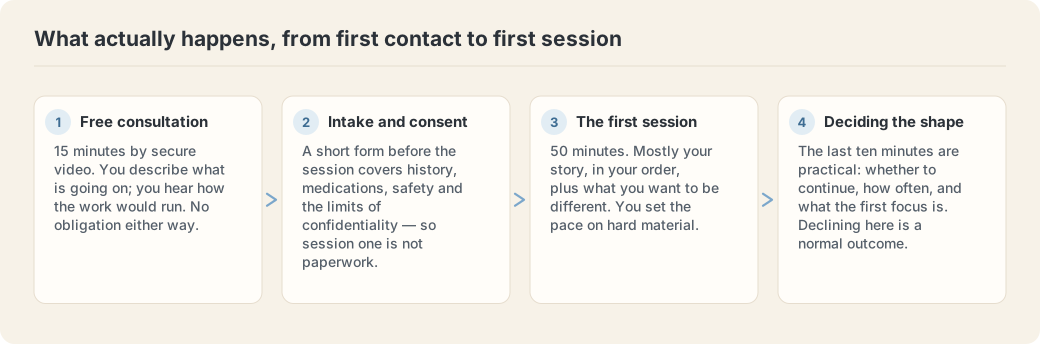
If you want a view on what frequency your situation actually calls for, ask in a free 15-minute consultation.
Working out what you can actually sustain
The best frequency is the one you will still be attending in three months, and that is an arithmetic question as much as a clinical one. It is worth doing the arithmetic before starting rather than discovering it at session eight.
Take the session fee, decide honestly what you can commit per month without it becoming a stressor of its own, and divide. That number is your real starting frequency. Where extended health covers a portion, check the annual maximum and work out how many sessions it actually funds, plans are usually expressed in dollars rather than sessions, and people consistently overestimate.
Then bring the number to the consultation rather than hiding it. A counsellor who knows the budget can plan around it: prioritising differently, front-loading the work, or building in longer gaps deliberately with something to practise between. A counsellor who does not know will plan for a frequency you cannot maintain, and the work will end abruptly at the worst moment.
It is also worth knowing that intensity can be varied deliberately rather than only reduced. Some people do better with a concentrated block: weekly for eight weeks, then a long gap, then a review, than with the same number of sessions spread thinly across a year. For time-limited budgets that is frequently the better structure, and it is rarely offered unless you ask.
None of this is an awkward conversation. Money determining the shape of treatment is entirely ordinary, and pretending otherwise mostly produces abandoned courses of work.
Planned breaks, and how to take one without losing the work
Breaks happen: holidays, work travel, money, a period where life has no room in it. Taken deliberately they cost little; taken by drift they frequently end the work entirely.
The difference is a conversation before rather than a cancellation during. Name the length. "I need six weeks" is a plan; "I will get in touch" is usually the end. Book the return session before you stop, which is the single most effective thing on this list, because the return is the part that does not happen otherwise.
Agree what to hold onto. One or two specific things to keep doing. A practice, a boundary, a piece of tracking, so the break is a plateau rather than a slide.
Agree what would bring you back sooner, and write it down. A defined trigger removes the need to make that judgement later, when judgement is least available.
It is also worth knowing which phases tolerate a break poorly. Mid-way through trauma reprocessing is the clearest case. A memory that has been opened and not fully processed is a bad thing to carry for six weeks. Where a break is unavoidable at that point, the work should be deliberately closed down first rather than paused mid-target, and a counsellor should raise that rather than agreeing to the dates.
Where Westpeak Wellness fits
Frequency is agreed rather than assigned, and it is revisited as the work changes. Weekly is usually suggested at the start and during any intensive phase; fortnightly is often right afterwards.
There is no package and no minimum commitment. Sessions are booked as you go, so a change in frequency does not require renegotiating anything.
If cost is what is shaping the decision, say so. It changes what gets prioritised and what you can carry on with independently. That is a planning conversation, not an awkward one.
Common questions
Can I start weekly and move to fortnightly later?
Yes, and that is the most common shape: weekly while the work is intensive, spacing out as things stabilise, then a deliberate ending.
Is monthly enough?
For maintenance after a course of work, sometimes. As a way of doing therapy from the start, rarely, too much of each session goes on catching up.
Does EMDR have to be weekly?
It is strongly preferable. The protocol depends on opening and closing material within a session and re-evaluating at the next, and long gaps interfere with that.
What if I need to skip a few weeks?
Say so in advance and it can be planned around, including what to do in the gap. Sessions here are booked as you go, so a break does not cost you anything.
Sources
- BC Association of Clinical Counsellors
- Canadian Mental Health Association, BC Division
- HealthLink BC, mental health and substance use
General information, not clinical or legal advice. Fee ranges are typical BC private-practice ranges and vary by practitioner. Confirm any practitioner’s registration directly with the relevant college or association.
Individual sessions are $140 for 50 minutes, after a free 15-minute consultation; card at booking.
Many extended health plans reimburse a Registered Clinical Counsellor, depending on the plan, so check yours; MSP does not cover private counselling. All fees.
Talk it through before you commit.
A free 15-minute consultation, including an honest answer if what you need is someone other than an RCC.
Book Free ConsultationNot ready to book? Send a line about what is going on. A reply comes within one business day.
Or a smaller step: What sessions cost · What the free 15 minutes is like
Looking on behalf of someone else? What to send them, and what not to, including the funded routes most people do not know they qualify for.
Where you are
Online counselling across British Columbia
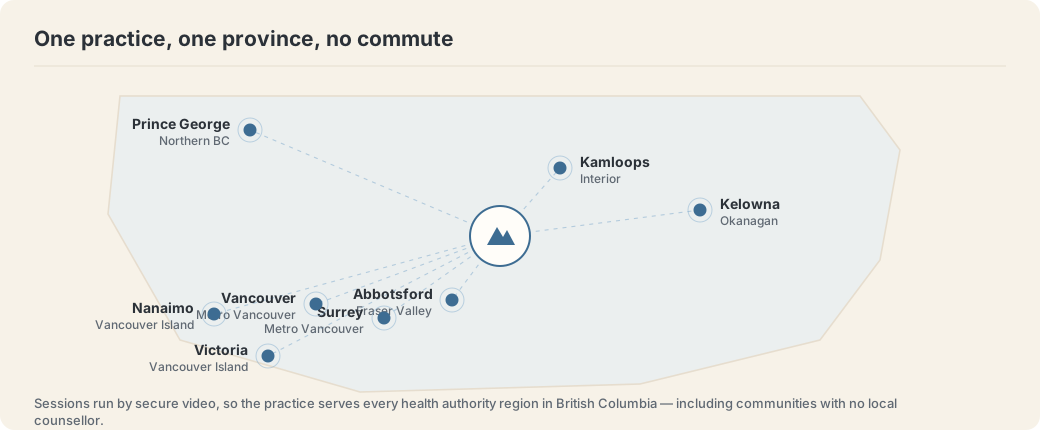
Every session is by secure video, so the counsellor you see does not depend on where you live. Each city page covers coverage, local public services and who is taking new clients there.