Compare · Choosing support
Therapy or coaching, which one do you actually need?
Coaching is oriented to performance and forward movement for someone who is functioning; counselling is a regulated health service for difficulties that are causing distress or impairment, including ones with a history behind them. The practical difference is accountability: "coach" is a title anyone can use in British Columbia with no training, insurance or complaints process, while a Registered Clinical Counsellor is accountable to a professional body.
From the outside they look similar: an hour, a conversation, someone helping you work something out. The differences that matter are structural.
7 min read · Updated
| Coaching | Counselling (RCC) | |
|---|---|---|
| Typical focus | Goals, performance, decisions, forward planning | Distress, patterns, history, relationships, functioning |
| Entry requirement to practise | None in BC. The title is unprotected | Master's degree, supervised clinical hours, ongoing education |
| Accountable to | Nobody, unless voluntarily certified | BC Association of Clinical Counsellors, with a complaints process |
| Insurance requirement | None | Professional liability insurance required |
| Covered by extended health | Almost never | Frequently, depends on your specific plan |
| Works with trauma or mental illness | Outside scope | Within scope, with defined limits |
| Confidentiality obligations | Contractual at best | Professional and legal, with named exceptions |
| Typical length | Short, often a fixed package | Variable, reviewed as it goes |
The overlap is real, and it is not the point
A good coach and a good counsellor will both listen carefully, notice patterns you have stopped seeing, ask better questions than your friends do, and hold you to what you said you wanted. Sessions can look almost identical from outside, and a lot of what makes either work is the same thing: a relationship in which you can be honest.
So the comparison is not about quality. Plenty of coaches are excellent at what they do, and plenty of people get more from coaching than they would have got from therapy. The distinction is about scope and about what happens when things go wrong.
The accountability gap
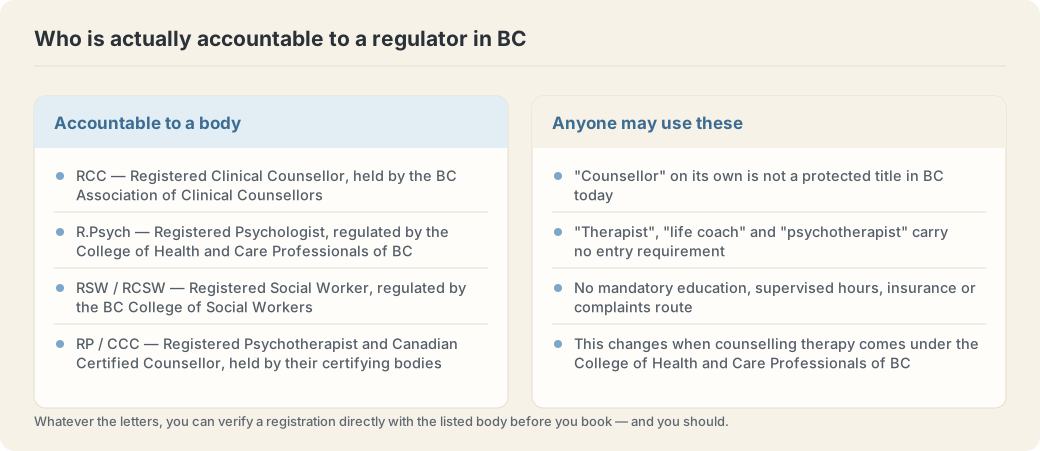
In British Columbia, "coach" is not a protected title. Neither, today, is "counsellor" or "therapist", which is exactly why the designation matters more than the job title. A Registered Clinical Counsellor (RCC) has met defined educational and supervised-practice requirements, carries liability insurance, works under a published code of ethics, and can be investigated and lose the designation.
A coach may hold a rigorous credential, or may have completed a weekend course, or may hold nothing at all. There is no way to tell from the website. Some coaching bodies certify voluntarily and their standards vary considerably.
This is not a reason to avoid coaching. It is a reason to ask a coach exactly what training they have and what they will do if something clinical surfaces, because something clinical surfacing in a coaching conversation is common. A coach who has a clear answer to that question is a good sign; one who is confident they can handle anything is not.
Questions that separate the two
- Is the difficulty causing distress, or is it about ambition?, Wanting a better career strategy is a coaching question. Being unable to sleep because of the job is a counselling one. The two frequently coexist, which is why people end up in the wrong room.
- Does it have a history?, If the current pattern is recognisably an older one. The same difficulty with authority, the same collapse at the same point. That is therapeutic territory. Coaching generally works forward from now.
- Have you tried the obvious things and they did not stick?, Repeatedly knowing what to do and not doing it is usually not an information problem, and more strategy will not fix it.
- Is your functioning affected?, Sleep, appetite, concentration, the ability to work or hold relationships. Once functioning is affected, you are past what coaching is designed for.
- Would you need this covered?, A practical filter. Extended health plans routinely reimburse counselling and almost never reimburse coaching.
Where is coaching genuinely the better answer?
Coaching is well suited to someone who is broadly well and wants to move: a career transition, a leadership challenge, a specific performance goal, accountability for something you keep deferring. It tends to be more directive, more structured around goals, and shorter, and for a person who does not need to understand why, only to act, that is an efficient use of time and money.
It is also a reasonable choice for someone who has already done therapeutic work and is now in a building phase. Plenty of people move between the two over a life, and there is no hierarchy implied by using either.
What coaching is not designed for is trauma, depression, anxiety disorders, addiction, or grief. A coach who takes those on is working outside their scope, and the risk is not usually dramatic. It is that months pass with the wrong tool.
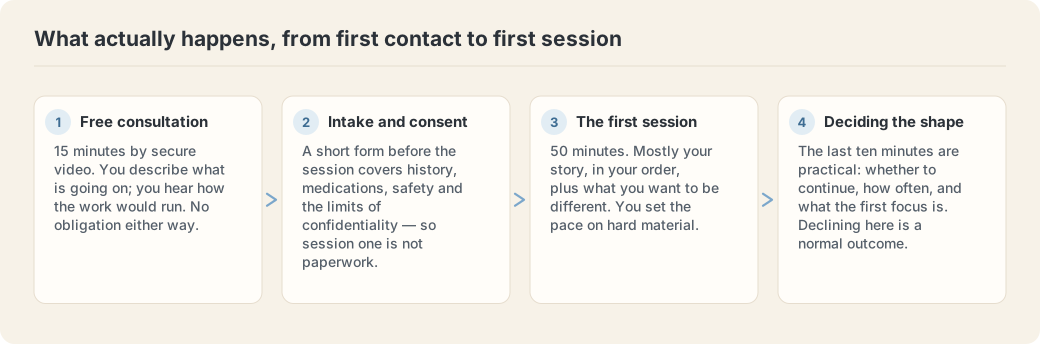
If you are not sure which of the two your situation calls for, a free 15-minute consultation is a fast way to find out.
Warning signs in either direction
- A coach who works on your childhood, If sessions are steadily moving into early history and family patterns, that is therapy being delivered by someone with no clinical training and no complaints process behind them.
- Anyone promising an outcome, Guarantees are a marketing device. Counsellors are prohibited from making them; coaches are not, which is precisely why you see them more often on that side.
- Large pre-paid packages, Common in coaching, rare in counselling. A structure you cannot leave without financial loss is a structure built for the provider.
- Diagnostic language from an unqualified source, Anyone telling you that you have ADHD, are a narcissist, or are traumatised, without the qualifications to assess it, is guessing with authority.
- A counsellor who never sets any direction, The mirror-image failure. Open-ended sessions with no target can drift for months. See when therapy is not working.
Questions that separate a good coach from a bad one
- "What training do you have, and with whom?", A specific answer naming a programme and a certifying body is a good sign. Vagueness, or a heavy emphasis on personal experience rather than training, is worth weighting.
- "What do you do if something clinical comes up?", The single most revealing question. A good coach has a clear answer involving referral and a boundary. A coach confident they can handle anything is describing a risk.
- "Do you carry professional insurance?", Not required for coaches in BC, which is exactly why asking is informative.
- "What is your refund and cancellation policy?", Large pre-paid packages with no exit are common in coaching and rare in regulated professions. A structure you cannot leave without loss is built for the provider.
- "Have you worked with something like this before?", Reasonable, and reasonable to expect an honest answer including no.
The regulatory picture, and where it is heading
It is worth understanding why this gap exists rather than treating it as an oversight, because it explains what will and will not change.
Health professions in British Columbia are regulated where the province has decided the risk of unregulated practice is high enough to warrant it. Psychologists, social workers and several others are inside that system. Psychotherapy is being brought in: under the Health Professions and Occupations Act, in force since 1 April 2026, it becomes a regulated profession on 29 November 2027, licensed by the College of Health and Care Professionals of BC, with "psychotherapist" as the protected title and a statutory complaints process. "Counsellor" stays unprotected.
Coaching is not a health profession and is not part of that process. There is no proposal to regulate it, and there is unlikely to be one, because it does not claim to treat health conditions. That is a coherent position. The problem is not that coaching is unregulated, it is that the boundary is invisible to consumers.
The practical consequence is that the burden of distinguishing them falls on you, permanently. A coach and a counsellor can both have a professional website, both charge similar fees, and both offer weekly hour-long conversations. Only one has an entry standard, mandatory insurance and somewhere to complain.
None of which makes coaching a bad choice for what it is for. It makes asking directly what someone is trained in, and what they do when something clinical surfaces, the single most useful question available, see how to verify a counsellor in BC.
Where Westpeak Wellness fits
This is a counselling practice, not a coaching one. Sessions are provided by a Registered Clinical Counsellor working under the BCACC code of ethics, with the accountability that comes with it.
That also means the scope has limits, and they are stated openly on the standards page. No diagnosis, no prescribing, no formal psychological assessment, and no pretence of being a crisis service.
If what you actually need is a coach, a consultation will say so. Referring someone to a better-fitting service is a normal outcome and a considerably better use of fifteen minutes than a booking that was never going to help.
Common questions
Can I do both at once?
Yes, and some people do. A coach for a career transition and a counsellor for the anxiety underneath it. It works best when both know about the other and the roles are clearly separated.
Is coaching cheaper?
Not usually. Coaching is often more expensive per hour and more likely to be sold in packages, and it is rarely covered by extended health benefits.
Is a life coach a therapist?
No. There is no required training, registration, insurance or complaints route for a life coach in British Columbia. Some are highly skilled; the point is that the title itself guarantees nothing.
How do I check what a counsellor is registered as?
Ask which body holds their designation, then search that body's public register directly. See questions to ask a therapist.
Sources
- BC Association of Clinical Counsellors
- College of Health and Care Professionals of BC
- Canadian Mental Health Association, BC Division
General information, not clinical or legal advice. Fee ranges are typical BC private-practice ranges and vary by practitioner. Confirm any practitioner’s registration directly with the relevant college or association.
Individual sessions are $140 for 50 minutes, after a free 15-minute consultation; card at booking.
Many extended health plans reimburse a Registered Clinical Counsellor, depending on the plan, so check yours; MSP does not cover private counselling. All fees.
Talk it through before you commit.
A free 15-minute consultation, including an honest answer if what you need is someone other than an RCC.
Book Free ConsultationNot ready to book? Send a line about what is going on. A reply comes within one business day.
Or a smaller step: What sessions cost · What the free 15 minutes is like
Looking on behalf of someone else? What to send them, and what not to, including the funded routes most people do not know they qualify for.
Where you are
Online counselling across British Columbia
Every session is by secure video, so the counsellor you see does not depend on where you live. Each city page covers coverage, local public services and who is taking new clients there.