Comparison · Choosing a format
Individual or couples therapy: which should you start with?
Start with couples therapy when the problem lives in the pattern between you and both of you are willing to work on it. Start individually when what is driving the difficulty is largely yours to work on, when your partner is unwilling, or when something needs stabilising first. When there is ongoing violence or coercive control, couples sessions are not the safe starting point.
Relationship trouble does not automatically mean couples therapy, and starting in the wrong format wastes months.
6 min read · Updated
| Individual therapy | Couples therapy | |
|---|---|---|
| Who attends | You | Both partners, together |
| What it works on | Your patterns, history, reactions, and choices | The pattern that happens between you |
| Needs partner buy-in | No | Yes. It does not function with one willing participant |
| Confidentiality | Yours alone | Shared; the relationship is effectively the client |
| Typical session length | 50 minutes | 50 minutes, or a longer extended format |
| Best when | The difficulty is largely yours to work on, or your partner will not attend | Both of you want change and keep failing to get there alone |
| Not appropriate when | Rarely, individual work is almost always available | Ongoing violence or coercive control is present |
Start with couples therapy when…
- The same argument keeps happening, A recurring loop with predictable moves on both sides is the clearest indication for couples work. That pattern is difficult to change from one side alone.
- You have drifted into logistics, Two competent people running a household with no remaining friendship. Common, unglamorous, and responsive to structured work.
- There has been a rupture and you both want to repair, An affair, a betrayal, a serious breach. Both words matter: both of you, and want.
- You are facing a decision you cannot discuss, Children, moving, family obligation, money, where every attempt to talk about it ends badly.
- You need clarity about whether to stay, A legitimate goal. Couples therapy is not obliged to produce a reconciliation, and a good practitioner will say so.
Start individually when…
- Your partner will not come, The most common reason. Individual work on a relationship is useful, changing your side of a pattern changes the pattern, sometimes enough that the other person becomes willing.
- Something of yours needs attention first, Untreated trauma, depression, or addiction will limit what couples work can achieve. Sequencing it, or running both in parallel, usually gets further.
- You do not know what you want, Working out whether you want to stay is often better done somewhere your partner is not in the room.
- The pattern predates the relationship, If you recognise this dynamic from previous relationships, or from the house you grew up in, that points to individual work, see intergenerational trauma.
- You need somewhere entirely your own, Couples therapy is shared space. Sometimes what is needed first is space that is not.
The safety exception
This needs stating plainly. Where there is ongoing intimate partner violence or coercive control, couples therapy is not the right starting point and can increase risk. Sessions require honesty, and honesty is not safe when there are consequences afterward.
A responsible practitioner screens for this, which is one reason a proper couples assessment includes individual sessions with each partner. If this is your situation, individual support and a specialist service are the safer route. VictimLinkBC is available 24/7 at 1-800-563-0808, and in immediate danger, call 911.
Can you do both?
The two are not mutually exclusive, and a common arrangement is couples sessions alongside individual therapy for one or both partners, usually with different counsellors, to keep the individual space separate and avoid the awkwardness of one practitioner holding private information from one partner.
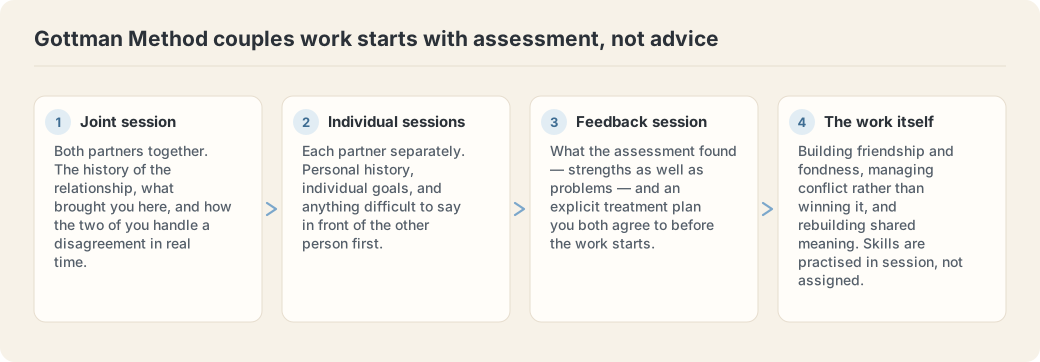
It costs more and it is often the most effective structure, particularly where the relationship difficulty and an individual difficulty are feeding each other. The Gottman Method guide covers what the couples side of that involves.
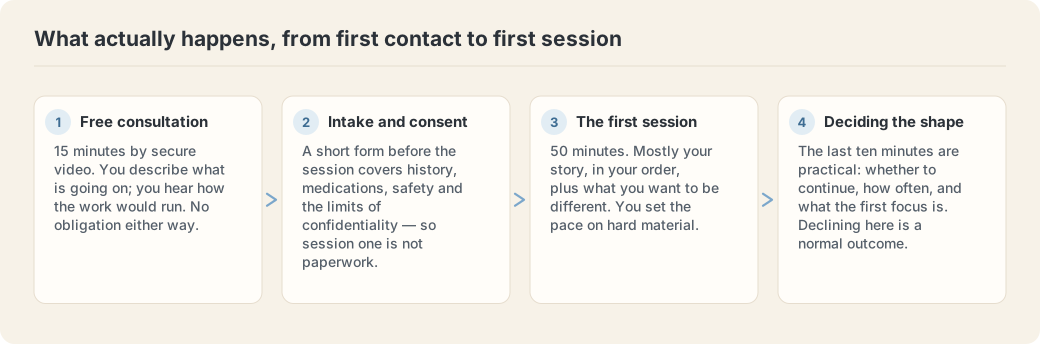
Not sure which format fits? Fifteen minutes on a call usually settles it. Book a free consultation.
Doing both at once, and the trap in it
A fair number of people end up in individual and couples work simultaneously, and it can work well. It also has one specific failure mode worth naming in advance.
The trap is using individual sessions to build a case. Where individual work becomes a place to rehearse grievances and gather evidence, it quietly undermines the couples work rather than supporting it, you arrive at the joint session better armed rather than more open. Counsellors watch for this, and it is worth watching for yourself.
The version that helps looks different: individual work on your own contribution to the pattern, on something older that keeps getting triggered inside the relationship, or on a difficulty that is genuinely yours rather than the couple's. That reliably makes the joint work go better.
On the practical side, there is a strong argument for the two being done by different counsellors. One clinician holding both roles accumulates individual confidences that cannot be used in the joint room, which constrains the couples work in ways neither partner can see. Where the same counsellor does both, that limitation should be named openly at the start.
And where one partner will not attend at all, individual therapy focused on the relationship is a genuine option rather than a consolation. Changing your own half of a pattern changes the pattern, which is not a guarantee of any particular outcome, and is considerably more leverage than most people assume they have.
Starting individually when your partner refuses
This is one of the most common situations and one of the most quietly hopeful, because the assumption underneath the question. That nothing can change unless both people participate, is not correct.
Relationship patterns are maintained by both people, which means either can interrupt them. If one partner stops pursuing, the pursue-withdraw cycle cannot run in its usual form. If one stops matching escalation, escalation is much harder to sustain. That is not a technique for manipulating someone; it is a description of how a two-person system responds when one half changes.
What individual work realistically offers here is threefold. Clarity about what is actually happening, which is difficult to obtain from inside it. Your own contribution, which is the only part you can change directly and is nearly always larger than it appears from inside a grievance. And the decision, which for many people is the actual question underneath.
What it cannot do is produce a guaranteed change in the other person. Sometimes one partner changing brings the other into the work; sometimes it clarifies that the relationship is not going to change. Both are real outcomes and neither can be promised.
It is also worth being honest about a risk. Individual work on a relationship can become a place to build a case rather than to examine a pattern. A good counsellor will notice that drift and name it, see when therapy is not working.
Where Westpeak Wellness fits
Westpeak Wellness offers both individual therapy and Gottman-informed couples therapy, virtually across BC. Because sessions are online, partners can even join from different locations when work makes that necessary.
If you are unsure which to book, that is a reasonable thing to work out on the consultation call rather than in advance, and if the answer is individual therapy with someone else while couples work happens here, that is a fine outcome too.
Common questions
Can one counsellor do both our individual therapy and our couples therapy?
Some practitioners will; many decline, and for good reason. Holding private individual information from one partner while also working with the couple creates a genuine conflict. Separate counsellors for individual work is the cleaner arrangement.
What if my partner refuses to come?
Start individually. Relationship-focused individual therapy is real work, not a consolation prize, and partners who initially refuse sometimes reconsider once they see change rather than pressure.
Is couples therapy only for people in crisis?
No. Couples who come before things are dire generally have an easier time of it. Arriving early is an advantage, not an overreaction.
Will the counsellor tell us to break up?
No. That is not a counsellor's call. The work helps you both see the pattern clearly enough to make your own decision, whatever that turns out to be.
Sources
- The Gottman Institute, research on couples
- VictimLinkBC, 24/7 support, 1-800-563-0808
- HereToHelp BC, relationships and mental health
General information, not clinical or legal advice. Fee ranges are typical BC private-practice ranges and vary by practitioner. Confirm any practitioner’s registration directly with the relevant college or association.
Individual sessions are $140 for 50 minutes, after a free 15-minute consultation; card at booking.
Many extended health plans reimburse a Registered Clinical Counsellor, depending on the plan, so check yours; MSP does not cover private counselling. All fees.
Talk it through before you commit.
A free 15-minute consultation, including an honest answer if what you need is someone other than an RCC.
Book Free ConsultationNot ready to book? Send a line about what is going on. A reply comes within one business day.
Or a smaller step: What sessions cost · What the free 15 minutes is like
Looking on behalf of someone else? What to send them, and what not to, including the funded routes most people do not know they qualify for.
Where this leads
Online couples and marriage counselling across BC
The practice is virtual, so the same counsellors see people in every one of these cities. Each page says what the service involves there and who is taking new clients.
Where you are
Online counselling across British Columbia
Every session is by secure video, so the counsellor you see does not depend on where you live. Each city page covers coverage, local public services and who is taking new clients there.