For · Post-secondary students
Counselling for university and college students in BC
Counselling for BC post-secondary students, online across the province. Campus counselling is free and often has a session cap and a waitlist; private sessions have neither, and this page sets out honestly when the free option is the better one and when it is not.
Everyone says these are the best years of your life, which makes it harder to admit you are barely holding it together.
6 min read · Updated
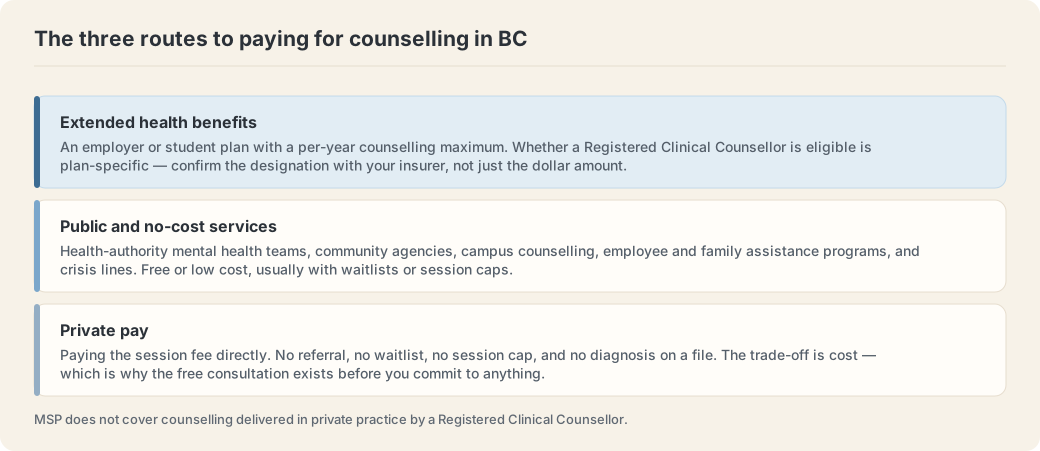
Many extended health plans reimburse a Registered Clinical Counsellor, depending on the plan, so check yours; MSP does not. Receipts are issued for every session, and the fees are published in full. On a calendar-year plan, sessions held by 31 December count against this year: using benefits before the plan year ends.
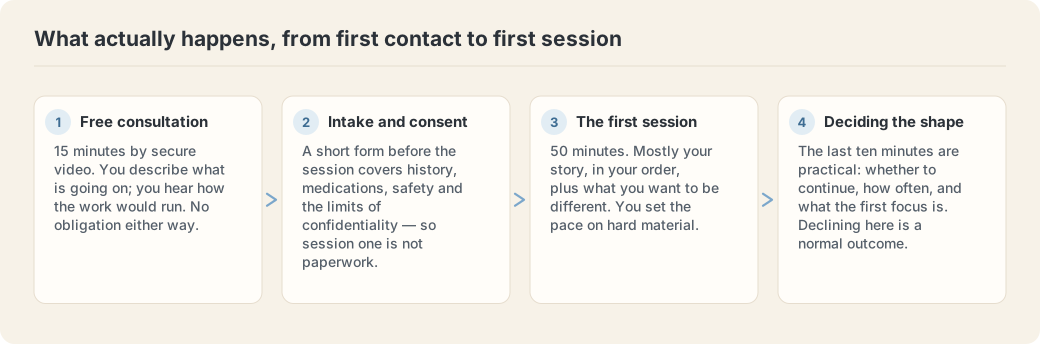
Individual sessions are $140 for 50 minutes, after a free 15-minute consultation.
Post-secondary compresses an unusual number of hard things into a short window. You are making decisions with long consequences while your prefrontal cortex is still finishing, often away from home for the first time, frequently in debt, and surrounded by people who appear to be managing effortlessly. Almost none of them are.
The specific difficulty is that the pressure is invisible from outside. Nobody sees the 2am panic about whether you picked the right programme, or the phone call home where you say everything is fine. What they see is someone getting through it.
Before anything else, use the free options. Your institution's counselling service is already paid for in your fees. Here2Talk offers free, confidential single-session counselling to students registered at a BC post-secondary institution, 24/7, by app, phone, or online. Foundry provides free counselling for anyone aged 12 to 24 across BC, virtually and in centres. Private therapy is worth paying for when those are full, when the waitlist runs past the point you can wait, or when you want continuity that does not reset each term.
What comes up
The things people actually say
"I picked the wrong programme"
Two years in, a great deal of money spent, and the growing certainty that this is not it, plus the fear of what changing course would mean to the people funding it.
Performing fine while not being fine
Grades holding, attendance holding, everything on the outside intact, and nothing underneath it. This is when people delay getting help longest.
The gap between your life and your family's expectations
Particularly when they sacrificed to get you here. Disappointing them can feel less survivable than being miserable.
Comparison as a constant background hum
Everyone's highlight reel, all day, on a device you cannot put down, plus the classmates who genuinely do seem to find it easy.
Sleep gone completely sideways
Nocturnal schedules, all-nighters, caffeine to start and something to stop. Sleep disruption both causes and mimics anxiety and low mood.
Loneliness in a crowd
Surrounded by thousands of people and knowing none of them well. Very common, rarely said out loud, and worse for commuter and international students.
If the free campus service has a three-week waitlist and three weeks is too long, a free 15-minute call is a reasonable next step. Book a free consultation.
The pressure that is specifically about family
For many students in BC, and disproportionately for students from immigrant families. The academic pressure is not academic. It is about what the degree represents: the reason a family moved, the justification for what a parent gave up, the security everyone is counting on.
That turns an ordinary bad semester into something much heavier. A failed course is not a failed course; it is evidence about whether the whole thing was worth it. And it makes the obvious solutions: switch programmes, take a term off, reduce your course load, feel unavailable, even when they are clearly the right call.
This is workable, and it usually starts with separating the two things that have fused: what you want, and what you owe. Those are different questions, and most people have never been given room to ask the first one. There is more on that pattern in the guide to intergenerational trauma and on the page for first- and second-gen South Asian adults.
When to get support rather than wait it out
- It has outlasted the stressor, Exam-period stress that lifts after exams is normal. Stress that stays once the term ends is different.
- You have stopped attending, Skipping the class you cannot face, then avoiding the professor, then the whole course. Avoidance compounds fast in a structured programme.
- Substances are doing the regulating, Needing something to sleep, to socialise, or to sit down and work is worth taking seriously early.
- You are isolating, Declining things you would normally want to do, going quiet on people, spending most of your time alone in your room.
- Any thought of not being here, That does not wait for an appointment. Call or text 9-8-8 (Canada, 24/7), or 310-6789 for BC Mental Health Support. In immediate danger, call 911.
Why virtual usually suits student life
No travel between campus and an office, which matters when your day is already fragmented. Sessions that survive moving home for the summer, going on co-op, or transferring institutions. The counselling relationship does not reset with your address, as long as you are in BC. And a format that works from a residence room with the door shut, which is often the only private space available.
Video helps too: a session fits any open time without a trip across campus, and most student days do not have a convenient hole in the middle of them.
Two plans, and who sees the claim
Many BC students have two plans: the student society's health plan, which is in your fees, and sometimes a parent's plan as a dependant. Whether either pays for an RCC depends on the plan. Claim on your own student plan first, then send what it did not pay to the parent's plan. That order is how coordination between plans normally works, and it is also the private one.
A claim on a parent's plan shows up in the parent's claim history and on their statements: usually the provider type, the date and the amount. Counselling stays confidential, but the claim itself is not invisible to the plan member. A claim on your own student plan goes to you. If it matters who sees what, check your student plan's booklet before the first session, and claim there.
What the main student-society plans pay is below, read from each plan's own page. Each yearly maximum is shared with psychologists and social workers, and resets with the plan year, usually in September.
| Plan | Pays | Yearly maximum | Sessions at $140 | Names the RCC? | Referral | Source |
|---|---|---|---|---|---|---|
| UBC AMS/GSS University of British Columbia (Vancouver) | 100% of each visit | $1,250 | 8 | Yes | Not stated on the plan page | Plan page read 1 October 2026 |
| SFSS Enhanced Simon Fraser University | 90% of each visit | $750 | 5 | Yes | Not stated on the plan page | Plan page read 1 October 2026 |
| SFSS Basic Simon Fraser University | $30 of each visit | $650 | 21 | Yes | Not stated on the plan page | Plan page read 1 October 2026 |
| UVSS University of Victoria | 70% of each visit | $800 | 8 | Yes | None stated for mental-health practitioners | Plan page read 1 October 2026 |
| Langara Students’ Union Langara College | 100% of each visit | $500 | 3 | Yes | Not stated on the plan page | Plan page read 1 October 2026 |
| Kwantlen Student Association Kwantlen Polytechnic University | 80% of each visit | $500 | 4 | Yes | Not stated on the plan page | Plan page read 1 October 2026 |
| Douglas Students’ Union Douglas College | 80% of each visit | $450 | 4 | Says “counsellor”; ask | Not stated on the plan page | Plan page read 1 October 2026 |
Read from each plan’s own page on 1 October 2026. The yearly maximum is shared with psychologists and social workers, so anything already claimed this year comes off it. The sessions column is the maximum divided by what the plan pays back on one $140 individual session. Plans change each policy year and coverage is whatever your plan’s booklet says; check it before the first session. You pay at booking and claim the receipt; the practice does not bill the plan.
Who you would see
Taking new clients and seeing people across BC by secure video. Each is a Registered Clinical Counsellor; the registration is on the profile and can be checked on the BCACC register.

Camille Granda, RCC, CCC
English and Tagalog · Trauma, Anxiety and chronic stress, Grief, loss and life transitions
In her words: “I want sitting with me to feel like the biggest belly breath you have ever taken.”

Savneet Singh, RCC
English and Punjabi · Anxiety, Depression, Trauma and attachment
In her words: “Comforting, safe and supportive, is what I aim for.”
Where to start
What to do when a term is already going wrong
By the time most students seek help, several deadlines have passed and the situation feels irrecoverable. It is usually less irrecoverable than it looks, and the order of operations matters.
Go to the accessibility office before you go anywhere else. Mental health conditions can qualify for academic accommodation, and options exist that students do not know about: extended deadlines, alternative exam arrangements, a reduced course load without losing full-time status for funding, and in some cases retroactive withdrawal from a failed term. Documentation usually has to come from a physician rather than a counsellor.
Find out your institution's withdrawal dates. There is nearly always a date after which a withdrawal appears differently on a transcript, and knowing it converts a vague dread into a decision with a deadline.
Talk to one instructor. Faculty have more discretion over deadlines than students assume, and the conversation is far easier before the deadline than afterwards. You do not have to disclose details.
Check the funding implications before reducing a course load. StudentAid and institutional systems do not always align automatically, and a reduction made for good reasons can create a second problem.
Then deal with the underlying thing. In that order, because managing a mental health difficulty while an academic disaster compounds in the background is considerably harder than dealing with one at a time.
Deciding whether to keep going
A significant number of students arrive at counselling with a question that is not about mental health: should I still be doing this degree? It is a legitimate use of sessions and it is worth separating into its parts.
Is this a capacity problem or a fit problem? They feel identical from inside. Struggling because you are unwell, under-slept and unsupported is a different situation from struggling because the subject is wrong for you, and the first is usually fixable without changing anything about the degree.
Whose decision would this be? For many students, and disproportionately for first-generation students, the programme was chosen with heavy family involvement. Disentangling what you want from what was expected is difficult and it is exactly the kind of thing counselling is for.
What are the reversible and irreversible parts? A leave of absence, a reduced load, a programme transfer and a withdrawal have different consequences, and most students do not know which of them are recoverable. The registrar and the accessibility office have those answers.
And what is the sunk cost doing to the reasoning? Two years already spent is not an argument for four more. It feels like one, powerfully, and it is worth naming.
None of this is a counsellor telling you what to do. It is having somewhere to think that is not the dinner table, with someone who has no stake in the answer.
Services that tend to fit
Individual therapy
For exam anxiety and panic, low mood that outlasts the semester, and working out what you actually want.
Punjabi-speaking counselling
For family expectation, and the weight of being the one the family's plans depend on, without translating the cultural context first.
Tagalog-speaking counselling
Sessions in Tagalog or English, for a student whose family lives in one language and whose campus runs in the other.
Common questions
Is my campus counselling service not enough?
Often it is, and it is free, start there. Its limits are usually capacity and session caps, so private therapy tends to make sense when the waitlist is longer than you can wait or you need work that runs longer than a fixed number of sessions.
Will my parents find out?
Not from the counsellor. If you are 19 or over, counselling is confidential and your family has no access to it. Under 19, confidentiality still generally applies where you are capable of consenting to your own care. The limits are risk of serious harm and court orders, not parental curiosity. The one route that is not private is a claim on a parent's plan, which appears in their claim history; claim on your own student plan first.
Can I afford this as a student?
Check your student health plan first. The table on this page shows what the main BC student-society plans pay for a Registered Clinical Counsellor, read from each plan's own page, and most students never claim it. Here2Talk and your campus counselling service are free and already paid for through your fees, and both are worth using before paying out of pocket.
What if I go home for the summer?
As long as home is in BC, sessions continue unchanged. That continuity is one of the practical advantages of a virtual practice for students.
Sources and further support
- Here2Talk, free 24/7 counselling for BC post-secondary students
- Foundry BC, free services for ages 12–24
- HereToHelp BC, mental health information
General information, not clinical advice, and not a diagnosis. If you are in crisis, call or text 9-8-8 (Canada, 24/7) or BC Mental Health Support at 310-6789. In immediate danger, call 911.
Where you are
Online counselling across British Columbia
Every session is by secure video, so the counsellor you see does not depend on where you live. Each city page covers coverage, local public services and who is taking new clients there.
One conversation, no commitment.
A free 15-minute consultation over secure video, including an honest answer if something other than counselling would serve you better.
Book Free ConsultationNot ready to book? Send a line about what is going on. A reply comes within one business day, or read the guides first and come back when you want to.
Looking on behalf of someone else? What to send them, and what not to, including the funded routes most people do not know they qualify for.