For · New and expecting parents
Counselling for new parents in BC
Counselling for new and expecting parents in BC, online by secure video in English, Punjabi or Tagalog. Covers the postpartum year, birth that did not go as planned, the identity shift nobody warns you about, and the strain a baby puts on a relationship, with sessions that can be taken during a nap rather than requiring childcare.
The gap between how you were told this would feel and how it actually feels can be enormous, and there is little permission to say so out loud.
6 min read · Updated
Many extended health plans reimburse a Registered Clinical Counsellor, depending on the plan, so check yours; MSP does not. Receipts are issued for every session, and the fees are published in full. On a calendar-year plan, sessions held by 31 December count against this year: using benefits before the plan year ends.
Individual sessions are $140 for 50 minutes, after a free 15-minute consultation.
Almost a quarter of Canadian parents who have recently given birth report symptoms consistent with postpartum depression or an anxiety disorder, according to Statistics Canada's 2019 survey. That is not a rare complication. It is roughly one in four, and the figure counts only those who reported it.
The reason it still feels isolating is that the postpartum period comes with a narrow script. You are supposed to be tired but grateful. If what you actually feel is flat, or frightened, or resentful, or nothing much at all, the script has no line for it, so most people stop talking rather than risk the reaction.
Counselling is somewhere the script does not apply. You can say the thing you have not said to your partner, your mother, or your public health nurse, and have it met as information rather than as an alarm.
What comes up
The things people actually say
"I love them and I want my old life back"
Both of these are true at once for a great many people, and holding them together is not a sign that anything has gone wrong.
Intrusive thoughts that frighten you
Sudden, unwanted, vivid thoughts about harm coming to the baby are extremely common in the postpartum period and are typically a feature of anxiety rather than an intention. Most parents have never been told this, and carry them in silence for months.
Rage that arrives out of nowhere
Postpartum distress does not always look like sadness. For a lot of people it looks like a short fuse and then guilt about the short fuse.
The relationship has quietly become logistics
Two people managing shifts. Score-keeping about sleep. Resentment neither of you planned on and both of you feel guilty about.
Losing the person you were
Career, body, friendships, autonomy, the version of yourself that existed before, grief for that is legitimate and does not compete with loving your child.
Cultural expectation on top of everything
Family arriving with strong views on feeding, sleeping, and what a good mother does. Managing that while depleted is its own separate load, and it is heavier when the expectations come in a language and a framework you cannot opt out of.
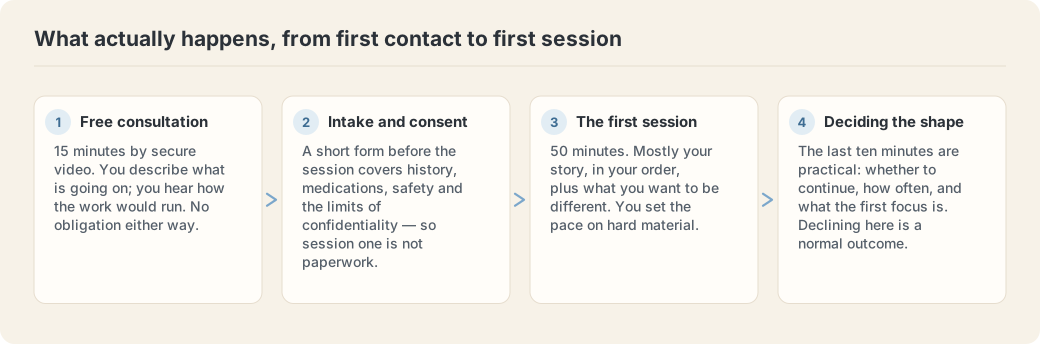
If you have read this far, some of it probably landed. Fifteen minutes on a call costs nothing and commits you to nothing. Book a free consultation.
This is not only about the person who gave birth
Partners and non-birthing parents experience postpartum depression and anxiety too, and are far less likely to be screened for it or asked about it. Adoptive parents are largely absent from the public conversation altogether. If you are exhausted, anxious, and functioning while nobody has asked how you are once, that is worth bringing somewhere.
When it is worth talking to someone
There is no threshold you have to cross to deserve support, and waiting to be bad enough is a common and costly mistake. That said, these are the patterns that most often bring people in:
- It has been more than two or three weeks, Short-lived mood swings in the first fortnight are extremely common. Something that has settled in and stayed is different.
- You are not enjoying anything, Not just the baby, anything. Flatness that does not lift when the baby sleeps or a friend visits.
- Anxiety is running the day, Constant checking, inability to sleep even when the baby does, a persistent sense that something terrible is imminent.
- You are avoiding being alone with the baby, Or arranging your day so you never have to be.
- You feel like they would be better off without you, This one does not wait. Call or text 9-8-8 (Canada, 24/7), or 310-6789 for BC Mental Health Support. If you are in immediate danger, call 911.
What is actually available in BC
Private counselling is one option among several, and it is not always the first one worth trying:
Pacific Post Partum Support Society runs free peer support groups, online and in person, for parents in BC with a baby under eighteen months, plus a support line. Free, specific to this, and staffed by people who have been through it. For many parents it is the right first call.
Public health nurses in your health authority screen for postpartum mood concerns and can refer onward. HealthLink BC at 8-1-1 is free, 24/7, and will talk through symptoms with a nurse. Your GP or midwife can assess whether medication is worth discussing. A question a counsellor cannot answer, and should not pretend to.
Private counselling fits when you want sustained one-to-one work rather than a group, when you want to go into territory a group setting does not reach, or when the waitlist for a public service is longer than you can comfortably hold. It is not a replacement for the medical side of things, and the two work perfectly well in parallel.
Why virtual sessions tend to suit this particular stage
This is the one group for whom video is often not a compromise but the better format. There is no childcare to arrange and no travel window to protect. Sessions can happen during a nap, or with a baby asleep on you, or in a parked car outside the house because that is the only door that closes. Nobody has to be presentable. If the session gets interrupted, it gets interrupted. That is expected, not a problem.
For a parent in the first year, the difference between "therapy I have to get to" and "therapy that happens where I already am" is frequently the difference between going and not going.
Who you would see
Taking new clients and seeing people across BC by secure video. Each is a Registered Clinical Counsellor; the registration is on the profile and can be checked on the BCACC register.

Camille Granda, RCC, CCC
English and Tagalog · Trauma, Anxiety and chronic stress, Grief, loss and life transitions
In her words: “I want sitting with me to feel like the biggest belly breath you have ever taken.”

Savneet Singh, RCC
English and Punjabi · Anxiety, Depression, Trauma and attachment
In her words: “Comforting, safe and supportive, is what I aim for.”
Where to start
The window that gets missed
Perinatal mental health has a specific timing problem. The formal check-ins cluster in the first weeks, and a meaningful share of difficulty arrives later: at four months, at eight, at the return to work, at weaning. By then the appointments have stopped and everyone has moved on to asking how the baby is.
It is also the period when reaching out is hardest. The practical obstacles are real: an hour is difficult to find, leaving the house is a project, and a video session during a nap is frequently the only format that exists. That is not a preference; it is the difference between getting support and not.
The other obstacle is what people expect to be told. A great many parents fear that describing intrusive thoughts, or admitting they do not feel what they expected to feel, will trigger a child-protection response. Intrusive thoughts are extremely common in new parents and are not, in themselves, a risk indicator. That distinction is well established clinically and almost never explained to anyone.
What does warrant urgent attention rather than a booking: thoughts of harming yourself, any sense of losing touch with reality, or a rapid change in functioning. Those need same-day medical assessment: 9-8-8, 310-6789, or 9-1-1 in immediate danger. Everything else is a normal reason to book something.
The second parent, and the relationship
Almost all perinatal support is directed at the birthing parent, for good reasons. Two things get missed as a result.
The first is that non-birthing parents experience significant perinatal mental health difficulty too, at rates high enough to matter, and there is essentially no screening for it. They are also the least likely to raise it, because the culturally available role is support rather than need. Difficulty here frequently presents as irritability, withdrawal, working longer, or drinking more, rather than as anything anyone would name as depression.
The second is that relationship satisfaction declines sharply after a first child for a large proportion of couples. That is one of the more robust findings in the literature and it is almost never mentioned to anyone in advance. Couples experiencing it typically conclude something has gone specifically wrong with them, which adds a second problem to the first.
What tends to help is unromantic. Sleep is the single largest variable, and any arrangement that gets each parent one protected block of uninterrupted sleep is worth more than any conversation about the relationship. Beyond that: making the invisible work visible and dividing it explicitly rather than by drift, and protecting one short predictable window of adult conversation that is not logistics.
Counselling for couples covers the relationship side directly, and it is worth saying that arriving in the first year is early rather than late.
Services that tend to fit
Depression counselling
For postpartum depression, persistent low mood, and the flatness that does not lift.
Anxiety counselling
For postpartum anxiety, intrusive thoughts, and checking behaviour.
Couples therapy
For the relationship strain that arrives with a newborn and the resentment neither of you planned on.
Punjabi-speaking counselling
For navigating family expectation around new motherhood without having to translate the context first.
Trauma therapy
For a birth that was frightening, or a medical experience that has not settled.
Common questions
Can I bring the baby to a session?
Yes. This is a virtual practice, so the baby is welcome by definition: feeding, holding, settling, all fine. Sessions get interrupted and that is entirely expected. Waiting until you have childcare usually means waiting a long time.
Is what I am feeling postpartum depression, or just exhaustion?
A counsellor cannot diagnose in BC, so that specific question belongs with your GP, midwife, or a psychologist. What counselling can do is help you describe what is happening clearly enough to make that conversation useful, and work on it in the meantime.
I had my baby two years ago. Is it too late?
No. Plenty of people come to this work well after the first year, often once there is finally enough space to notice what the first year cost. There is no expiry on being able to process it.
My partner is the one struggling. Can they come?
Yes, partners and non-birthing parents experience postpartum depression and anxiety too and are screened for it far less often. They can book individually, or you can look at couples sessions together.
Sources and further support
- Symptoms of postpartum anxiety and depression among women in Canada, national cross-sectional survey
- Pacific Post Partum Support Society, free peer support across BC
- HealthLink BC, postpartum depression
- HereToHelp BC, postpartum depression info sheet
General information, not clinical advice, and not a diagnosis. If you are in crisis, call or text 9-8-8 (Canada, 24/7) or BC Mental Health Support at 310-6789. In immediate danger, call 911.
Where you are
Online counselling across British Columbia
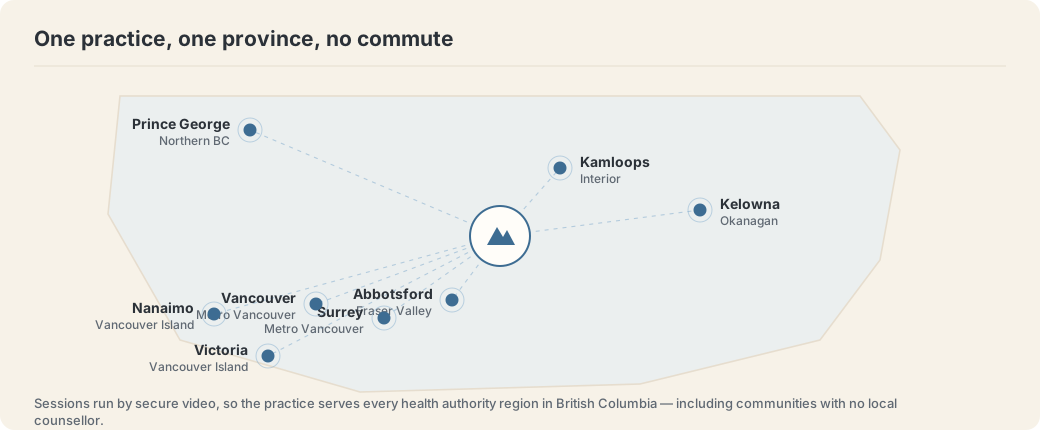
Every session is by secure video, so the counsellor you see does not depend on where you live. Each city page covers coverage, local public services and who is taking new clients there.
One conversation, no commitment.
A free 15-minute consultation over secure video, including an honest answer if something other than counselling would serve you better.
Book Free ConsultationNot ready to book? Send a line about what is going on. A reply comes within one business day, or read the guides first and come back when you want to.
Looking on behalf of someone else? What to send them, and what not to, including the funded routes most people do not know they qualify for.