Guide · BC systems
Is there counselling in BC with no waitlist? How long each route waits
Publicly funded counselling in BC is triaged and the wait is often months. Private Registered Clinical Counsellors keep no central list: each books from their own calendar, so the shortest private wait is whoever has an open time soonest, and the reliable way to find out is a calendar that shows real openings rather than an “accepting clients” label. The next open free consultation times here are shown just below, when the calendar has any. The services with no wait at all are the crisis and support lines, Foundry for ages 12 to 24, an EFAP if you have one, and campus counselling if you are a student.
Being told the wait is four to eight months is its own kind of blow. There is more available in the meantime than most people are told.
8 min read · Updated
Why the wait exists, and what it is not
Publicly funded mental-health services in British Columbia are delivered largely through the regional health authorities: Fraser Health, Vancouver Coastal, Island Health, Interior Health and Northern Health: alongside community agencies and, for young people, the Foundry network. Demand exceeds capacity almost everywhere, and the result is triage: the more urgent your presentation, the faster you are seen.
The consequence is a genuine unfairness that is worth naming plainly. A person who is struggling but functioning waits longest, because triage is designed to catch the people at greatest immediate risk. Deteriorating in order to be seen sooner is a terrible incentive and it is the one the system creates.
What the wait is not is a judgement that your situation does not matter. It is a capacity problem, and it is not a reason to conclude that you were right to think you were not bad enough.
Get on the list properly
- Refer yourself where you can, Many health-authority mental-health services accept self-referral rather than requiring a doctor. Ask directly rather than assuming a GP appointment is a prerequisite, since that step can add weeks by itself.
- Be accurate rather than stoic, Intake triage works from what you report. Understating it, which many people do reflexively, particularly if they were raised to cope, places you lower. Describe the worst of it, not the average of it.
- Ask for a realistic timeframe and a cancellation slot, Ask two specific questions: what the current wait actually is, and whether they hold a short-notice cancellation list. Being available at short notice can move you forward substantially.
- Stay in contact, Lists get cleaned. A missed call or an unanswered letter can remove you without your knowing. Confirm periodically that you are still on it, and update them if things get worse.
- Be on more than one list, A health-authority service, a community agency, and a campus or employer programme are not mutually exclusive. Take whichever comes first.
What has no waitlist at all
- 9-8-8, by call or text, Canada's suicide crisis helpline, twenty-four hours a day, and not only for the moment of highest risk. It is a legitimate place to talk when things are bad at 3 a.m. and nothing else is open.
- 310-6789, BC Mental Health Support, twenty-four hours, no area code needed anywhere in the province. Emotional support and information about local services.
- Foundry, for ages 12 to 24, Centres across BC plus a virtual service offering free counselling with no referral and, in many cases, drop-in access. Caregivers can use it too.
- An employee and family assistance programme, If you or a partner has one through work, it typically provides a small number of free sessions starting within days rather than months. Capped, and fast. See low-cost counselling in BC.
- Campus counselling, Every public post-secondary institution in BC provides some counselling to enrolled students at no cost, usually short-term and usually available far faster than community services.
- Bounce Back and structured self-help, Free, guided, evidence-based programmes for low mood and anxiety, delivered by phone and workbook with a coach. Not the same as therapy, and considerably better than nothing for months.
Finding a private counsellor with the shortest wait
- Look for a live calendar, not a label, Directory profiles carry an “accepting new clients” flag that the counsellor sets by hand, and it can be weeks out of date. A booking calendar that shows real open times answers the question directly, and a free consultation slot shows how soon you could start.
- Ask two questions on the first call, When the first regular session could be, not only the consultation, and whether there is a short-notice list for cancellations. Being able to take a time at a day’s notice often moves the start forward.
- Widen the map, not the standard, Registration covers the whole province, so a Registered Clinical Counsellor by video in another BC city is as available to you as one down the street. Keep the fit: the approach, the language and the designation matter more than a week saved.
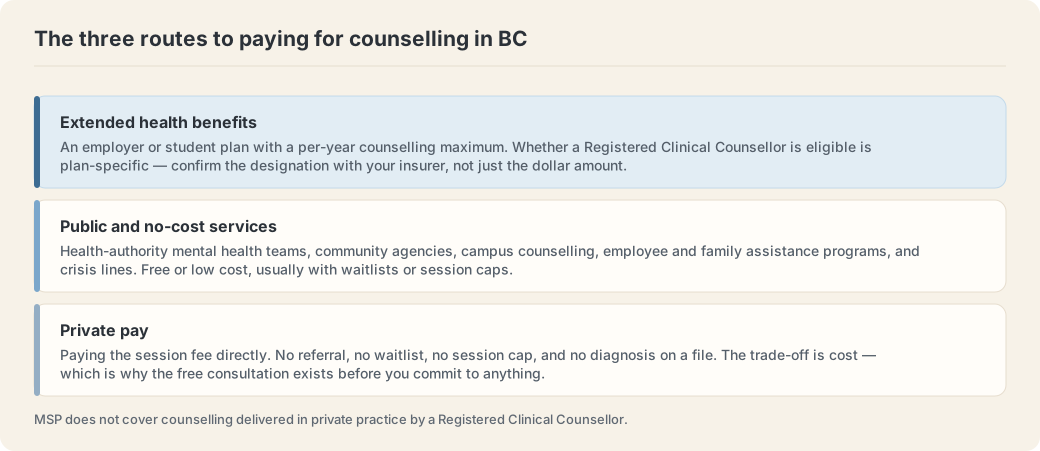
- Check the cost side before the first paid session, Whether an extended health plan reimburses a counsellor depends on the plan and on the designation it names. What BC plans reimburse shows what to look for.
- Here, the calendar is the only queue, Each counsellor’s open consultation times are on the booking calendar, and the line under the button at the top of this page names the next ones when there are some. If none suits you, the booking page has a way to ask for a time.
Structuring the interval
The instinct while waiting is to hold on until the real help arrives. It is worth resisting, because months of unstructured waiting tends to mean months of deterioration, and you will arrive at the appointment with more to work on.
The things that reliably help are unglamorous and specific: a consistent wake time; some daily movement, ideally outdoors and ideally early; one or two social contacts a week that are actually scheduled rather than intended; and reducing alcohol, which is a depressant and reliably makes both anxiety and sleep worse while appearing to help with both.
A written record is more useful than it sounds. A few lines a day on how bad it was and what was happening. It gives you something concrete to bring to a first appointment, which shortens the assessment considerably, and it frequently reveals a pattern that is invisible from inside the week.
Practical loose ends also carry weight. Sorting out the unopened envelopes, the overdue call, the thing you have been avoiding does not treat anything, and it removes a background load that has been consuming capacity you need.
If a few sessions during the wait would take the pressure off, a free 15-minute consultation costs nothing to find out.
When paying privately makes sense, and when it does not
Private counselling usually has a much shorter wait and a real cost, and it is worth being straightforward about the trade-off rather than presenting it as an obvious answer. The booking calendar shows the real next open times.
It makes sense when the wait would be materially harmful, when you have extended health benefits that will cover some or all of it, when the difficulty is time-sensitive, a deteriorating relationship, an impending decision, or when you need a specific approach the public system does not offer quickly. Even a handful of sessions during a long wait can stop things sliding.
It makes less sense when it would create financial strain that becomes its own stressor, or when what you actually need is medical assessment, psychiatric input or an intensive programme, none of which private counselling substitutes for. In that case the better move is to keep pushing the medical route and use the free services in the meantime. Extended health coverage in BC sets out what plans usually cover, and MSP vs extended health explains what the public plan does not.
If things get worse while you wait
Tell the service. Waitlists are re-triaged, and a deterioration you do not report cannot move you. A short call describing what has changed is worth more than waiting for the scheduled review.
Tell your GP as well, if you have one. They can escalate a referral, and there are medical routes into urgent assessment that a counselling waitlist does not touch.
And if it reaches the point of thoughts about ending your life, that is not a waitlist question. 9-8-8 by call or text, twenty-four hours a day, anywhere in Canada. 310-6789 for BC Mental Health Support. Immediate danger is 9-1-1 or your nearest emergency department. The full list is on the BC crisis and support directory.
A realistic plan for a long wait
Four to eight months is long enough that "hold on" is not a plan. What follows is deliberately unglamorous, because the things that hold people through a wait are structural rather than inspiring.
Set a floor, not a goal. Decide the three things that happen regardless of how bad the week is. A fixed wake time, one walk a day, one human contact. Floors survive bad weeks; goals do not, and a missed goal produces a second problem.
Put one thing in the calendar per week that involves another person, scheduled rather than intended. Isolation deepens almost everything on this list and it advances quietly, largely because declining is easier than attending.
Use the no-waitlist services rather than saving them. People treat crisis and support lines as reserved for emergencies. They are not, 9-8-8 and 310-6789 are legitimate places to talk at 3 a.m., and using them early is what they exist for.
Start a structured programme. Free, coach-supported options for low mood and anxiety exist and have real evidence behind them. Over a four-month wait, that is not a small thing.
Book one review point. Put a date in the calendar six weeks out to reassess: is this the same, better, or worse? Deterioration you have not reported cannot re-triage you, and drift is much easier to see against a fixed checkpoint than in the moment.
And decide the trigger in advance for going private or escalating. Writing down now what "worse" would look like removes the need to make that judgement later, at exactly the moment when judgement is least available.
Using a group or a programme in the meantime
Group and structured programmes are consistently the most under-used resource during a wait, mostly because people assume they are a downgraded version of individual counselling. They are a different thing rather than a lesser one, and for some difficulties they outperform individual work.
The waits are also much shorter. Health authorities, community agencies and campus services routinely run groups with a fraction of the wait for individual sessions, and many are free. It is worth asking specifically, groups are frequently not mentioned unless you do.
What a group offers that individual work cannot is the direct experience of not being unusual. Hearing someone describe your exact 3 a.m. thought pattern in their own words does something that reassurance from a clinician does not, and it is the most commonly reported benefit.
What it does not offer is depth on your specific history, or privacy. Group work is a poor container for trauma processing and for anything you are not prepared to say in front of other people.
Structured self-help with coach support is the third option and it is genuinely evidence-based for mild to moderate low mood and anxiety. It is not therapy and it is considerably better than four months of nothing, which is the actual comparison rather than the theoretical one against ideal care.
Common questions
Which private therapists have the shortest wait?
Whoever has an open time soonest, which changes week to week, so no list of names stays true for long. Private counsellors book from their own calendars, so look for one that shows real open times rather than an “accepting clients” label, and ask when the first regular session could be. The next open consultation times for the counsellors here are printed under the button at the top of this page.
Is there counselling in BC with no waitlist?
The crisis and support lines, 9-8-8 and 310-6789, have no list at all, and an EFAP, campus counselling or Foundry for ages 12 to 24 usually start far sooner than community services. For regular counselling sessions, a private counsellor’s wait is simply their next open time: see the next open consultation times at the top of this page rather than taking a “no waitlist” claim on trust, including this one.
How long are the waits, really?
They vary widely by health authority, by service and by urgency, from weeks to many months. The only reliable number is the one the specific service gives you when you ask, and it is worth asking directly rather than relying on general figures.
Does going private remove me from the public waitlist?
Not automatically, but policies differ by service. Ask the service directly, and tell them if you want to stay on the list.
Is Bounce Back the same as therapy?
No. It is a structured, coach-supported self-help programme with real evidence behind it for mild to moderate low mood and anxiety. It is a genuine option during a wait rather than a replacement for counselling.
Can I be on a public waitlist and see a private counsellor at the same time?
Generally yes. Tell both, so that neither is working blind and so that the eventual handover is coherent.
Sources
- BC government, mental health and substance use support
- Foundry BC
- Canadian Mental Health Association, BC Division, Bounce Back
This guide is general information, not clinical advice, and it cannot diagnose anything or replace an assessment. If you are in crisis, call or text 9-8-8 (Canada, 24/7) or BC Mental Health Support at 310-6789.
Who you would talk to
Taking new clients and seeing people across BC by secure video. Each is a Registered Clinical Counsellor; the registration is on the profile and can be checked on the BCACC register.

Camille Granda, RCC, CCC
English and Tagalog · Trauma, Anxiety and chronic stress, Grief, loss and life transitions
In her words: “I want sitting with me to feel like the biggest belly breath you have ever taken.”

Savneet Singh, RCC
English and Punjabi · Anxiety, Depression, Trauma and attachment
In her words: “Comforting, safe and supportive, is what I aim for.”
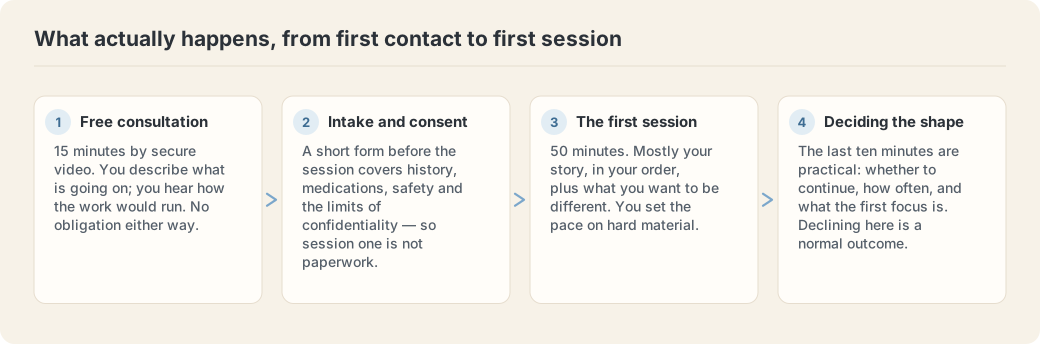
Individual sessions are $140 for 50 minutes, after a free 15-minute consultation; card at booking.
Many extended health plans reimburse a Registered Clinical Counsellor, depending on the plan, so check yours; MSP does not cover private counselling. All fees.
Still deciding?
A free 15-minute consultation is the least committal way to find out whether this is a fit. No pressure, and no obligation to book a session afterward.
Book Free ConsultationNot ready to book? Send a line about what is going on. A reply comes within one business day.
Or a smaller step: What sessions cost · What the free 15 minutes is like
Looking on behalf of someone else? What to send them, and what not to, including the funded routes most people do not know they qualify for.
Keep reading
Related pages
Where you are
Online counselling across British Columbia
Every session is by secure video, so the counsellor you see does not depend on where you live. Each city page covers coverage, local public services and who is taking new clients there.