Guide · Grief
Grief that does not follow the timeline
Grief does not move through tidy stages and has no correct duration. It also attaches to losses that are not deaths. A marriage, a country, a career, a body that used to work, a future you had assumed. Counselling is worth considering when grief is stuck rather than present: when it is unchanged after a long period, or when it cannot be spoken about anywhere.
The stages were never a sequence, and almost everyone has been told otherwise.
7 min read · Updated
The stages problem
The five stages: denial, anger, bargaining, depression, acceptance, entered public understanding as a schedule people are supposed to follow, and that was never the claim. The original work described patterns observed in people facing their own terminal illness, not a sequence that bereaved people move through in order.
The damage of the misunderstanding is specific: people conclude they are grieving incorrectly. They did not feel denial. They reached something like acceptance and then found themselves back in anger eight months later. They never experienced bargaining at all. Each of these is entirely ordinary, and each gets read as evidence of doing it wrong.
The models clinicians tend to find more useful describe grief as oscillating rather than progressing: moving between confronting the loss and getting on with life, back and forth, with the proportions gradually shifting. On that account, a good day is not progress you can lose, and a bad week eleven months in is not a relapse.
Losses that are not deaths
A great deal of grief has no funeral attached, and the absence of ritual makes it considerably harder to process. Divorce and separation. Estrangement from a living family member. Infertility, pregnancy loss, and the specific grief of a future that had already been imagined in detail. Migration, and the loss of a place where you knew how everything worked.
There is also grief for the loss of a self: after a diagnosis, a disability, a career ending, or a role that has quietly finished, such as the version of parenting that ends when children leave. These frequently arrive without being recognised as grief at all, which is why they get treated as failures of adjustment.
Where a loss is not socially acknowledged as a loss, clinicians sometimes call it disenfranchised grief, grief that is real but has nowhere to go, because the people around you do not recognise it as bereavement. The grief for an abusive parent falls here, as does grief after estrangement, and both are complicated by the fact that relief is often present alongside the loss.
What grief actually looks like
- Waves rather than a slope, Fine for days, then flattened by something small. A song, a smell, a form asking for next of kin. The unpredictability is often harder than the intensity.
- Physical symptoms, Exhaustion, chest tightness, appetite change, susceptibility to illness, difficulty concentrating. Grief is a bodily event, not only an emotional one.
- Anger, including at the person who died, Extremely common and rarely said aloud, because it arrives with guilt attached.
- Relief, After a long illness, a difficult relationship, or a prolonged decline. Relief and grief coexist routinely, and the relief is frequently the part people cannot admit to anyone.
- Searching, Thinking you saw them. Reaching for the phone. Expecting them in the room. Not a sign of anything going wrong.
- Difficulty with ordinary decisions, Grief consumes a substantial amount of cognitive capacity, and there is not much left for choosing between two things at a supermarket.
When to bring it to counselling
Most grief does not require professional help, and saying otherwise medicalises something that is a normal human response to loss. Most people are carried by time, other people, and their own capacity.
Counselling is worth considering when grief appears stuck rather than moving: essentially unchanged in intensity after a long period, with life still organised entirely around the loss. When there is no one to speak to about it, because the loss was disenfranchised, or because everyone around you has moved on. When it is entangled with trauma, particularly after a sudden, violent or witnessed death. And when it is accompanied by a persistent wish not to be here.
That last one is not something to work out on your own. 9-8-8, by call or text, anywhere in Canada, twenty-four hours a day. 310-6789 for BC Mental Health Support.
If a loss has stopped moving and there is nowhere to put it, a free 15-minute consultation is a place to start.
What grief counselling involves
It is not a technique for accelerating grief, and any approach promising to speed it up is misrepresenting itself. What it offers is somewhere the loss can be given its full size, in front of someone whose relationship with you does not depend on you being alright.
Practically, that often means telling the story properly, including the parts that are unacceptable elsewhere, such as the anger, the relief, or the fact that the relationship was not good. It usually involves working out what continuing relationship you want with the person or thing that is gone, since the goal is rarely severance. And where the death was traumatic, it may involve trauma-focused work, because an intrusive image of how someone died can block the grieving entirely. Trauma therapy and EMDR both apply here.
For anyone who wants support that is not one-to-one, BC has bereavement services, hospice-based groups and peer support in most regions, much of it free. A group of people who are not surprised by anything you say is a different and sometimes better resource than a counsellor.
The dates, and the second year
Two things about the calendar catch people unprepared, and both are easier with warning.
Anniversaries operate on a longer horizon than the date itself. The dread frequently starts weeks out and the day itself is often less bad than the approach to it. The same applies to birthdays, the season the death happened in, and dates that only you know about, the last ordinary conversation, the day of the diagnosis. Anticipating them removes the disorientation of being flattened for no visible reason in the middle of March.
What tends to help is deciding in advance rather than improvising: what you will do, who you will be with, and whether you want the day marked or ordinary. Both are legitimate. Being asked to perform grief on a particular date when you do not feel it is its own difficulty, and so is having nowhere to put it.
The second year is frequently harder than the first, and almost nobody is told this. The first year runs on structure: arrangements, paperwork, people checking in, and the sheer novelty of each first-without-them. In the second year the support has receded, the practical tasks are finished, and the permanence arrives properly for the first time.
People in that position often conclude they are going backwards. They are not; they are grieving without the scaffolding that carried the first year. It is one of the most common reasons people seek grief counselling twelve to eighteen months afterwards, long after everyone around them has assumed the matter is settled.
Grieving someone the relationship with was difficult
The grief that gets least support is grief for someone who was not good to you. It is extremely common and almost impossible to bring anywhere, because the socially available responses assume a loss worth mourning.
What people in this position usually describe is not sadness but a tangle: relief, and guilt about the relief; anger with nowhere to send it now; grief for the relationship you did not get, which is a real loss even though nothing was taken away at the point of death; and a bewildering absence of the feelings everyone expects to see.
That last one causes disproportionate distress. People conclude something is wrong with them for not crying at a funeral. Nothing is wrong; the grief is for a different object than the one everyone else is mourning.
The additional difficulty is that death removes the possibility of resolution. Whatever had not been said cannot now be said, and whatever apology was still theoretically available is not. That is its own loss and it deserves to be named as one rather than folded into general bereavement.
This is one of the clearer indications for individual counselling rather than a bereavement group, largely because a group organised around loving what was lost is a difficult place to say any of the above. It is also work that frequently reaches back well before the death, see what trauma actually means and intergenerational trauma.
How long should you wait for bereavement counselling?
The question gets asked as if there were a mandatory quarantine, and there is not. The old advice to "wait six months or a year" is a distortion of something true: acute grief in the early weeks is not a disorder, most people move through it carried by their own people, and counselling is not a required part of normal grieving. Nothing about that makes early support wrong. It makes it optional.
A more honest rule: come when the grief is not moving, whenever that is. Right away, if the death was traumatic, if the relationship was complicated, or if there is simply no one to fall apart in front of. Months later, if the numbness never thawed or the wave pattern never started spacing out. Years later, if it calcified into something you walk around. There is no too early that a decent counsellor cannot simply say "this is normal grieving, you may not need me yet", and no too late.
Common questions
How long should you wait before starting bereavement counselling?
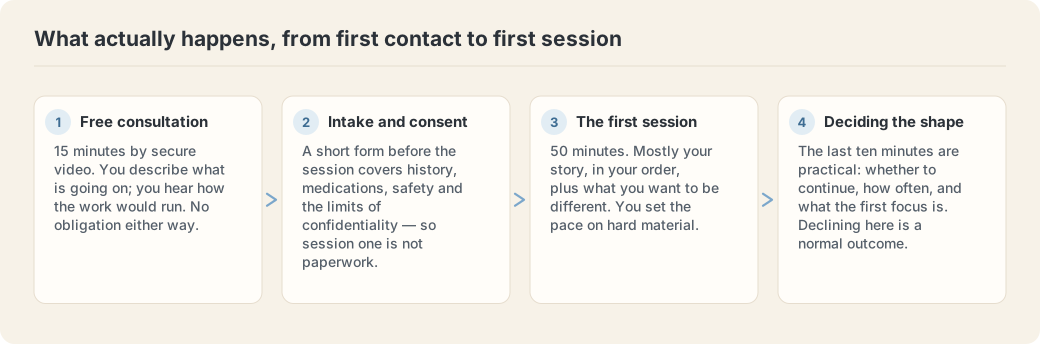
There is no waiting period, and the idea that there should be is the most common reason people delay. You do not have to be "not coping" to qualify, and you do not have to wait until the funeral is over or the estate is settled. Some people come in the first weeks because the practical load is unbearable, some come at the six-month mark when everyone else has stopped asking, and some come years later when something reopens it. All three are normal. The one signal worth acting on early is when grief stops moving at all: no change month to month, nothing that used to matter mattering, and the sense that it is not going to.
Is it too late to get counselling for a death that happened years ago?
No, and late grief is far more common in this work than early grief. Losses that were never properly grieved, because you were holding a family together, or were a child at the time, or the death was complicated by things nobody would say out loud, tend to surface later, often attached to something that looks unrelated. Arriving years afterwards is not a sign of failure, and it does not make the work slower.
How long should grief last?
There is no correct duration. What matters more is whether it is changing at all, and whether life has any room in it besides the loss.
Is it normal to feel relief when someone dies?
Yes, and it is far more common than anyone admits, particularly after a long illness or a difficult relationship. Relief and grief are not mutually exclusive.
Can I grieve someone who is still alive?
Yes. Estrangement, dementia, addiction and the end of a relationship all produce genuine grief, and the absence of a death often makes it harder rather than easier.
Should I go to a group or see a counsellor?
Either, and sometimes both. Groups offer the specific relief of people who are not surprised by what you say; individual counselling offers depth and privacy. They are not in competition.
Sources
- BC Bereavement Helpline
- Canadian Mental Health Association, BC Division
- HealthLink BC, mental health and substance use
This guide is general information, not clinical advice, and it cannot diagnose anything or replace an assessment. If you are in crisis, call or text 9-8-8 (Canada, 24/7) or BC Mental Health Support at 310-6789.
Individual sessions are $140 for 50 minutes, after a free 15-minute consultation; card at booking.
Many extended health plans reimburse a Registered Clinical Counsellor, depending on the plan, so check yours; MSP does not cover private counselling. All fees.
There is no wrong way to start.
A free 15-minute consultation over secure video, whenever you are ready for one. Nothing is committed by having it, and no card is needed to book it.
Book Free ConsultationNot ready to book? Send a line about what is going on. A reply comes within one business day.
Or a smaller step: What sessions cost · What the free 15 minutes is like
Looking on behalf of someone else? What to send them, and what not to, including the funded routes most people do not know they qualify for.
Where you are
Online counselling across British Columbia
Every session is by secure video, so the counsellor you see does not depend on where you live. Each city page covers coverage, local public services and who is taking new clients there.