Guide · Practical
Telling your family you are going to therapy
You are not obliged to tell anyone. Counselling is confidential, sessions are online, and no family member is entitled to know. If you do want to tell someone, decide in advance what you are telling them and why: support, practical logistics, or a request for something specific, because those are three different conversations and mixing them is what tends to go badly.
For some people this is a non-event. For others it is the single largest obstacle between them and a first appointment.
6 min read · Updated
First: you do not have to
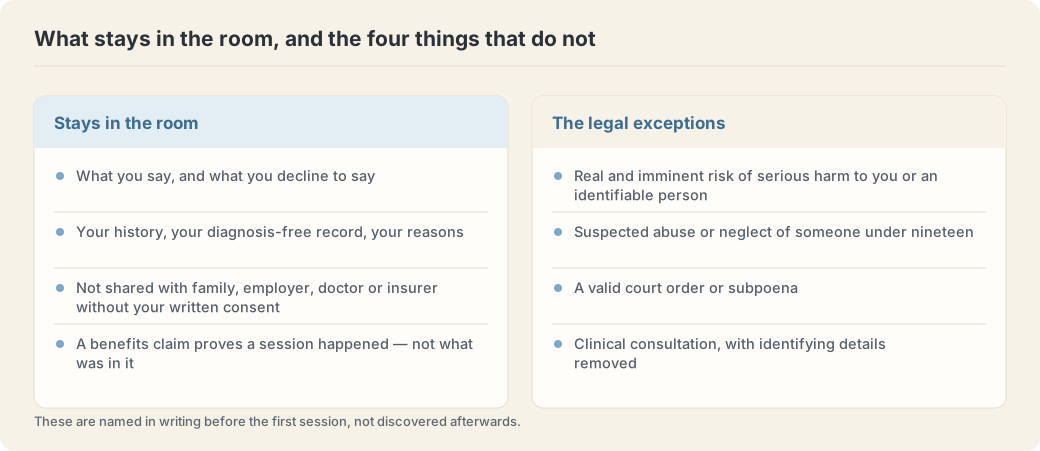
This is worth stating before anything else, because a surprising number of people delay booking for months over a conversation that is entirely optional. Counselling in British Columbia is confidential within the legal limits set out in writing before your first session. No family member is informed, no record goes anywhere, and paying with extended health benefits gives the insurer a receipt rather than your session content.
Sessions are online, which removes the logistics that used to make privacy difficult. No waiting room, no clinic to be seen entering, no explanation needed for an absence. A session can happen from a home office, a bedroom with the door shut, or a parked car during a lunch break.
Deciding not to tell anyone is not secrecy or shame. It is a boundary, and it is a reasonable one, particularly early on, when you do not yet know what the work will involve.
If you do want to tell someone, decide what you are asking for
Most of these conversations go wrong because two different things get bundled together: sharing information, and requesting something. They are separable and they land differently.
- Information only, "I have started seeing a counsellor." Complete in itself. It does not invite discussion, does not require a reason, and does not obligate you to explain what you are working on.
- A logistics request, "I have an appointment Thursdays at six: can you take the kids for an hour?" Concrete, small, easy to agree to, and it does not require anyone to have a view about therapy.
- A request for support, "I would like to be able to mention it without it becoming a conversation." Specific, and far more likely to be met than a general appeal to be understanding.
- A request for change, The largest one, and worth separating out entirely. Asking a family member to change how they behave is a different conversation and usually a later one, often after some work in session on what you actually want to ask for.
When therapy carries stigma in the family
In plenty of families, and this is common across many cultural contexts rather than specific to any one, going to counselling is not read as looking after yourself. It is read as airing private matters outside the family, as a failure of resilience, or as an accusation levelled at the people who raised you.
That reading is worth taking seriously rather than dismissing, because it usually comes from somewhere. Families that got through migration, instability or poverty by holding together and not complaining have good historical reasons for the belief that difficulties are handled internally. The belief is not stupid; it is out of date.
You are not required to win this argument, and attempting to is usually a poor use of energy. "I am doing something that helps me" is a complete position, and it does not require anyone else's agreement. Counselling for first-generation South Asian adults goes further into the specific version of this bind, where obligation and love are difficult to separate.
If the conversation at home is the obstacle rather than the counselling itself, that is a reasonable thing to raise in a free consultation.
Partners: a slightly different conversation
Partners frequently ask two things underneath the stated question. The first is are you talking about me? The second is does this mean you are leaving? Naming both directly, early, tends to defuse a great deal.
A useful frame: individual therapy is not a tribunal. You are not building a case, and a counsellor is not adjudicating your relationship. It also helps to be clear that you are not going to be reporting session content back, which some partners expect and which would make the therapy considerably less useful.
If your partner wants to be involved, that is worth taking seriously as an offer. It might mean couples work rather than individual work, or it might mean an occasional joint session. Either is possible; both are decisions to make deliberately rather than by drift. See counselling for couples.
What to do when the response is bad
- Do not defend the decision, Justifying invites debate, and there is no version of this argument you win by continuing it. "I have thought about it and I am doing it" is sufficient and repeatable.
- Expect the second conversation to differ, First reactions are often about the listener rather than about you. Their own fear, guilt, or history with the subject. Give it a fortnight before concluding anything.
- Do not share content to prove it is working, The pull to demonstrate value by describing sessions is strong and usually a mistake. It converts your therapy into something you are performing for someone else.
- Notice pressure to stop, Sustained pressure to end counselling is worth bringing into the room, because it is usually about something in the relationship rather than about therapy.
- Keep the practical part protected, Whatever the discussion, hold on to the hour. Losing the appointment is the outcome that actually costs you something.
Scripts for the conversations that actually happen
- To a partner who asks if it is about them, "It is about me. Some of it will touch on us, and I am not going to be reporting back on sessions, not because I am hiding anything, but because it stops working if I am composing it for an audience."
- To a parent who takes it as an accusation, "This is not about assigning blame. I am doing something that helps me, and I would rather you knew than found out." Then stop. Elaboration invites a debate about whether your reasons are sufficient.
- To someone who offers to fix it instead, "I appreciate that, and this is not something I want to problem-solve right now. What would help is if it can just be a thing I do."
- To a colleague or manager, if you need an hour, "I have a standing appointment on Thursdays at four." That is a complete sentence at work, and no further detail is owed.
- To someone who says therapy is self-indulgent, "You may be right that it is not for everyone. It is helping me." Agreement is not required, and defending it is how the conversation continues for another forty minutes.
- To a child, if they ask, Age-appropriate honesty tends to serve everyone better than concealment: "I talk to someone whose job is helping people work things out. Lots of grown-ups do." Children generally register that something is happening; the mystery is worse than the answer.
When the family is part of what you are working on
There is a particular complication when the person you are considering telling is also a significant part of the material. Telling a parent you are in therapy, when a good deal of the therapy concerns that parent, is a different decision from telling a friend.
The general answer is that you do not have to, and it is worth being clear about why that is not evasion. Therapy is not a proceeding requiring the participation of everyone discussed. You are working on your own experience of a relationship, which is yours to examine without anybody's consent.
There is also a practical argument for not telling, at least early. Once a family member knows, sessions can acquire an audience. A part of you composing what will be reported back, or anticipating their reaction to a conclusion you have not reached yet. That reliably makes the work less useful, and it is difficult to notice happening.
What frequently works better is telling them later, if at all, once you know what you actually think. A conversation from a settled position is a different conversation from one conducted in the middle of working something out.
And if they find out and react badly, that reaction is itself material. A family member who is threatened by you having somewhere to think is telling you something, and it is usually the thing the therapy was already about.
Common questions
Will my family find out through insurance?
If you are on a family plan, the plan holder may see that a claim was made and for what type of practitioner, not what was discussed. If that matters, paying without claiming keeps it entirely separate.
Do I have to tell my partner?
No. There is no obligation, and plenty of people do not. It is your decision and it can change later.
What if my family wants to come to a session?
That is a decision made with your counsellor, and it depends on what you are working on. Sometimes a joint session is useful; sometimes it changes what can be said and is worth declining.
Can my parents access my records if I am an adult?
No. Your records are yours, and access requires your written consent. The exceptions are the legal ones set out on the privacy page.
Sources
- Canadian Mental Health Association, BC Division
- Office of the Information and Privacy Commissioner for BC
- HealthLink BC, mental health and substance use
This guide is general information, not clinical advice, and it cannot diagnose anything or replace an assessment. If you are in crisis, call or text 9-8-8 (Canada, 24/7) or BC Mental Health Support at 310-6789.
Who you would talk to
Taking new clients and seeing people across BC by secure video. Each is a Registered Clinical Counsellor; the registration is on the profile and can be checked on the BCACC register.

Camille Granda, RCC, CCC
English and Tagalog · Family counselling, Trauma, Anxiety and chronic stress
In her words: “I want sitting with me to feel like the biggest belly breath you have ever taken.”
Individual sessions are $140 for 50 minutes, after a free 15-minute consultation; card at booking.
Many extended health plans reimburse a Registered Clinical Counsellor, depending on the plan, so check yours; MSP does not cover private counselling. All fees.
Still deciding?
A free 15-minute consultation is the least committal way to find out whether this is a fit. No pressure, and no obligation to book a session afterward.
Book Free ConsultationNot ready to book? Send a line about what is going on. A reply comes within one business day.
Or a smaller step: Which kind of counselling fits? · What sessions cost · What the free 15 minutes is like
Looking on behalf of someone else? What to send them, and what not to, including the funded routes most people do not know they qualify for.
Where this leads
If this is close to your own situation, there is a page written for it: Counselling for Filipino-Canadian families and adult children in BC.
Where you are
Online counselling across British Columbia
Every session is by secure video, so the counsellor you see does not depend on where you live. Each city page covers coverage, local public services and who is taking new clients there.